

レポート

概要
- More capital is flowing into funds that invest according to principles of environmental and social responsibility, and good governance. It’s becoming increasingly important for energy and natural resources companies to provide investor propositions that allow them to tap those funds.
- The activism of ESG investors has helped executives grasp the scale and urgency of issues related to climate change, kick-starting the response.
- Now it may be time for ESG investors and energy and natural resources companies to work together to accomplish their common goals.
- Although these companies have the experience and capabilities to drive the energy transition at industrial scale, they’ll struggle to do so if they’re poorly funded.
This article is part of Bain's 2021 Energy and Natural Resources Report.
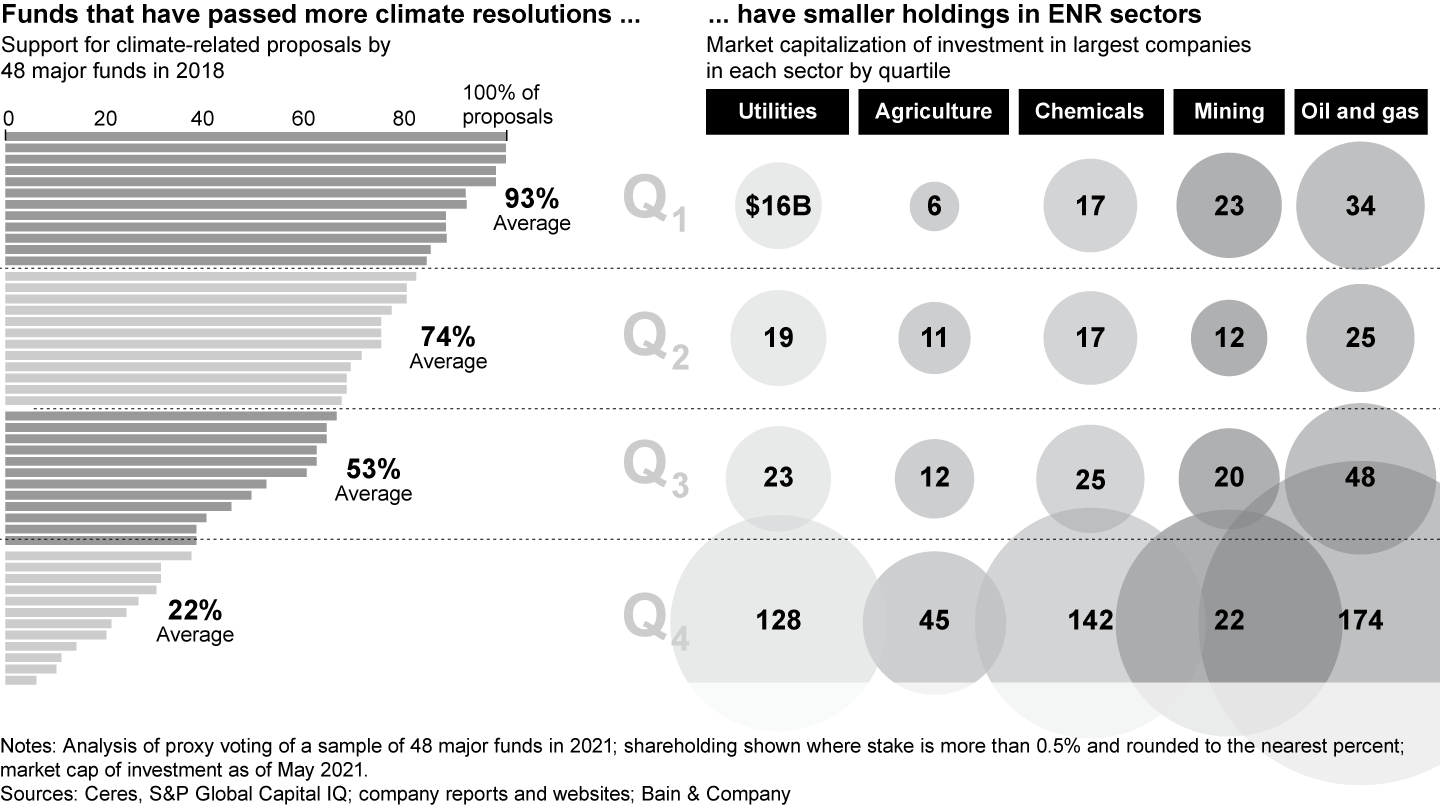
Energy and natural resources (ENR) companies have had a bumpy ride with ESG investors over the past few years. Capital is lining up behind ESG funds, which focus on promoting principles of environmental and social responsibility, and good governance. For example, the Net Zero Asset Managers group recently highlighted 87 funds with close to $37 trillion in assets, and some investors have taken high-profile advocacy positions. Bain’s analysis finds that funds with more climate resolutions tend to have smaller holdings in ENR sectors (see Figure 1).
Relations between ENR companies and ESG investors have become strained, particularly on issues of carbon emissions and climate change. Shareholder pressure to set climate targets, link compensation to outcomes, and adopt resolutions at annual meetings has increased, and companies are looking for ways to manage them. Occidental Petroleum and Conoco recently asked the Securities and Exchange Commission if they could ignore these resolutions at their annual meetings since climate goals are now just a part of ordinary business operations, but the SEC denied the request and ordered them to proceed with the votes. These shareholder challenges are becoming more common not only with oil and gas majors, but across the energy and resource sectors as carbon emissions, water use, and transparency become higher profile issues.
Figure 1

However, if we think about the relationship between ESG investors and the ENR sector as progressing in waves, it may be time to declare that this first, adversarial wave has run its course. The adversarial wave has achieved a great deal. Executives have a better understanding of the scale and urgency of the challenge before us, and most have committed to greater sustainability in their operations and products. Pilot programs are well underway, but to achieve scale industrialization of these transitions, we’ll need to take a different tack.
Both sides, companies and investors, must begin to realize that they’re more likely to achieve their objectives through collaboration rather than confrontation. If companies want to ensure access to the capital necessary to build a net-zero world, they must be prepared to show they can scale quickly and demonstrate the economic viability of new models. For their part, investors should be prepared to “lean in” to companies that show they can reduce carbon emissions at scale and create new options for the future.
First wave: confrontation
In the wake of the 2015 Paris Agreement on climate change, ESG investors sharpened their focus on corporate and investor responsibility, adopting one or more of these strategies.
- Activism. Investors are pressing companies to raise their game on ESG matters through specific targets, measures, and portfolio shifts, and to adopt specific resolutions, such as linking executive compensation to outcomes.
- Avoidance. Investment funds are announcing policy guidelines and have divested from companies that failed to meet their expectations.
- Articulation. Investors are requiring companies to redouble their efforts and shift communications from low-impact vanity projects to fully formed strategic plans and roadmaps, with economic rationales.
Leading companies are beginning to make progress, setting CO₂ targets in line with the Paris Agreement and addressing relevant aspects of the United Nations’ Sustainable Development Goals. Others are improving the transparency of their supply chains and appointing new faces to boards to speak more forcefully for sustainability. Companies are tackling larger issues collaboratively, as in the Alliance to End Plastic Waste. While a lot of work lies ahead, the contours are beginning to emerge of a next wave that will require more cooperation.
Second wave: collaboration
With momentum established and ESG targets growing, the challenge shifts from recognizing the need to change, to funding that change sufficiently enough to make a difference. Energy and resource companies will need to draw on the strength of their traditional businesses to secure funding for capital expenditure in new assets and infrastructure that supports the energy transition, everything from bio feedstock production to renewable power generation, hydrogen electrolyzers, electric vehicle charging infrastructure, waste recycling, and much more.
However, over the past decade, investors have been more attracted to other sectors, particularly technology and communications. In 2010, companies in energy, utilities, materials, and the industrial sector made up 30% of the S&P 500; by the end of 2020, their share had fallen to 16%. The top five oil and gas supermajors together have lost about $200 billion in market capitalization since 2015, compromising their ability to fund change at the scale and pace required.
ESG investors could achieve more by investing in areas that need capital, instead of pulling back.
Some will be able to recapture that ability by investing in promising second engines of growth in more sustainable businesses, such as the announcements by several oil and gas leaders of investments in areas like low-carbon power and carbon capture and storage. These commitments can spark a virtuous cycle that enables investors to rerate valuation multiples for longer-dated sustainable assets and put shareholder returns and market values back on an upward path. Improving the balance sheet this way ensures access to capital and the ability to reinvest in greater sustainability.
ESG investors can support this momentum by turning from adversary to advocate, leaning in to companies that demonstrate a good change trajectory―those showing 20% to 30% of future revenues coming from new, sustainable activites. They could achieve more by investing in areas that need capital, instead of pulling back. A poorly funded energy producer with a weak balance sheet is less capable of reducing or offsetting its carbon footprint than a well-supported, well-funded one.
In some cases, ESG investors could go further by helping public companies go fully or partially private for a spell, to speed up transitions that could be much more difficult under public ownership. Dell’s 2013 deal with Silver Lake to take the company private again after 24 years on public markets allowed Dell to rapidly reorient its business. Dell went public again in 2018 and now has a market cap that tops $75 billion―a testament to the success of its bold move.
The Expanding Case for ESG in Private Equity
Customers, employees and limited partners are demanding more sustainable, socially conscious corporate behavior. PE firms that can deliver are reaping the rewards.
Other companies will transform themselves or spin off some of their more sustainable businesses to try to revalue their market positions and ensure better access to capital. Few have gone as far as Ørsted, which reoriented its business model from fossil fuels to wind energy in only a few years and has been rewarded with a return to profitability and a price-to-earnings ratio that reached as high as 40 in 2021. But many others are doing something similar with parts of the company. The spin-off of Siemens Energy in May 2020 combined some of the parent company's renewable and hydrogen assets into a new firm that investors could revalue based on the long-term potential of these more sustainable business models. ENI has also said that it’s considering spinning off or selling a minority stake in its retail and renewable businesses in 2022, to allow those parts of its business to be revalued based on their fast growth.
Third wave: reinforcement
Where might we be in five years?
If energy and natural resources companies and their investors are where they say they’d like to be in 2026, what will have changed to make that progress possible?
First, the relationship between these companies and their investors will have improved. Looking back from 2026, we saw a sea change in the dialogue between them, which became more constructive and cooperative. The best energy and resource companies were no longer just trying to convince shareholders and customers that they were doing the right things; they began demonstrating that they were changing their operations, adapting their products, and getting positive results in revenues and capex profiles. As their operations changed, they became more transparent, and the two-way dialogue became more innovative, reinforcing, and forward-looking. Their relationship with customers also changed, with ENR companies seen as key partners for business and responsible supplier for consumers.
At the same time, these companies moved beyond pilot programs and began revamping their operations and supply chains at an industrial scale. They learned quickly and applied that learning rapidly in the next generation of activity. As these new businesses and methodologies matured, executives realized that they really can redefine the economics of their industries. They were no longer investing below the desired rate of return and hoping for a subsidy; they were investing at the rate and seeing attractive returns. Executives got better at measuring the things that traditional metrics like net present value overlook, things like company reputation, competitive advantage, customer advocacy, and the expansive options created by a growing, sustainable business.
As the energy and natural resources sectors got better at reducing and mitigating emissions, other aspects of the ESG agenda also moved closer to center stage: water scarcity, diversity and equity issues, corporate governance, stronger relationships with local communities. Some executives looked back nostalgically at a time when their performance was measured simply by profitability and share price. Those, of course, remain essential, but by 2026, the other elements of the ESG scorecard were also important indicators of a company’s resilience and success.
If ESG investors and energy and resource companies can decide to work together to pursue their common goals, there’s every reason to believe they can achieve them.
Whether this hindsight view becomes a reality depends entirely on how we engage in constructive dialogue across the chasm that now exists. The ambitious goals of 2030 and 2050 remain critical, and our position in 2026 will show whether we’re on the right trajectory. ESG investors and the leaders of energy and resource companies can decide to work together to pursue their common goals, and given their long record of success, there’s every reason to believe they can achieve them. The alternative would be the escalation of a dysfunctional relationship between the organizations most capable of making the energy transition a reality and the financing mechanisms that should be deployed to make that possible.
Read our 2021 Energy and Natural Resources Report
More from the report
-
Two out of Three Won’t Do
-
Harnessing the Energy and Resource Transition
-
Net Zero: From Political Targets to Industry Action
-
Energy Is Only One Part of the Sustainability Transition
-
Redesigning Value Chains to Deliver More Sustainable Goods
-
Time for ESG Investors and Energy and Natural Resources Companies to Work Together
-
Business Opportunities in Low-Carbon Hydrogen
-
Raising Productivity in Energy and Natural Resources Capital Projects
-
Creating Resilience, Sustainability, and Accountability in Supply Chains
-
Engine 2: How to Grow a Sustainable New Business
-
Accelerating the Journey to Net Zero
-
Four Ways to Scale Digital in Energy and Natural Resources Companies
First published in 6月 2021