

論説

概要
- Many executives are pushing their companies to "go digital," but they do not know where to start, or they launch a slew of one-off projects.
- Leading firms have found an effective way forward, by focusing on customer "episodes" within the overall experience. Episodes encompass a variety of shopping, usage or service activities.
- These firms design and implement episodes in a customer experience "factory."
- They start with the episodes that cause the most pain for customers and have the highest cost for the company.
Explore Bain’s latest Customer Loyalty in Banking insights.
In a recent bid to expand its base of credit card customers, a major North American bank improved its capabilities to attract and onboard customers through mobile and website channels. The digital application process was quick and easy, did not require a huge amount of information and allowed for instant approval. Everything worked well at launch—in theory. However, several status checks showed that the new customer approval rate, as well as the economics of the project, steadily declined. The return on investment of the digital channel was worse than for direct mail offers. Even among customers with high credit ratings, 40% got a "not approved" online message. Worse, the message told them they would receive a letter in 7 to 10 days explaining why. When it arrived, that letter often asked for more information, such as a pay stub to verify income, which had to be mailed back to the bank.
At the heart of the problem, the bank's many steps required for approval—risk assessment, antifraud verification, credit underwriting and so on—were handled by different functions operating in silos. No single team with authority had designed or analyzed the entire experience end to end. Each part, which had a solid rationale on its own, could not combine into a coherent, seamless whole. And this dynamic characterized other digital initiatives across the bank.
Like this bank, many companies that aim to structurally reduce costs or improve the experience for their customers decide to "go digital, a goal so vague as to be meaningless. Executives know they need to digitalize many aspects of their customer experience, including products, support, and the backstage processes and policies that influence the experience. They have plenty of projects underway—a mobile app for the salesforce here, a new e-commerce platform for small business customers there. Yet too often, these fragmented projects in different corners of the organization do not tie together in a coherent strategy.
Katrina Cuthell, a partner with Bain's Customer Strategy & Marketing practice, explains how to design and implement a customer experience “factory” that can increase customer satisfaction and decrease costs.
Frustrated executives wonder, "To transform my business through digital, how do I get started, and how do I orchestrate the digital transformation?"
Responding to the loudest voices within the organization is not the way. Instead, established companies that are reaping the greatest benefits from digital begin with the customer—his or her needs, priorities, points of pain and points of delight. Customers may not always know they want an innovation (few customers were clamoring for the first cars or computers), but they do know what they value. Here again, though, trying to tackle the entire customer experience at once, to infuse digital elements throughout, is an overly broad and complex goal.
Episodes that customers love and hate
Leading firms have found a more practical and effective way to manage the experience, by focusing on customer "episodes," which encompass a variety of shopping, usage or service activities. When customers have a task to complete or a need to fulfill through the company, that's an episode. It has a clear start and end, marked by the customer completing what he or she set out to do. Episodes range from a single interaction (such as paying a bill online) to an intricate series of interactions spanning weeks (getting fixed broadband service moved to a new home). The sum of a customer's episodes over time constitute the entire experience of dealing with the company (see Figure 1).
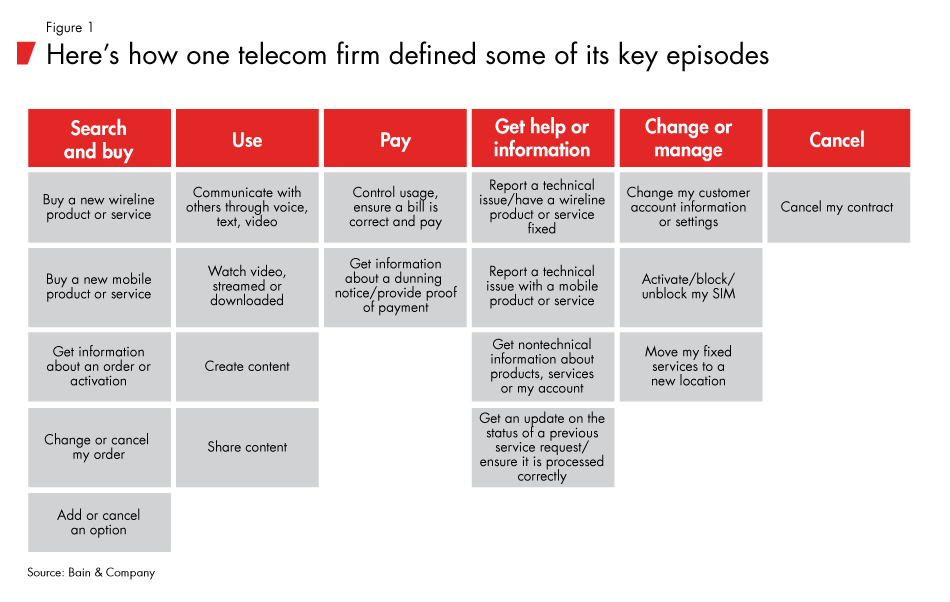
The episode approach has found enthusiastic converts globally. Bain & Company recently surveyed 700 senior executives worldwide about their use of and satisfaction with 20 customer experience tools. Despite being a relatively new approach, episode management ranked second of all the tools in satisfaction, and it was the top choice among firms with the strongest financial performance.
Improving episodes requires a repeatable process that uses in-house resources efficiently. Think of a customer experience "factory" in which the company designs and manages key episodes directly, rather than indirectly via functions or departments. Different teams might manage the "I need to pay a bill" episode and the "I need technical support" episode, but they should be using the same design and development process, the same customer data and the same management playbook.
Leading companies have used the factory approach to fix performance gaps in episodes or completely transform them. For example, a European telecommunications carrier designed a new bill-collection episode from scratch. The sprint to design the episode and detail its implementation requirements took six weeks. Within four months of implementation, dunning calls and bad debt dropped by half, and involuntary customer churn fell by 15%. Similarly at a retail bank, after a team redesigned the "I need to relocate" episode, it quickly shifted more than half of the affected customers to an efficient online platform, reducing the volume of work handled by the call center and back office by 80%.
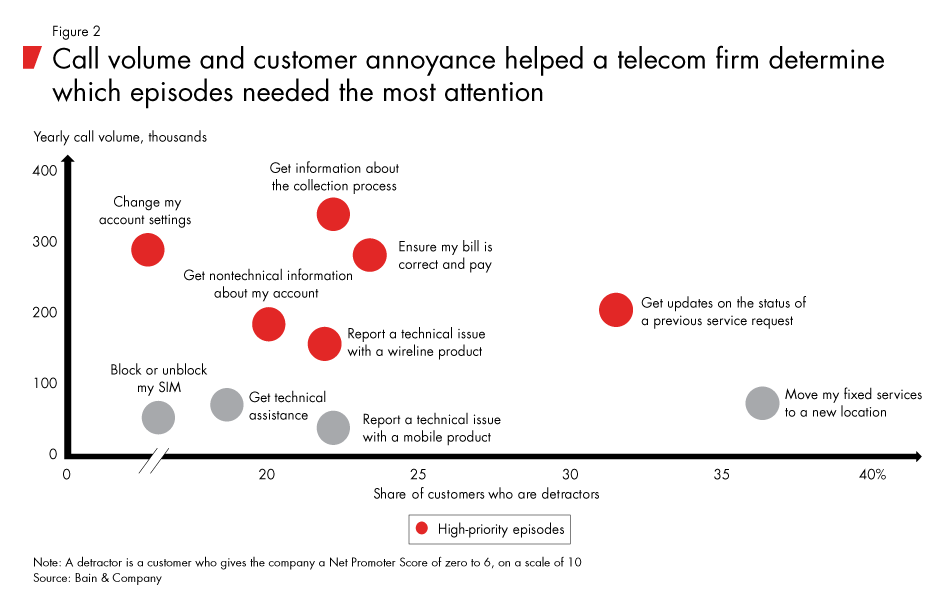
Given that a customer's experience spans so many episodes, which ones should a company start with? Often, the best way to identify the leading candidates is to map episodes by the pain they cause customers (as measured by, say, the share of customers giving a low Net Promoter Score®) and the pain for the company (the volume of complaints, the budget to fix problems or another quantifiable metric). One telecommunications provider, for example, mapped two dozen episodes and found six to be the most urgent, including "get information about the collection process" and "control usage, ensure bill is correct and pay" (see Figure 2).
How the factory works
Depending on the episode, the primary objective will be to take out cost, improve the experience, or both. We have seen companies achieve a 30- to 50-point improvement in their Net Promoter Score and a 30% decrease in operating costs for individual episodes.
Once the initial high-priority episodes have been identified, they are assigned to episode teams staffed with internal experts drawing on the relevant functional expertise. Teams use Agile rather than waterfall methods, so they can quickly test each iteration of the episode with customers, who give feedback that informs refinements (see Figure 3). Agile does not mean chaos; the factory standardizes Agile methods so that each team goes through the same process. Nor does Agile involve simply creative workshops and sticky-note exercises. Simplifying and digitalizing requires hard work and dedication from the teams.
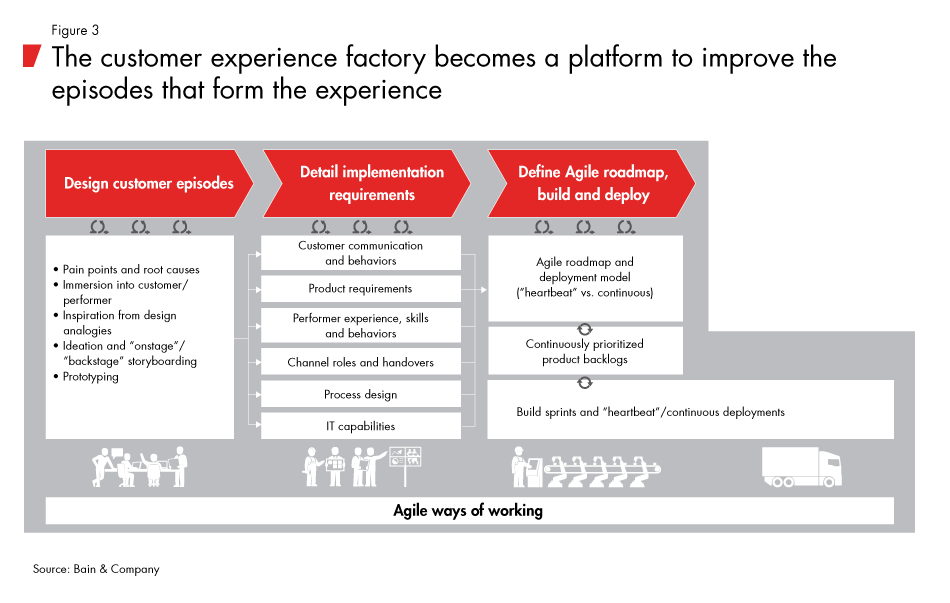
A "production manager" oversees the factory, identifying dependencies and ensuring alignment among episodes, especially when several episodes get redesigned in parallel. Improving an episode end-to-end requires coordinating all the factors that affect it, including product features, policies, processes and communication. For instance, setting up broadband service cannot become simple and digital without seamless backstage processes, which sometimes flow through multiple technology systems. Teams thus should be staffed by all the functions that influence the episode, such as regulatory compliance in a bank offering a new type of retail product.
Note how this approach differs from a digital factory that produces websites and mobile apps. Comprehensive experience design moves beyond digital to determine which people, capabilities and systems need to coalesce within each episode. It incorporates employees, contractors and partners who will actually deliver the experience. That includes the backstage work—the processes, policies, capabilities and systems required to deliver a great overall experience reliably and at scale.
Some changes to an episode, such as training agents or rewriting marketing communications, focus on human behavior. However, technology is a critical part of most episodes. Teams can achieve a fair amount of improvement by changing the front-end website or mobile app, which does not require fundamentally changing the underlying technology systems. And firms that have modular architecture for most tasks in an episode will have ample flexibility on what they can change and update on the back end. But when monolith software dominates the architecture, changing the back end will be a long, laborious and expensive process, perhaps best addressed during a major change in architecture.
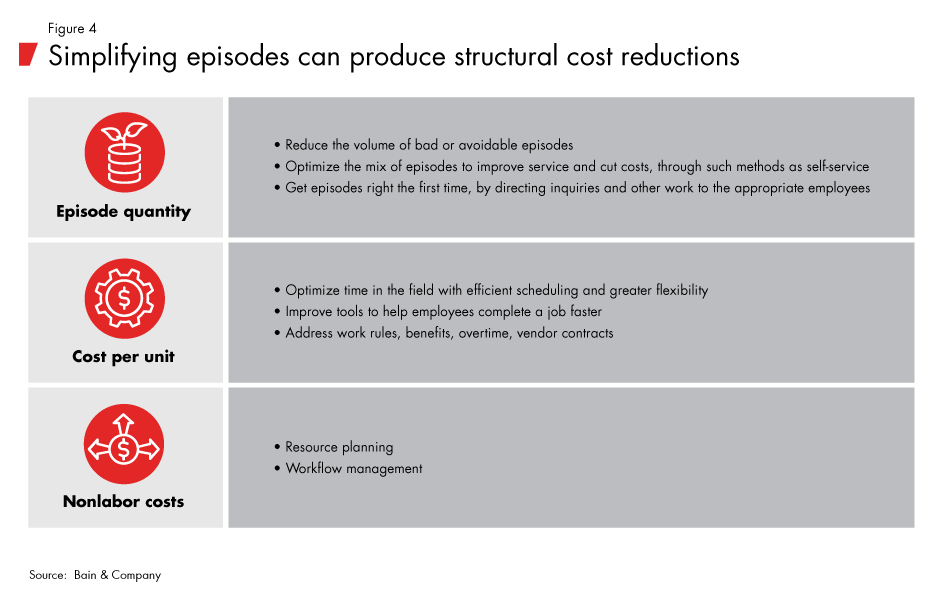
Much of the cost takeout results from simplifying an episode. Simplification can come from paring down 100 SKUs to 10, or from reducing process complexity overall, rather than shuffling some of the complexity to other departments. In service episodes, the lowest-cost path comes from installing a "right first time" approach and incentives. For example, if onboarding a credit card customer costs $17, peel the episode apart to scrutinize each activity. Does the current episode design frequently force employees to talk with the customer by phone, resend physical mail or cross-reference a digital inquiry? Understanding the economics of the episode in detail allows you to set a hard target for the design process, such as $10 per onboarding (see Figure 4). Simplification has the added advantage of unlocking benefits for customers—faster and more intuitive transactions—and for the organization, in the form of reductions in training needs, employee attrition and testing costs for future IT changes.
One European telecommunications carrier has an ambitious simplification program underway. For instance, the episode of checking and renewing one's mobile service contract had been bogged down by a cluster of business rules, such as a contract renewal and handset upgrade being out of sync. Confused customers were constantly calling the contact center to get clarification. Redesign of the episode trimmed or overhauled those rules and developed a new mobile app, so that most customers can easily review and renew through the app, without help from the contact center.
Questions to help focus the approach
Executives who aspire to transform their customer experience by deploying digital technologies as simply as possible can use several questions to structure their approach:
- How do we encourage and educate customers to behave in the desired way? How do we steer them to the right channel?
- What product specifications should we change?
- What technology architecture would improve specific episodes?
- How do we motivate and equip employees to behave in the desired way? Which capabilities do they lack, and what training is required?
- How do we ensure a consistent, seamless experience between channels?
- How should back-end processes change? What manual tasks can be automated to cut costs?
Digital technologies can help make customer episodes scalable and low-cost, but digital is not sufficient by itself. Human judgment and communication still matter for many high-stakes moments. And behind the digital veneer, factory teams will have to redesign the supporting processes and policies in order to simplify customers' lives and keep them returning for more—all while improving the company's economics.
Jens Engelhardt, Gerard du Toit and Frédéric Debruyne are partners with Bain & Company's Customer Strategy & Marketing practice. Jeff Melton is a partner with Bain's Performance Improvement practice. They are based, respectively, in Zürich, Boston, Brussels and Melbourne.
Net Promoter Score®, Net Promoter System®, Net Promoter® and NPS® are registered trademarks of Bain & Company, Inc., Fred Reichheld and Satmetrix Systems Inc.

Bart Delmulle: How to Improve Customer Episodes
Bain Partner Bart Delmulle discusses the benefits of implementing a customer experience factory to create simple, digital experiences.

Jens Engelhardt: Firing Up the Customer Experience Factory
By redesigning customer episodes from end to end, leading companies can reduce consumer pain and company costs.
First published in 6月 2018