

論説

概要
- Most banks' business models are not well equipped to adapt to technological disruption.
- Profit pools are shifting to new areas such as customer acquisition, customer advice and technology services.
- Four models are emerging as viable.
- To thrive with any of the models, banks will likely have to accelerate partnerships with technology firms or retailers, and will need to invest in customer experience and improve technology capabilities.
Turbulence in banking markets just won’t let up. New competitors ranging from established technology giants, such as Alibaba and Amazon, to smaller specialists, such as Mint and Betterment, have steadily encroached on traditional banking activities. Customers are willing to try these alternatives because they trust the companies and have grown accustomed to easy, convenient and personalized digital interactions in other parts of their lives. And technology firms generally set the standard for a great customer experience.
If those incursions weren’t challenging enough, new regulations, including Open Banking in the UK and PSD2 and GDPR in Europe, give customers greater control over their data and greater choice of financial services providers.
Most banks’ current business models are not well equipped to deal with the disruptions, as digital-native competitors take attractive slices of the profit pool, such as originating loans or facilitating payments. The traditional model of providing a full suite of standard products and services through legacy organizations and proprietary channels—branches, call centers, websites—does not have enough flexibility and speed to adapt to the coming shift in profit pools.
For example, Bain & Company anticipates that the total profit pool for US retail banking will hold roughly steady by 2025 at between $70 billion and $80 billion, but the composition of the pool will look very different. New profit pools such as customer acquisition, customer advice and technology services will grow faster than the traditional banking book and yield higher margins than holding loans and deposits on the balance sheet. They will also secure higher multiples from investors, mainly because these businesses have higher growth, and require less capital than credit and less operational intensity than deposits. Banks will realize the highest profits where they don’t have to go through intermediaries—not unlike the US mortgage market, which enjoyed a 4:2:1 ratio of profitability for banks between direct, wholesale and multiparty distribution channels. But banks will need to consider increasing reach and relevance by using third-party or cobranded digital distribution.
As profit pools shift, we expect four viable models to emerge (see Figure 1).
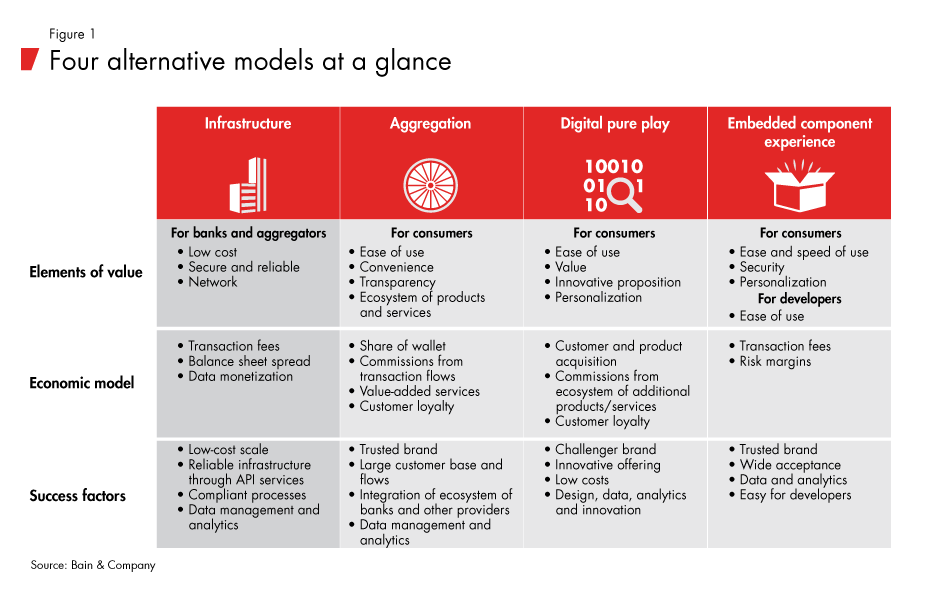
Infrastructure. Open banking regulations will require banks to share data and ultimately banking services with other providers. Anticipating this shift, some banks have chosen to extend their core banking infrastructure to other banks or institutions. Bradesco, for example, has given other companies access to some of its core services through open application programming interfaces (APIs). Instead of a bank needing its own infrastructure for transaction accounts in, say, Brazil, the bank can use Bradesco’s balance sheet, regulatory compliance function and other services. New competitors also have emerged, such as Clear Bank, the UK’s first clearing bank in nearly 200 years, established by the founder of Worldpay. Clear Bank provides other banks, credit unions and fintech companies with access to major payment and card systems, so that those companies don’t have to assemble their own systems.
Many banks could be pushed into infrastructure and manufacturing. To survive and thrive in this role, banks need to substantially reduce costs, improve regulatory and compliance processes, and give careful thought to how they will provide reliable data and services to others through an open architecture. But forward-looking banks recognize that other options exist to retain the customer relationship. Scanning the landscape, three other models have emerged that show promise.
Aggregation. This option aggregates in one place a customer’s interactions across multiple financial institutions, in order to make it easy and convenient to do business. Many online companies now aggregate data across multiple banks and provide customers with some limited insight. One can imagine customers getting greater insight into managing their money, then making payments and investments and borrowing money based on this insight across several financial institutions. They might also have access to an ecosystem of benefits, such as home buying services, lower utility bills and special retailing offers. HSBC, for instance, started a mobile app that gives its own customers access to accounts they might have with other banks.
Skeptics of this model argue that banks will lose market share to technology companies and will not be able to stave off declining prices. Others believe that the model will allow banks to gain share of wallet and create value for customers with additional services, potentially beyond banking. What’s clear is that the economics of aggregators hinge on taking a larger share of the banking wallet, earning greater loyalty from customers and taking a fee for various value-added transactions flows. Success with this model will require a trusted brand, a large customer base and added value in the form of lower prices, rewards or access to other offers.
Digital pure play. Many fully digital banks, such as Atom in the UK, N26 in Germany and Marcus by Goldman Sachs, are trying to attract new customers, particularly younger ones. These customers tend to want simple service at competitive prices, often engineered around an innovative proposition. For example, Fidor offers an online community in which customers can turn to their peers for tips and advice and to an ecosystem of services outside basic banking. Next by Bradesco strives to make it easy for young people to fit banking to their lifestyle, by paying friends, for instance, and splitting bills.
The economics of a digital pure play look like a traditional bank, except that the business runs off a lower cost base, since it has little or no physical distribution, and collects fees from the providers who fill out the growing ecosystem of services. Key to success is a credible challenger brand, an innovative proposition and low-cost operations and technology.
Embedded component experiences. A number of banks and fintech firms have set up a branded experience that’s embedded in other companies’ online platforms, complete with a link to customer data and automated decision logic, for transactions such as a credit authorization or identity verification. For example, the Swedish bank Klarna offers online payments and easy collection of payments for merchants. Customers benefit by having their personal details prepopulated for a retail transaction, and getting an easy, secure payment experience.
Banks that offer a strong embedded experience can extend it across business lines and distribution channels, and thus extend their reach and relevance. The economic model here revolves around transaction fees from the retailer or other company running the online platform. Success requires smart investment in reliable, plug-and-play components, a trusted brand, wide acceptance by consumers, and data and advanced analytics to build a personalized experience.
These models are not mutually exclusive (see the sidebar, "Questions to help bankers select a model"). Within a large bank, one business unit could take a utility role providing core infrastructure, while another unit could concentrate on developing stronger customer relationships through one of the three other models. The choice of models in different business lines will depend on a bank’s starting point and the degree of disruption in the market. Assembling a portfolio of models would allow a bank to win a greater share of the profit pool. Sticking to the current incumbent model, by contrast, might be viable in the medium term if a bank continues to reduce its costs, but the model will struggle to attract new customers and thus will atrophy over time.
A key decision will be whether to run each model in the same company, or take an "engine 1/engine 2" approach, separating the new model into a different organization and brand that might better be able to compete for talent and resources. Senior banking teams may be wary of cannibalizing their core business, but it is possible and even essential to start experimenting with new models while protecting and sustaining the value of that core.
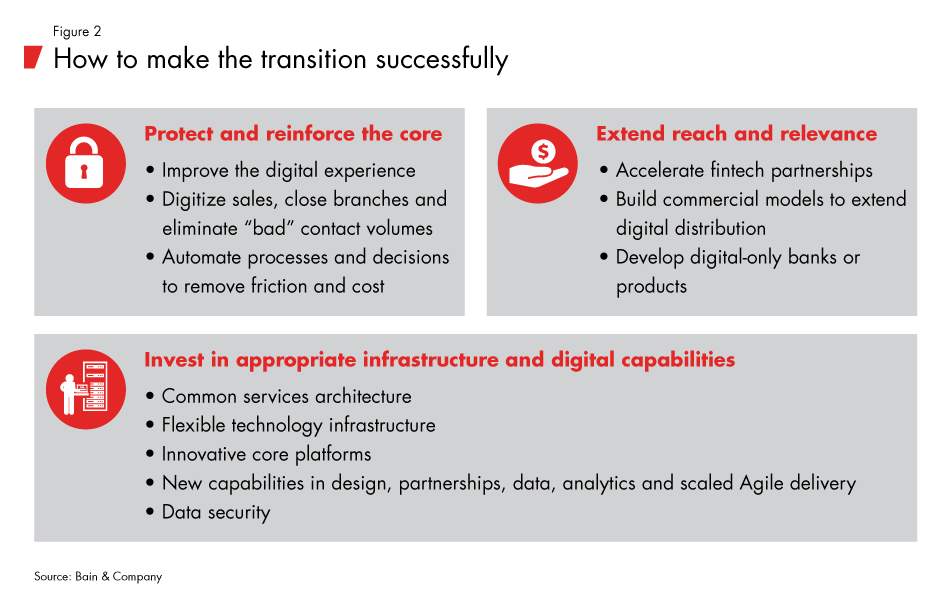
Banks should not slow down their ongoing transformation of leaning out branches, digitizing and automating processes and otherwise removing friction and cost from the business. At the same time, they will want to extend their reach and relevance by exploring the new models (see Figure 2). They will likely have to accelerate partnerships with fintechs, retailers or large technology firms. They will also need to invest in customer experience design, cloud infrastructure, APIs or other capabilities that underpin the new models. Turning the flurry of disruption to advantage will not be easy, but banks have no choice but to adapt, or become less relevant to ever-more-discriminating customers.
Questions to help bankers select a model
Infrastructure
- What people, systems and processes make up the core infrastructure of the bank?
- What is the right cost base for this infrastructure?
- What data and services will we share externally?
- What is the commercial model for sharing data and services?
- How should we modernize and strengthen our capabilities in core infrastructure?
Aggregation
- Why would customers aggregate with us and not another company?
- Can we provide a differentiated proposition based on insight, value, ease or convenience?
- Do we have the brand and reach to attract customers to the proposition?
- Can we create an ecosystem of value-added services?
Digital pure play
- Who is our target customer? Can we create a distinctive proposition for this target?
- Can we acquire customers at a reasonable cost without adverse risk selection?
- Can we create a substantially lower-cost delivery model?
- How do we deal with the competition for resources between our digital-only and our existing business models?
Embedded component experience
- What customer pain points can be addressed on digital platforms—such as paying for things, borrowing money, buying insurance, saving small amounts, verifying identity?
- How can we make the experience really easy for customers?
- Do we have the capabilities to develop an elegant solution with appropriate risk management?
- Can we create a commercial proposition and a network of partnerships?
Richard Fleming, Joe Fielding and Eduardo Roma are partners with Bain & Company’s Financial Services practice. Fleming and Fielding are based in New York, and Roma is based in London.
First published in 5月 2018