

論説

概要
- Years of benign conditions mean few executive teams have had to manage rampant inflation, which makes today’s surging costs an even bigger challenge.
- Retailers need to reset their pricing and promotion strategy, optimize their category strategy and assortment in partnership with suppliers, and build an organization that is both structurally lean and customer centric.
- Companies that are customer-obsessed, driven by data, and willing to self-disrupt will be best placed to execute this playbook and tame inflation.
The inflation headlines just keep coming, with double-digit price increases showing up in some months for a number of consumer goods from food to home improvement. Most of today’s retail leaders haven’t faced a sustained period of destructive inflation. They haven’t felt the margin squeeze that occurs when soaring costs aren’t (or can’t be) passed on to consumers. Nor have they seen the damage caused by clumsy responses to inflation, such as indiscriminate price increases that erode customer loyalty, or an unsustainable attachment to today’s price tags that saps profits.
Now, after years of price stability in many markets, a perfect inflationary storm is raging. Supply-side disruptions have pushed commodity prices up, and consumer goods makers have been quick to offset them by hiking the prices they ask from retailers. With unemployment in various economies having returned to the low levels seen pre-Covid, retailers are also paying more to fill roles and maintain service levels. Higher energy prices have made lighting, heating, refrigeration, and logistics more expensive, too. These dynamics were challenging before Russia’s invasion of Ukraine compounded the pressure on commodities, leaving consumer confidence even more delicately poised.
Amid such macroeconomic instability, executive teams need to move faster than they did in a low-inflation environment. A “last year + x%” approach to budgeting and planning won’t counter the threats to revenue and profit either. Instead, retailers need to reset their pricing and promotion strategy, optimize their category strategy and assortment in partnership with suppliers, and build an organization that is both structurally lean and customer centric. Those that can do this with speed—and above all by placing their customers’ priorities at the heart of their approach—should emerge stronger from today’s turbulence.
Resetting pricing and promotional strategy
Retailers have not been passing on to shoppers all the supplier cost increases they have faced in recent months. In the US, for instance, year-on-year consumer price inflation may have hit a four-decade high, but it has still lagged producer price inflation (see Figure 1). One of the most pressing tasks on today’s executive agenda is to create a data-driven understanding of just how much room retailers have to alter their prices—and how to minimize the consumer impact of upward adjustments.
Figure 1
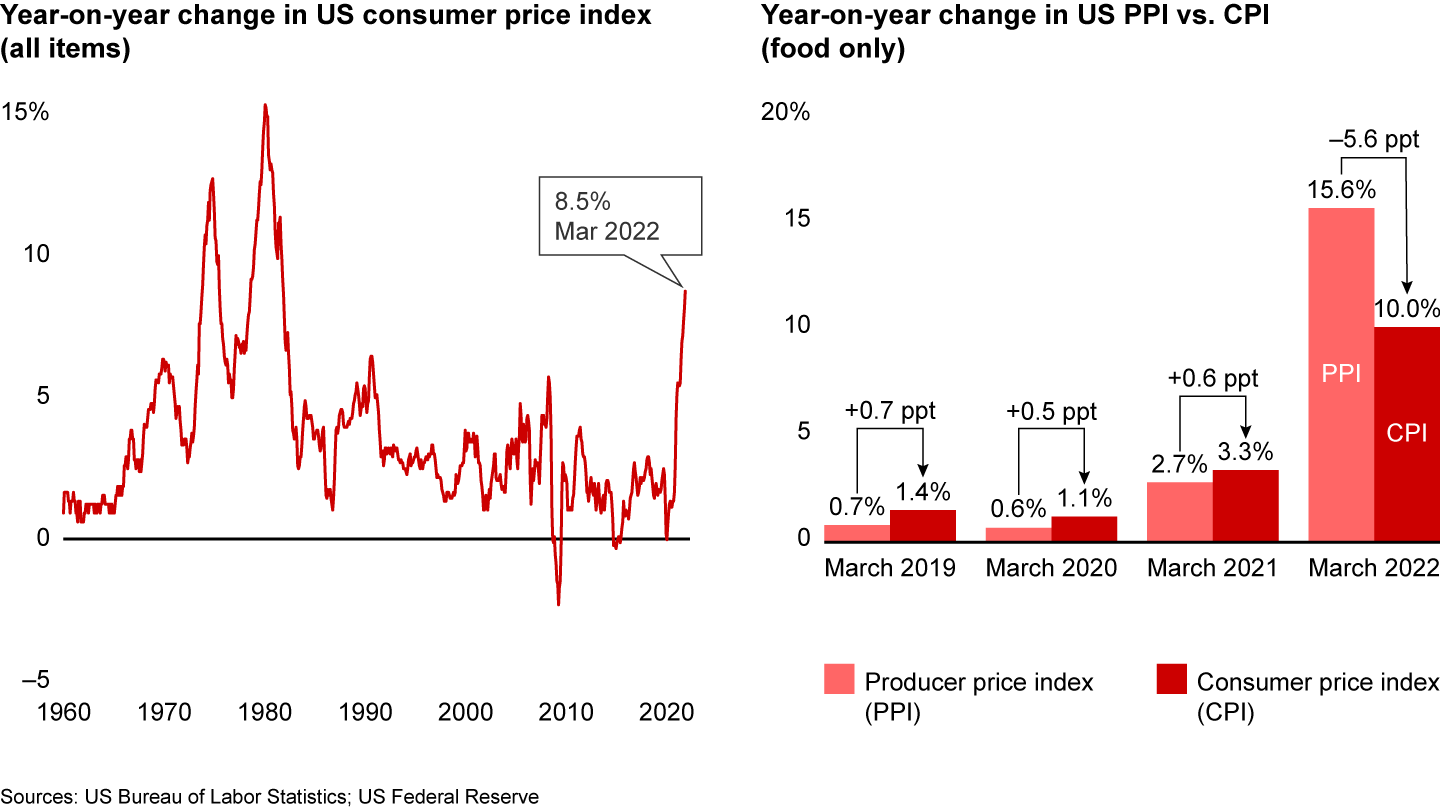

One effective approach starts with building an item-level view of customer price sensitivity in each category. That needs to include not just an assessment of current price positioning but also of how customers perceive a retailer’s prices. Understanding elasticity patterns is also key to determining where and how price increases can be passed on to consumers. In situations where historical data is not available to analyze, live tests can provide quick insights into shopper behavior.
The next stage is to take rapid action that defends margins without jeopardizing the banner’s value proposition. That will often mean increasing prices of “background” items (whose price is less salient to customers) to protect margins. For key value items (KVIs) that do influence price perception, commercial teams need to keep a keen eye on competitors and promptly respond to their price increases. Focusing promotional investments on the most prominent KVIs, and linking them to personalized offers, can be a potent way of keeping a reputation for value when other KVIs are tracking inflation in line with rivals. Multi-buy offers are also a useful tool for softening price increases.
With so much recalibration of pricing needed across categories, there has never been a better time to be ruthless about identifying and ending ineffective promotional activity. In contrast, marketing communication might need to increase to avoid losing ground on pricing perception.
Optimizing category strategy and assortment in partnership with suppliers
With higher prices and falling real wages sparking a widespread cost of living crisis, many shoppers are being forced to shift their spending. Those responses will vary greatly across categories. In developed markets, for instance, grocery volumes have tended to be relatively stable in times of turbulence, with consumers likely to trade down to cheaper versions of products or private label alternatives rather than forgo them altogether. However, the risk of an abrupt spending pullback can be acute in more discretionary categories such as apparel and out-of-home dining.
No matter the category, optimizing assortment now means getting into the heads of consumers and understanding how they are likely to make decisions in these inflationary conditions. Key questions include “how quickly are they likely to trade down?” and “what substitutes can we offer?” Retailers that have built strong (well-priced and differentiated) private labels may find that they have a substitution advantage, as they can displace less affordable branded products (or products that become unavailable due to commodity shortages). Retailers can also introduce entry-level items from cost-efficient suppliers to address the needs of value-conscious shoppers.
One US retailer did both of these things when confronted with stock-outs in a subcategory of laundry and household cleaners. It expanded its own-brand offering while also collaborating with a national challenger brand that offered a more attractive margin than the No. 1 player. Customers were happy to move to the alternative products, and category sales have been strong amid the shift to a higher-margin mix.
Restructuring assortment isn’t just about keeping shoppers loyal, though. It can also create an opportunity to reset the supplier relationship. That’s not a euphemistic call for a clumsy supplier squeeze; retailers gain more if, in addition to challenging their suppliers, they also work with them. True, pricing and assortment changes create natural pressure that can be used in negotiations to secure better terms. But they also create opportunities to coinvest in category growth, and to secure win-win improvements that don’t damage what the consumer really values: for instance, a mutual decision to allow the supplier to make fewer drops in return for lower prices.
One retailer in Asia-Pacific found win-win operational efficiencies by accelerating the digitalization of its apparel supply chain, using 3-D design and prototyping to cut the lead time for products by as much as eight weeks, reducing the need for markdowns. The retailer also moved to consolidate the range of fabrics used for apparel. The resultant increase in volumes enjoyed by its key fabric mills enabled the retailer to save $10 million from better supply terms, while cutting lead times further.
Cost champions in retail also use commodity price analysis and cost price increase benchmarking to understand the extent to which a cost price increase request is justified by underlying commodity trends. Our experience shows that cost price increase requests are often overstated by up to 30%–50%. Other useful benchmarks for product cost inflation include private-label tenders, cross-supplier comparisons, and should-cost analysis. A fact-based advanced analytics approach to negotiations is at the heart of an effective challenge to suppliers’ requests for opportunistic price increases.
Building an organization that is both structurally lean and customer centric
Many executive teams are already searching for tactical savings in operating expenditure as part of their phase one response to the surge in inflation. This hunt for tactical gains is far from over, but it is only one component of a strategic streamlining. The bigger prize will go to those retailers that also rethink their operations to become structurally leaner while maintaining or even sharpening their focus on their customers’ needs.
When they seek savings of any kind, retailers must continue to place customers front and center. Some customer interactions have a disproportionate impact on their willingness to return to a brand and recommend it, and it’s vital that service levels are not cut in these critical areas. Companies that can get a clear quantitative view on which interactions are pivotal to their Net Promoter ScoreSM will have an advantage in knowing what to protect.
Accurate internal and external benchmarking of costs associated with key customer interactions will be crucial in the push to cut spending that the customer doesn’t value. In our experience, retailers’ store labor costs are often a tenth or more higher than their optimum efficiency level, which can be reached by focusing on the most relevant customer episodes and streamlining other interactions. For instance, a European retailer recently identified a process redesign that could cut the hours of labor required to operate its manual cash desks by as much as a fifth without damaging the customer experience.
As for nonlabor costs, there’s often substantial value in redesigning the supply chain. For example, a European retailer recently applied a should-cost approach to its outsourced supply chain costs, identifying and negotiating cost savings of more than 10% from contract renegotiations and joint processes optimization. Another opportunity is to encourage in-store pickup over more costly fulfillment methods.
The adaptive competencies needed to tame inflation
It has become commonplace to declare that the instability of today’s global markets and macro environment is here to stay. But that doesn’t mean it’s not true. The retailers that are best placed to thrive in this age of turbulence—and especially during this period of surging prices—are customer-obsessed, driven by data in all their decisions, and willing to disrupt themselves through radical operating model changes. Those are the adaptive competencies that are most needed to execute the three sets of actions that we’ve outlined above. There’s still time for a new generation of retail leaders to build those muscles and tame inflation.
First published in 5月 2022