

レポート

概要
- Capability deals represented around 20% of all deals valued at more than $1 billion in 2019 as companies buy new capabilities to respond to business model disruption.
- These deals are brand-new territory for most companies, including experienced acquirers.
- Capability deals are a different breed of M&A; they often involve entrepreneurial targets and sources of value creation that are quite distinct from traditional deals.
- Accordingly, successful dealmakers don’t approach these deals with the traditional integration playbooks; they disproportionately focus on joint value creation and the hard and soft enablers required to foster joint collaboration.
This article is Section 4.3 of Bain's 2020 Global Corporate M&A Report. Explore our latest annual M&A report here.
Capability deals continue to rise in prominence, yet we are early on the experience curve
Within scope deals, capability-driven deals have accelerated and are now about 20% of all large deals globally as more companies choose to buy new capabilities than build them (see Figure 4.5).
Figure 4.5
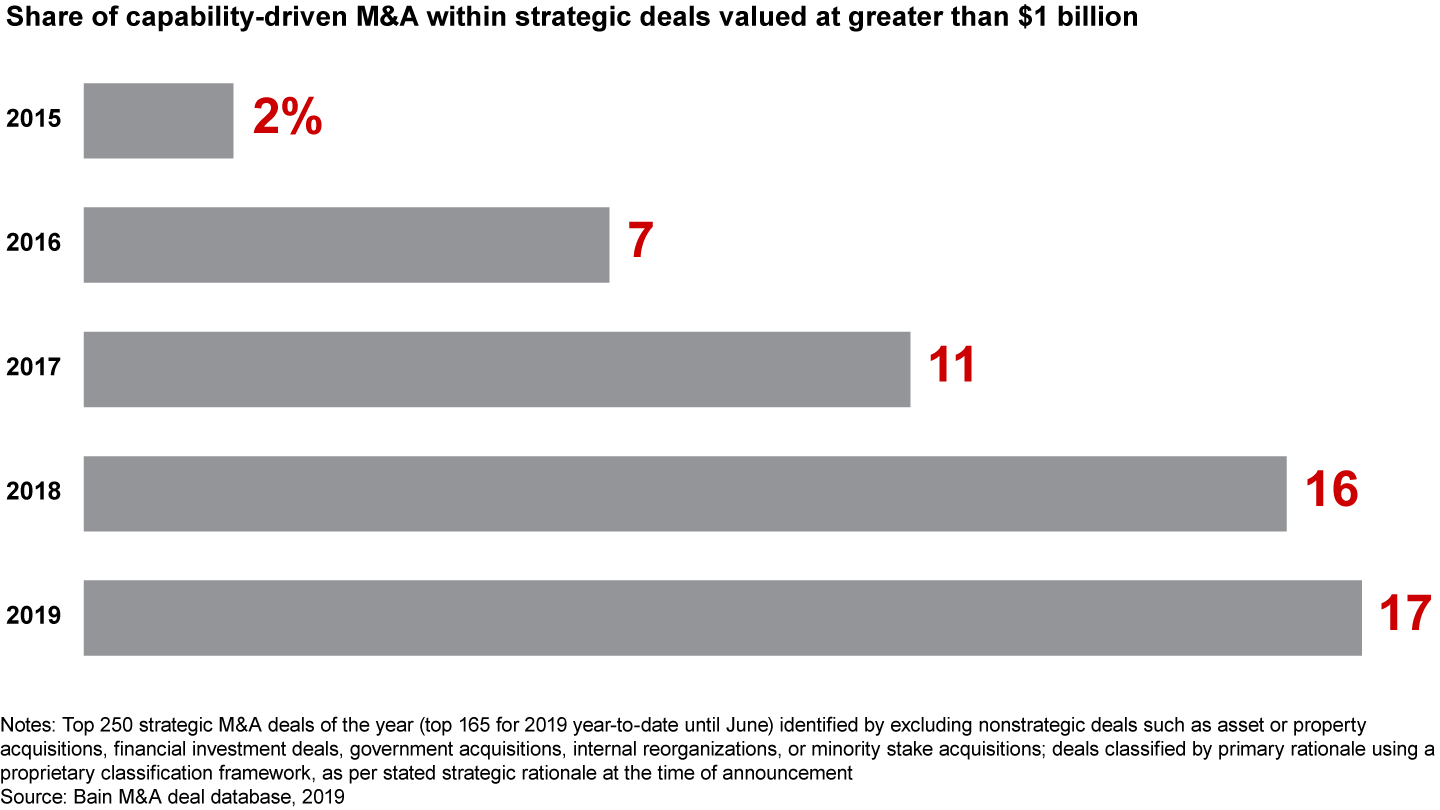

Capability deals are different from the more common growth scope deals that involve buying companies with faster-growing products or in faster-growing markets for an immediate growth uplift. Capability deals are about combining the complementary capabilities of the acquirer and target for a new value proposition or product development to generate future growth. That value creation is harder to quantify than either cost synergies (scale) or revenue synergies (growth scope).
We see three flavors of the capability deal: those aimed at strengthening an existing competitive advantage; those targeting digital opportunities; and those that aim to redefine a company through cross-sector or cross–value chain moves. Let’s look at these rationales one by one.
Examples of the first type include Salesforce’s $16.3 billion acquisition of Tableau, which enables Salesforce to strengthen the analytics capabilities of its customer relationship management offering, using Tableau’s data visualization platform. In media, Publicis Groupe bought Epsilon Data Management to develop the capabilities to provide data-driven advertising services.
The second major type of capability deal involves buying digital capabilities in emerging areas, such as robotics, artificial intelligence, e-commerce, the Internet of Things and big data analytics. Johnson & Johnson bought Auris Health to leverage its robotic platform technology (currently used in lung-related diagnostic and therapeutic procedures) to build a combined digital surgery portfolio. Bridgestone, the tire manufacturer, bought TomTom’s telematics fleet management business to establish itself as a key partner in the growing mobility-as-a-service industry. To target continuing growth in e-commerce, Edgewell Personal Care, a consumer products company, acquired Harry’s, known for its subscription-based online sales of shaving and other grooming products.
Finally, some companies are combining capabilities to redefine the joint business. These include cross–value chain deals and cross-sector deals such as United Technologies’ acquisition of Raytheon in the aerospace and defense sector, which combines capabilities in commercial aircraft and missile and defense systems.
Despite the rapid increase in capability dealmaking, these deals still are not very common. In a recent survey of senior executives, 70% to 80% of respondents had experience with scale and growth-oriented deals, but only about half of them reported doing a capability deal.
This is a different breed of M&A
Success in capability deals starts by acknowledging that they are different from what most acquirers may have done and experienced before. Capability deals are different in two meaningful ways: the characteristics of the target company itself and sources of value creation.
In capability deals, the target assets are likely to be smaller and more entrepreneurial with an Agile working culture—that is, with entirely different ways of working from the acquirer. The target’s value resides in the people who carry specialized knowledge of the technology, R&D capability or customer insights—knowledge that the acquirer does not yet have.
Second, the value in capability deals is not as obvious and visible as in scale and growth scope deals. The value in scale deals is mainly around cost synergies and in growth scope deals mostly around revenue synergies. The value in capability deals comes from bringing a new-to-the-world value proposition or new products for potential future growth.
The acquirer and target bring complementary capabilities to the table, and value creation lies at the intersection of these capabilities. While the acquirer’s business model represents the industry business model as it stands today, the target’s capabilities provide a future-back view of what could be—and both need to work together to realize that vision. Consider this comment by Salesforce Founder and Chairman Marc Benioff on the Tableau acquisition: “Tableau didn’t want our cash—they wanted our equity, because they know that the real value here is in the company that we’re creating together.”
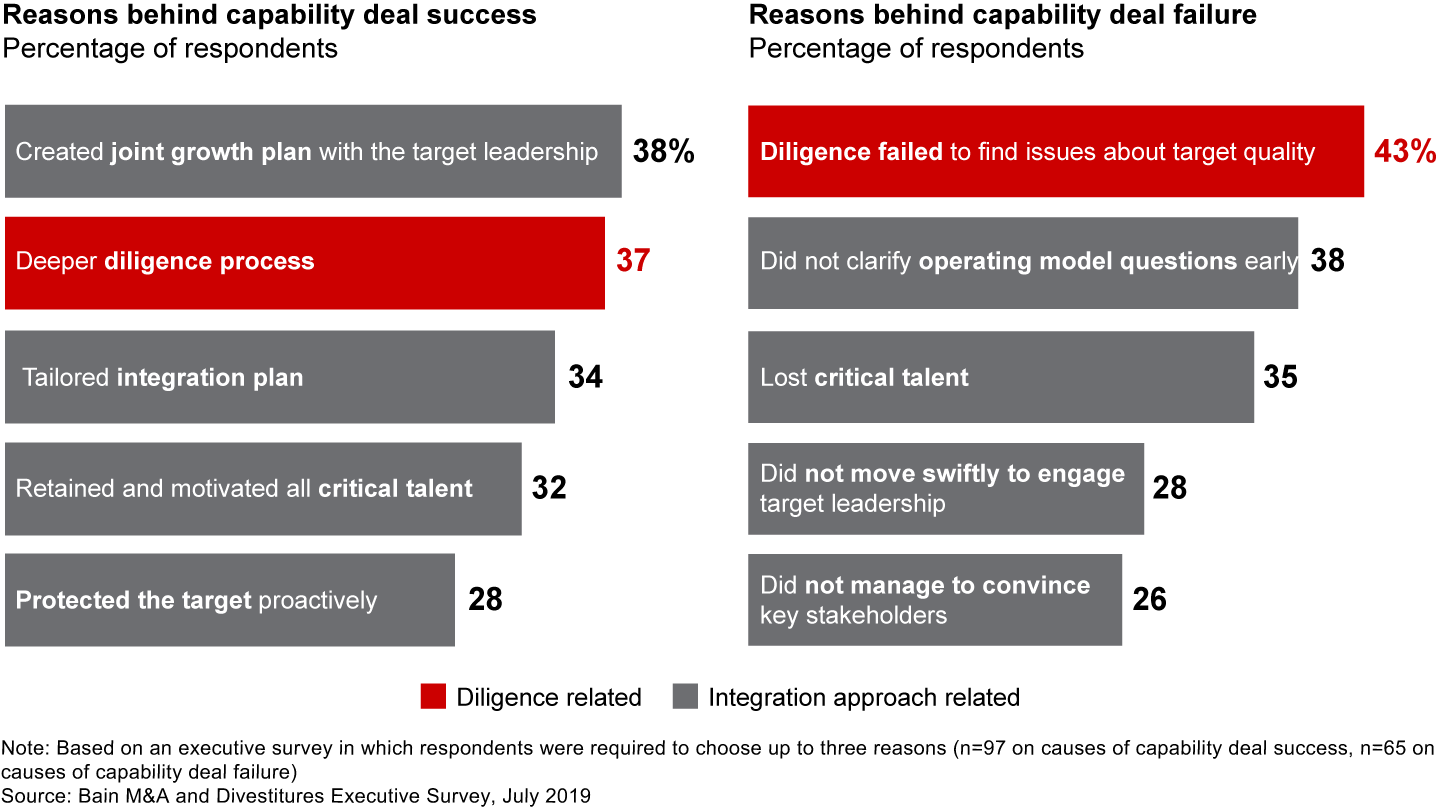
This is new territory to navigate for most acquirers, even highly experienced ones. At the outset, the quality of diligence on the standalone asset is itself an indicator of success or failure (see Figure 4.6).
Figure 4.6

Many acquirers take the conservative approach of not integrating the asset within the first few years. This is an easy but ineffective solution. No value is created, and it makes it hard to start integration once the cement has set. The best acquirers take the right actions while the cement is still wet.
Fulfilling the promise of the deal—joint growth planning and fostering collaboration
Successful capability acquirers know that they cannot simply rely on their traditional integration playbooks. It takes getting into the right mindset by staying open to learning from the smaller target and ensuring an equal share of voice for the target leadership.
When Microsoft embarked on a series of capability deals under CEO Satya Nadella, cultural openness and transformation was a key enabler for deal success. The company evolved from what Chris Capossela, the company’s chief marketing officer, referred to as a “know-it-all” culture to a “learn-it-all” culture, adding that “everything we do now is rooted in a growth mindset.” Said CEO Nadella: “Longevity in this business is about being able to reinvent yourself or invent the future.” Indeed, underpinning this transformation was the fundamental conviction that the firm needed these acquired capabilities to continue thriving.
In addition, successful acquirers intentionally force collaboration right out of the gate. This is how they learn to work together. It involves spending the time required to get to know each other, aligning the top leadership on the joint future vision and on the rules of engagement.
When it comes down to the tangible actions, a few things need to happen by deal close for all deal types—for example, closing the books, combining financial reporting, communicating to employees and other stakeholders. These actions have nothing to do with integration or the lack of it.
But that’s not where the value is. Successful acquirers get three things right in capability integrations.
- Develop a value-creation plan jointly with the target leadership.
- Protect the target’s talent, culture and ways of working, and find ways to scale it to support the value-creation plan.
- Consider operating model changes in support of the value-creation plan—both hard and soft tactics to get the teams to work together.
You don’t lead with functional integration in capability deal integrations; you lead with the value-creation plan. Given the valuation multiples involved, the true value lies in the revenue potential. If you chase after small cost synergies, you risk using up valuable and limited management bandwidth on things that don’t matter. That is a missed opportunity.
The window before and soon after deal close is a real breakthrough time to set the appropriate tone. Successful acquirers get the right people together, start with taking a future-back view of the customer, develop the product/service proposition in service of customer needs and use that to inform decisions around where to create connections. Functional integration, if any, would be a by-product here. In fact, if functional integration is required, it may be a few years down the line, when the product or service proposition is ready for rollout.
To see this approach in action, consider the example of an animal nutrition company (AgriCo) that acquired a small, fast-growing producer of natural additives for animal feed (FeedCo). The acquisition was aimed at accelerating combined growth and developing industry-leading capabilities and natural solutions for animal health and food safety.
This was both a growth scope and capability scope deal. FeedCo operates in the faster-growing natural solutions segment of the animal nutrition market and has proprietary products and technology. Given the relative size of the companies (AgriCo was many times larger than FeedCo) and the need to protect and accelerate FeedCo’s growth, AgriCo had to create a thoughtful plan to realize the deal thesis.
This integration approach was different from a traditional approach in many ways.
- The acquirer developed a value-creation plan jointly with the target leadership:
- Early joint sessions focused on learning and knowledge transfer, without jumping ahead to opportunity brainstorming and implementation planning.
- The value-creation plan was led and owned by the target leadership and enabled by the acquirer leadership.
- The value-creation plan was translated into an action plan, including both product development and go-to-market initiatives, and the enablers required to take action.
- The acquirer protected the target’s talent, culture and ways of working:
- AgriCo invested in building relationships and embraced the new leadership team as equals.
- People-first priorities, such as engagement and retention plans, were managed separately from HR onboarding efforts to ensure dedicated focus.
- Gatekeepers were appointed initially to protect the target management from direct requests from the acquirer side.
- The acquirer considered operating model changes in support of the value-creation plan:
- Functional integration was minimized to what was required for operationally critical tasks.
- Moreover, they took a “how can we help you?” posture that set the tone in the early days of integration. Joint growth teams were created to bring together the right people from both sides, with appropriate governance, to ensure successful implementation of the growth plan.
As a result of this integration approach, AgriCo and FeedCo jointly developed a five-year growth plan to double FeedCo’s revenue and ensured 100% retention of critical FeedCo employees.
They say a goal without a plan is just a dream. Successful acquirers embarking on capability deals proactively convert the deal thesis into an action plan. They leverage a capability deal’s tremendous potential to transform their company and leapfrog the competition.
This article is part of Bain’s 2020 Global Corporate M&A Report. Explore the contents of the report here or download the PDF to read the full report.
First published in 1月 2020