
Skip to Content
  • オフィス

    オフィス

    北米・南米
    • Atlanta
    • Austin
    • Bogota
    • Boston
    • Buenos Aires
    • Chicago
    • Dallas
    • Denver
    • Houston
    • Los Angeles
    • Mexico City
    • Minneapolis
    • Monterrey
    • Montreal
    • New York
    • Rio de Janeiro
    • San Francisco
    • Santiago
    • São Paulo
    • Seattle
    • Silicon Valley
    • Toronto
    • Washington, DC
    ヨーロッパ・中東・アフリカ
    • Amsterdam
    • Athens
    • Berlin
    • Brussels
    • Copenhagen
    • Doha
    • Dubai
    • Dusseldorf
    • Frankfurt
    • Helsinki
    • Istanbul
    • Johannesburg
    • Kyiv
    • Lisbon
    • London
    • Madrid
    • Milan
    • Munich
    • Oslo
    • Paris
    • Riyadh
    • Rome
    • Stockholm
    • Vienna
    • Warsaw
    • Zurich
    アジア・オーストラリア
    • Bangkok
    • Beijing
    • Bengaluru
    • Brisbane
    • Ho Chi Minh City
    • Hong Kong
    • Jakarta
    • Kuala Lumpur
    • Manila
    • Melbourne
    • Mumbai
    • New Delhi
    • Perth
    • Shanghai
    • Singapore
    • Sydney
    • Tokyo
    全てのオフィス
  • アルムナイ
  • メディア
  • お問い合わせ
  • 東京オフィス
  • Japan | 日本語

    地域と言語を選択

    グローバル
    • Global (English)
    北米・南米
    • Brazil (Português)
    • Argentina (Español)
    • Canada (Français)
    • Chile (Español)
    • Colombia (Español)
    ヨーロッパ・中東・アフリカ
    • France (Français)
    • DACH Region (Deutsch)
    • Italy (Italiano)
    • Spain (Español)
    • Greece (Elliniká)
    アジア・オーストラリア
    • China (中文版)
    • Korea (한국어)
    • Japan (日本語)
  • Saved items (0)
    Saved items (0)

    You have no saved items.

    後で閲読、共有できるようにするためにブックマークしてください

    Explore Bain Insights
  • 業界別プラクティス
    メインメニュー

    業界別プラクティス

    • 航空宇宙、防衛、政府関連
    • 農業
    • 化学製品
    • インフラ、建設
    • 消費財
    • 金融サービス
    • ヘルスケア
    • 産業機械、設備
    • メディア、エンターテインメント
    • 金属
    • 採掘・鉱業
    • 石油、ガス
    • 紙、パッケージ
    • プライベートエクイティ
    • 公共、社会セクター
    • 小売
    • テクノロジー
    • 通信
    • 交通
    • 観光産業
    • 公益事業、再生可能エネルギー
  • 機能別プラクティス
    メインメニュー

    機能別プラクティス

    • カスタマー・エクスペリエンス
    • サステイナビリティ、 社会貢献
    • Innovation
    • 企業買収、合併 (M&A)
    • オペレーション
    • 組織
    • プライベートエクイティ
    • マーケティング・営業
    • 戦略
    • アドバンスド・アナリティクス
    • Technology
    • フルポテンシャル・トランスフォーメーション
  • Digital
  • 知見/レポート
  • ベイン・アンド・カンパニーについて
    メインメニュー

    ベイン・アンド・カンパニーについて

    • ベインの信条
    • 活動内容
    • 社員とリーダーシップ
    • プレス・メディア情報
    • クライアントの結果
    • 受賞歴
    • パートナーシップを結んでいる団体
    Further: Our global responsibility
    • ダイバーシティ
    • 社会貢献
    • サステイナビリティへの取り組み
    • 世界経済フォーラム(WEF)
    Learn more about Further
  • キャリア
    メインメニュー

    キャリア

    • ベインで働く
      キャリア
      ベインで働く
      • Find Your Place
      • ベインで活躍する機会
      • ベインのチーム体制
      • 学生向けページ
      • インターンシップ
      • 採用イベント
    • ベインでの体験
      キャリア
      ベインでの体験
      • Blog: Inside Bain
      • キャリアストーリー
      • 社員紹介
      • Where We Work
      • 成長を後押しするサポート体制
      • アフィニティ・グループ
      • 福利厚生
    • Impact Stories
    • 採用情報
      キャリア
      採用情報
      • 採用プロセス
      • 面接内容
    FIND JOBS
  • オフィス
    メインメニュー

    オフィス

    • 北米・南米
      オフィス
      北米・南米
      • Atlanta
      • Austin
      • Bogota
      • Boston
      • Buenos Aires
      • Chicago
      • Dallas
      • Denver
      • Houston
      • Los Angeles
      • Mexico City
      • Minneapolis
      • Monterrey
      • Montreal
      • New York
      • Rio de Janeiro
      • San Francisco
      • Santiago
      • São Paulo
      • Seattle
      • Silicon Valley
      • Toronto
      • Washington, DC
    • ヨーロッパ・中東・アフリカ
      オフィス
      ヨーロッパ・中東・アフリカ
      • Amsterdam
      • Athens
      • Berlin
      • Brussels
      • Copenhagen
      • Doha
      • Dubai
      • Dusseldorf
      • Frankfurt
      • Helsinki
      • Istanbul
      • Johannesburg
      • Kyiv
      • Lisbon
      • London
      • Madrid
      • Milan
      • Munich
      • Oslo
      • Paris
      • Riyadh
      • Rome
      • Stockholm
      • Vienna
      • Warsaw
      • Zurich
    • アジア・オーストラリア
      オフィス
      アジア・オーストラリア
      • Bangkok
      • Beijing
      • Bengaluru
      • Brisbane
      • Ho Chi Minh City
      • Hong Kong
      • Jakarta
      • Kuala Lumpur
      • Manila
      • Melbourne
      • Mumbai
      • New Delhi
      • Perth
      • Shanghai
      • Singapore
      • Sydney
      • Tokyo
    全てのオフィス
  • アルムナイ
  • メディア
  • お問い合わせ
  • 東京オフィス
  • Japan | 日本語
    メインメニュー

    地域と言語を選択

    • グローバル
      地域と言語を選択
      グローバル
      • Global (English)
    • 北米・南米
      地域と言語を選択
      北米・南米
      • Brazil (Português)
      • Argentina (Español)
      • Canada (Français)
      • Chile (Español)
      • Colombia (Español)
    • ヨーロッパ・中東・アフリカ
      地域と言語を選択
      ヨーロッパ・中東・アフリカ
      • France (Français)
      • DACH Region (Deutsch)
      • Italy (Italiano)
      • Spain (Español)
      • Greece (Elliniká)
    • アジア・オーストラリア
      地域と言語を選択
      アジア・オーストラリア
      • China (中文版)
      • Korea (한국어)
      • Japan (日本語)
  • Saved items  (0)
    メインメニュー
    Saved items (0)

    You have no saved items.

    後で閲読、共有できるようにするためにブックマークしてください

    Explore Bain Insights
  • 業界別プラクティス
    • 業界別プラクティス

      • 航空宇宙、防衛、政府関連
      • 農業
      • 化学製品
      • インフラ、建設
      • 消費財
      • 金融サービス
      • ヘルスケア
      • 産業機械、設備
      • メディア、エンターテインメント
      • 金属
      • 採掘・鉱業
      • 石油、ガス
      • 紙、パッケージ
      • プライベートエクイティ
      • 公共、社会セクター
      • 小売
      • テクノロジー
      • 通信
      • 交通
      • 観光産業
      • 公益事業、再生可能エネルギー
  • 機能別プラクティス
    • 機能別プラクティス

      • カスタマー・エクスペリエンス
      • サステイナビリティ、 社会貢献
      • Innovation
      • 企業買収、合併 (M&A)
      • オペレーション
      • 組織
      • プライベートエクイティ
      • マーケティング・営業
      • 戦略
      • アドバンスド・アナリティクス
      • Technology
      • フルポテンシャル・トランスフォーメーション
  • Digital
  • 知見/レポート
  • ベイン・アンド・カンパニーについて
    • ベイン・アンド・カンパニーについて

      • ベインの信条
      • 活動内容
      • 社員とリーダーシップ
      • プレス・メディア情報
      • クライアントの結果
      • 受賞歴
      • パートナーシップを結んでいる団体
      Further: Our global responsibility
      • ダイバーシティ
      • 社会貢献
      • サステイナビリティへの取り組み
      • 世界経済フォーラム(WEF)
      Learn more about Further
  • キャリア
    人気検索キーワード
    • デジタル
    • 戦略
    前回の検索
      最近訪れたページ

      Content added to saved items

      Saved items (0)

      Removed from saved items

      Saved items (0)

      論説

      Rethinking M&A Valuation Assumptions

      Rethinking M&A Valuation Assumptions

      Why the assumptions behind many M&A models may be too onerous.

      著者:Michael Robbins and Hubert Shen

      • min read
      }

      論説

      Rethinking M&A Valuation Assumptions
      en

      Global mergers and acquisitions are on pace to reach a record high this year. Yet we continue to hear from many chief financial officers (CFOs), treasurers and other executives assessing M&A opportunities that they just can’t make deals pencil out.

      For every buyer, it seems, another dozen potential buyers have been walking away because their M&A models show that they will not earn adequate returns. They might have strong balance sheets, abundant dry powder and prospective targets that could add strategic value and growth, but many still choose to sit on the sidelines, in the interest of being prudent with their shareholders’ capital. And recent volatility in financial markets could make potential buyers even more hesitant.

      These reasons have led companies into a no-growth trap: Cautious companies wind up holding on to their cash, returning it to shareholders through dividends and share buybacks, or trying to boost profit margins through cost reductions. What should CFOs who are discarding potential deals and investments in their own business do with the mounting cash on their balance sheets? Should they simply wait for better valuations and, in the meantime, continue returning capital to shareholders?

      We suggest an alternative: Reassess internal hurdle rates to make sure they accurately capture current capital markets conditions. This reassessment could help expand and clarify the universe of attractive investment opportunities, whether they be M&A or organic.

      Two factors generally account for higher-than-necessary hurdle rates: the reluctance of companies to lower internal hurdle rates to the same extent as declines in their weighted average cost of capital (WACC), and the acquisition premiums placed on potential deals.

      Michael Robbins, a partner in the Corporate Finance practice, discusses what companies can do to avoid falling into a no-growth trap when M&A deals fall through.

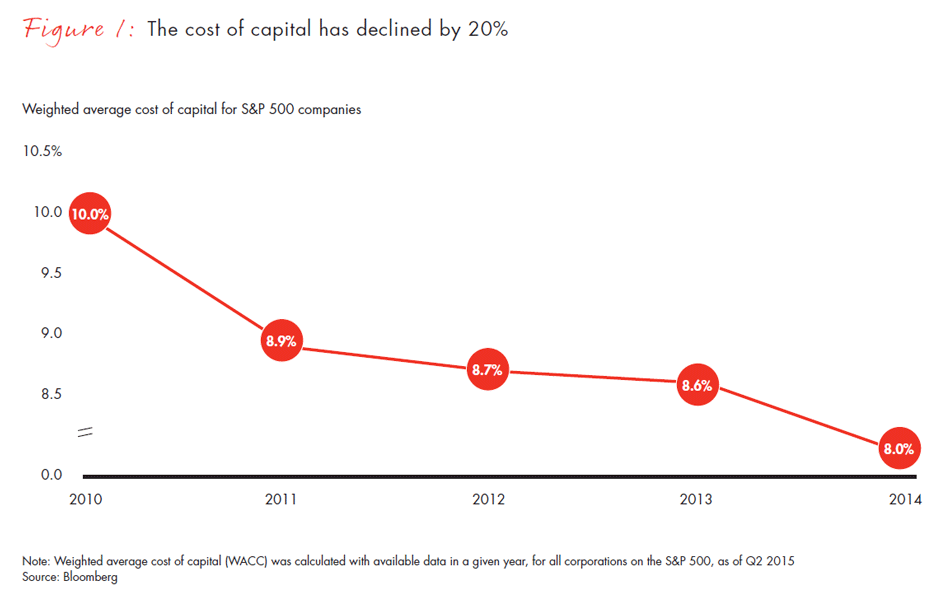
      Our analysis suggests that the WACC of the S&P 500 companies has steadily decreased and is, on average, 20% less than just a few years ago (see Figure 1). Many CFOs, however, have not lowered their internal investment hurdle rates as quickly or as far. Believing that interest rates must rise again soon, they have adopted a more conservative approach, lowering hurdle rates less than what the declining WACC would suggest.

      In addition, the risk premium they give to acquisitions (typically 200 to 300 basis points) and their general conservatism regarding WACC (typically 50 to 100 basis points) has not changed, further building in conservatism on a lower base.

      rethinking-ma-valuation-fig01_embed

      Why interest rates likely will remain low

      What corporate stewards of capital do from here depends in large part on the source of their concerns. If deals are not penciling out because potential buyers cannot get comfortable with the growth projections sellers have embedded into the price, then that may be a reasonable constraint. On the other hand, if the conservatism stems from worry that long-term interest rates will soon rise, that’s another matter.

      There is enough evidence to believe that long-term interest rates will remain low for a while, even after the US Federal Reserve begins the process of normalizing monetary policy. For one thing, the capital superabundance we first wrote about in 2012 continues to prevail, with $600 trillion in global financial assets available for investment. The law of supply and demand means that the cost of capital will likely remain low. (For more about capital superabundance, see Bain’s report, A World Awash in Money: Capital Trends through 2020.)

      Weakness in major economies, such as the eurozone, Japan and China, and in smaller markets, like Canada and Australia, has caused aggressive monetary easing in these countries, based on the pattern set by the Fed. It will be difficult for US interest rates to move sharply higher when overseas rates are being suppressed.

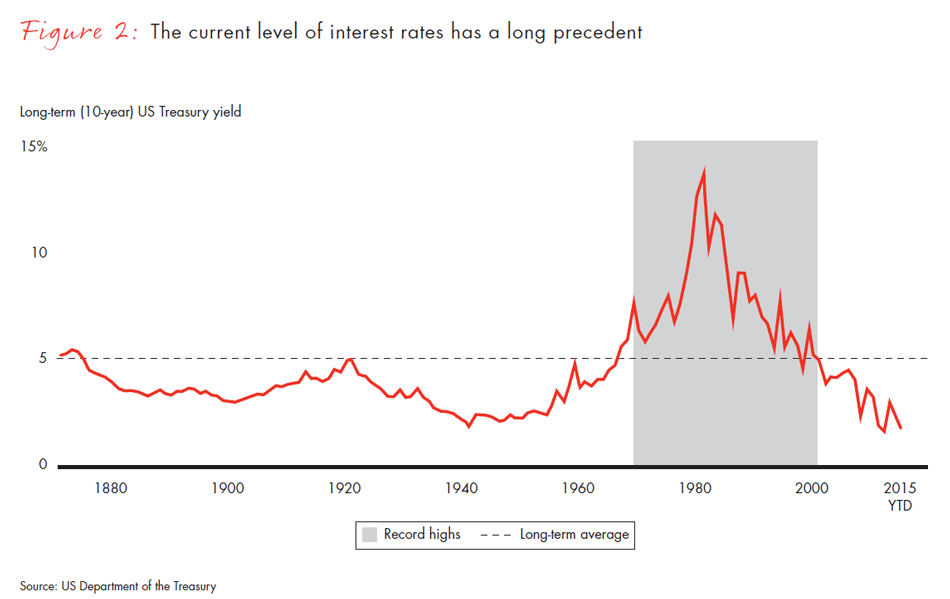
      Moreover, the strengthening of the US dollar serves as both signal and carrier of rising capital flows to the US. As international investors buy longer-term government and corporate bonds, interest rates generally will be suppressed. It’s also worth noting that the current level of rates is close to the long-term average over the past two centuries (see Figure 2).

      rethinking-ma-valuation-fig02_embed

      A prolonged period of capital surplus likely will be characterized by persistent low interest rates and thin real rates of return. The implication for CFOs, treasurers and others hunting for acceptable deals: Reevaluate and adjust internal investment hurdle rates and portfolio investment return targets accordingly. Without these adjustments, executives may end up parking capital on the sidelines indefinitely while waiting for higher-return opportunities that will not materialize.

      To be sure, by recent historical measures, valuation multiples in today’s environment still seem rich. Yet investors cannot invest in opportunities of the past, and very few can accurately time the valuation cycles of assets in the market. They must make capital allocation decisions and trade-offs against the only options presently available. And at present, interest rates have reached generational lows, partly because investors have found no better risk-reward trade-offs.

      Rethinking the assumptions that underlie a deal model is a big step. CFOs and other executives should examine several questions to determine whether to take that step and how much to reset the model (see the sidebar, “Fundamental questions for CFOs”).

      Fundamental questions for CFOs

      1. Do you separate the predictability of cash flows from the actual cost-of-capital requirements? This may require you to double down on due diligence efforts and invest more in scenario planning than in probability weighting and setting conservative hurdle rates, which serve to penalize the investment valuation twice.
      2. Have you updated cost-of-capital benchmarks to reflect most of the recent requirements for returns across different asset classes? Shareholders’ requirements for returns change over time and are influenced by the universe of alternatives available to them. In today’s capital markets, expectations for returns across asset classes have been tempered.
      3. Do you give yourself credit for having experience in making similar investments in the past? Do you evaluate the assigned risk premiums, given the lower cost of capital today? Our research suggests that serial acquirers are better at underwriting realistic assumptions and executing on deals. Your embedded acquisition premium may not need to be what it once was.
      4. Have you reevaluated the right target capital structure? Given current interest rates, it’s possible that your capital structure could be more productive at a different level, potentially lowering your WACC.

      Given current interest rates, it’s possible that your capital structure could be more productive at a different level, potentially lowering your WACC.

      Executives who still worry about timing this market at high valuations could consider a series of smaller investments or acquisitions over time, rather than one big acquisition that may be more susceptible to timing risk. Bain’s analysis shows that frequency and materiality both matter: Building M&A capabilities with a series of smaller acquisitions often leads to better returns over time. In addition, a company is more likely to perform better when more of its market capitalization comes from its acquisitions.

      More broadly, the most successful acquirers think long term about their portfolio of assets. They understand that strategic investments that complement their company’s core business can unlock more value than deals that simply pencil out in the near term. For CFOs finding deals that are attractive but too expensive, a reevaluation just might lead to a different conclusion.

      Michael Robbins, a Washington, DC-based partner with Bain & Company, is a leader of the firm’s Corporate Finance practice in the Americas. Hubert Shen is a principal with the practice and is based in Los Angeles.


      rethinking-ma-valuation-fig01_full

      rethinking-ma-valuation-fig02_full
      著者
      • Headshot of Michael Robbins
        Michael Robbins
        パートナー, Washington, DC
      • Headshot of Hubert Shen
        Hubert Shen
        パートナー, Los Angeles
      関連するコンサルティングサービス
      • 企業買収、合併(M&A)
      コンサルティングサービス
      • Corporate Finance
      企業買収、合併(M&A)
      Agitators and Reformers: How to Respond to Activist Investors

      Someday soon, an activist investor is likely to show up on your corporate doorstep.

      詳細
      ヘルスケア
      Mega-Mergers in Health Insurance: 10 Steps to Successful Integration

      Tailor integration to identify value, keep the right people and focus on critical decisions.

      詳細
      Corporate Finance
      Looking Ahead to 2026: Getting a Boost from the Great Rebound

      Why more companies will move from awareness to action.

      詳細
      企業買収、合併(M&A)
      What Agency Consolidation Means for CMOs

      As agency holding companies get bigger and deeper, CMOs must rethink ownership, integration, and how to stay in control.

      詳細
      Corporate Finance
      M&A Capability for a New Era: Five Ways AI Is Creating More Value in M&A Right Now

      What companies are learning as they use AI across more of the M&A process.

      詳細
      First published in 10月 2015
      Tags
      • Corporate Finance
      • 企業買収、合併(M&A)

      クライアント支援事例

      企業買収、合併(M&A) Post-merger cultural issues jeopardize a deal

      ケーススタディを見る

      企業買収、合併(M&A) A bank and a grocer build a fruitful alliance

      ケーススタディを見る

      企業買収、合併(M&A) Finance transformation: For one company, second time’s the charm

      ケーススタディを見る

      お気軽にご連絡下さい

      私達は、グローバルに活躍する経営者が抱える最重要経営課題に対して、厳しい競争環境の中でも成長し続け、「結果」を出すために支援しています。

      ベインの知見。競争が激化するグローバルビジネス環境で、日々直面するであろう問題について論じている知見を毎月お届けします。

      *プライバシーポリシーの内容を確認し、合意しました。

      プライバシーポリシーをご確認頂き、合意頂けますようお願い致します。
      Bain & Company
      お問い合わせ Sustainability Accessibility Terms of use Privacy Cookie Policy Sitemap Log In

      © 1996-2026 Bain & Company, Inc.

      お問い合わせ

      How can we help you?

      • ビジネスについて
      • プレス報道について
      • 採用について
      全てのオフィス