

論説

概要
- The increasing frequency and magnitude of supply chain disruptions over the past decade has exposed weaknesses in most companies’ supply chain models.
- That’s pushing more companies to transform their supply chains from global and lean to resilient, sustainable, and responsive—all while still maintaining cost competitiveness.
- To accomplish this, supply chain leaders are collaborating more with their business counterparts, thinking more boldly about transformation, investing in digital capabilities, and refreshing their operating model to better reflect these new supply chain priorities.
As executives prepare for a post-globalization, post-pandemic world, many are coming to grips with one of the most painful lessons of the past several years: Having the best product, technology, sales, marketing, and customer service doesn’t matter much if your company doesn’t have a resilient supply chain.
For decades, companies have embraced globalization and lean supply chain operations to meet more demanding customer expectations while bringing down costs and reducing inventory. But the inherent weakness and vulnerability of this model has been exposed by a decade of supply chain disruptions that grew in frequency and magnitude (see Figure 1). Natural disasters, weather events, labor shortages, trade disputes, and other geopolitical issues showed the cracks in global supply chains. Then, over the past two years, the devastating Covid-19 pandemic, the global semiconductor shortage, and the brutal war and humanitarian crisis in Ukraine made this vulnerability obvious to every business leader—and moved supply chain resilience to the top of the C-level agenda.
Figure 1
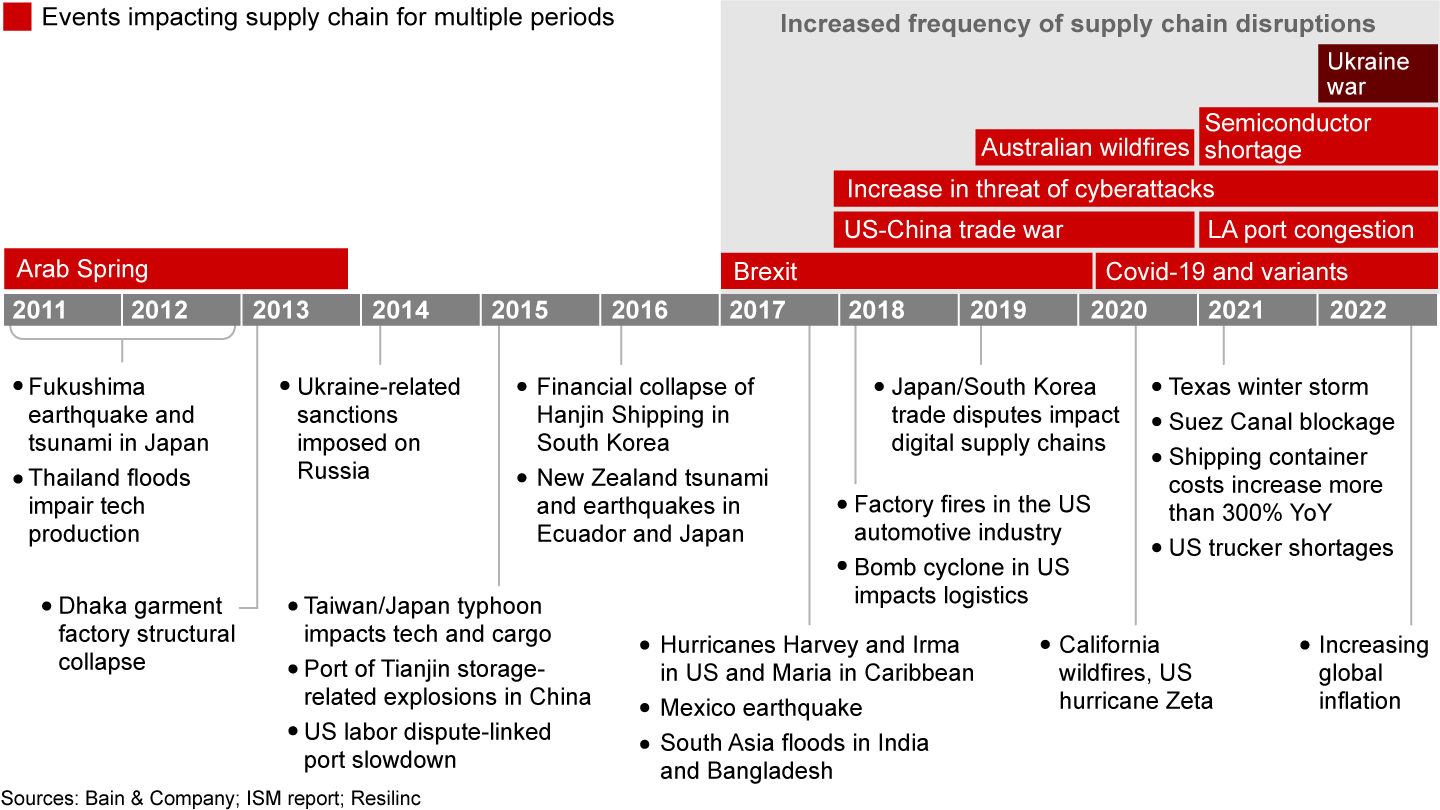

The worst of these supply disruptions have taken significant bites out of companies’ output, sales, profitability, and share prices, with recovery sometimes taking months or even years. The chip shortage, for example, is estimated to have curbed global automotive production by more than 7 million vehicles in 2021, and the industry, similar to others, has yet to fully recover.
Most of these disruptions understandably caught leadership teams by surprise. But the result is that they’re now constantly on edge, awaiting the next unforeseen disruption lurking around the corner. And more are certainly coming: geopolitical realignments, climate change challenges, labor issues, demand and supply shortfalls, increasing economic volatility, to name a few.
A growing number of executives have decided they can no longer afford to get caught flat-footed. They recognize that while it’s important to respond effectively to short-term supply chain shocks, they also have to reposition their supply chain for the long haul because disruption is the new global reality. Companies that manage these disruptions best will have a distinct competitive edge over the next decade. At the same time, pressure from consumers, regulators, and shareholders to increase sustainability is making supply chain repositioning an even more urgent priority—and creating another potential source of competitive advantage.
But most companies are only beginning to grapple with the magnitude of the overhaul that’s required. The emerging leaders in this area recognize that in order to pull away from their competitors in the coming years, they’ll need to fundamentally reinvent their supply chains. They’re working to transform them from global and lean to resilient, sustainable, and more responsive to customer needs—all while still maintaining cost competitiveness.
What it takes
The challenge is finding the appropriate balance among resilience, sustainability, responsiveness, and cost. These goals often run counter to one another. For example, a supply chain that is 100% resilient will also likely be too costly. There will always be trade-offs, and the balance will look different for every company, depending on various factors such as their industry, geographic footprint, and size.
A few questions can help jump-start the process of striking the balance that’s right for your company:
- In order to win in the marketplace, what does the business need from our supply chain in terms of resilience, sustainability, responsiveness, and cost?
- Where do our existing supply chain capabilities fall short?
- How often does the balance between these dimensions need to be refreshed in order to remain competitive?
- What capabilities and processes will be required to continually monitor and assess the balance of priorities?
These considerations make it clear that incremental changes won’t meet the challenge. Succeeding will require a bold strategy and fearless execution. What does this look like on the ground? Leading companies focus on the following four areas.
Improving collaboration between the supply chain team and other key stakeholders. At many companies, there can be limited communication between supply chain leaders and the sales team, business unit heads, or C-suite about strategy or investment priorities. Often this is because the organization is siloed or the supply chain department historically hasn’t had a seat at the leadership table. But the result is a lack of direction that can paralyze the supply chain team: They don’t want to embark on a multiyear redesign project only to find out partway through that they poured significant time and resources into a plan that doesn’t deliver what matters to customers or what the business needs. If, say, faster delivery is paramount in the revamped supply chain, they’ll design it differently than if low cost trumps all; there could be thousands of iterations in between.
Leading companies look for ways to improve communications among the supply chain, C-suite, sales, and other commercial teams so that supply chain leaders clearly understand the trade-offs required to win in the market. The most successful companies are also involving other key stakeholders in the supply chain balance equation discussion, including finance, R&D, regulatory, sustainability, and procurement. This ensures everyone understands all the implications of the proposed overhaul—and what’s feasible.
Covid-19 disruptions pushed a global apparel company to reorient its supply chain around resilience. Management recognized early on that this would require a transformation that would have ripple effects across other parts of the business. So, to craft the right plan, it pulled together a cross-functional strategy team that included the heads of supply chain, finance, sustainability, consumer insights, and the product’s business unit. The team saw the supply chain redesign as an opening to not only boost resilience but also responsiveness and sustainability. It determined that it could improve in all three areas by moving some of its manufacturing, which for decades had been concentrated in one low-cost region, closer to where most of its customers reside. Reducing reliance on any one location would provide insulation from supply disruptions, and making its products closer to customers would speed up delivery and shrink the supply chain’s carbon footprint.
The question was, how much of the company’s manufacturing operations should move closer to customers? Company leadership accepted that the new supply chain would increase costs. But to find the right balance of cost with the other factors, the cross-functional team mapped out multiple scenarios. They tuned the dials on all four key dimensions until they landed on a vision that’s anticipated to meet the company’s objectives and more than double the business’s annual sales volume over the coming decade.
Tapping into the power of unconstrained thinking to set a bold vision. Only transformational thinking can solve the problems that supply chains now face. Leading companies start with a blank sheet of paper, set aside all constraints, and draw up the end-to-end supply chain they expect they’ll need in order to win in their industry 5 to 10 years from now. Then, they chart a pragmatic, detailed roadmap to the target.
The perfect supply chain is likely unattainable. Some limitations (across operations, capital, commercial capabilities, suppliers, and regulations) must be factored into the real-world scenario. But based on our experience working with companies around the globe, when business leaders give themselves the space to think boldly and they work backward from the end goal, it usually allows the company to get a lot closer to perfect.
One consumer electronics company set out to overhaul its supply chain because it wasn’t well positioned to serve changing consumer preferences that demanded faster and more frequent product enhancements. The boldest change in the company’s supply chain redesign? It outsourced the majority of production to contract manufacturers. With some safeguards in place to protect the company’s intellectual property, the move has brought significant benefits. It reduced the company’s cost of goods sold by about 5% and avoided tens of millions of dollars in planned capital expenditures—all while increasing speed to market for its products. It also improved sustainability: The contract manufacturers are located much closer to most of the company’s customers than its previous manufacturing locations.
Ceasing in-house manufacturing was an option company management wasn’t even considering at the outset of the supply chain redesign project. Only by remaining open to any and all ideas was the company able to land on one that, while drastic and with risks attached, achieved its goals and has had an outsized effect on the business and its future.
Investing in digital capabilities that help connect the supply chain and change the economics in ways that weren’t previously possible. As they transition to Industry 4.0, companies’ investments in technology transformation and digitalizing their operations also play an essential role in supporting supply chain redesign initiatives. Digital capabilities are enabling companies to rebalance their supply chains toward resilience, sustainability, and responsiveness without taking an untenable hit on cost or efficiency.
Leading companies are applying machine learning and other digital tools to improve demand forecasting, inventory management, production scheduling, early detection of supply chain disruptions, and a host of other critical elements. They’re also using factory automation to bend the cost curve and increase resilience. Over the past several years, effective deployment of these technologies—in combination with rising geopolitical uncertainty and the rising costs of shipping and overseas labor—has completely restructured the calculus for many companies’ global manufacturing and supply chain footprints.
One tech company is shifting some of its production out of Asia to help protect itself from supply disruptions. Such moves would’ve been cost prohibitive in the past, but increased automation on the factory floor will allow it to make products in the new location at roughly the same cost. And by locating some production closer to more of its customers, the company will also reap the benefits of better responsiveness, flexibility, and sustainability.
Revamping the operating model to embrace the new supply chain balance. As companies change what they expect from their supply chains, it’s critical to revise how they measure and incentivize success. Efficiency gains and cost reduction have been paramount for so long that switching to a more balanced scorecard won’t be simple or happen overnight. But leading companies recognize that it’s foundational to making the new model work. The most successful companies also adjust their supply chain governance and planning and monitoring processes to rigorously track progress toward resilience, sustainability, and responsiveness goals and to improve collaboration and data sharing with partners up and down the supply chain. Putting this infrastructure in place will help make it easier for everyone, from the C-suite to the shop floor, to shed the legacy supply chain mindset and embrace the new approach.
Multiyear journey
The bottom line is this isn’t just an overhaul of the supply chain; it’s a companywide transformation and a multiyear journey. The emerging leaders are acting as quickly as they can to remake their supply chain’s vulnerabilities into virtues so that they not only get ahead of the next global supply chain crisis but also accelerate past their competitors.
First published in 5月 2022