
Skip to Content
  • オフィス

    オフィス

    北米・南米
    • Atlanta
    • Austin
    • Bogota
    • Boston
    • Buenos Aires
    • Chicago
    • Dallas
    • Denver
    • Houston
    • Los Angeles
    • Mexico City
    • Minneapolis
    • Monterrey
    • Montreal
    • New York
    • Rio de Janeiro
    • San Francisco
    • Santiago
    • São Paulo
    • Seattle
    • Silicon Valley
    • Toronto
    • Washington, DC
    ヨーロッパ・中東・アフリカ
    • Amsterdam
    • Athens
    • Berlin
    • Brussels
    • Copenhagen
    • Doha
    • Dubai
    • Dusseldorf
    • Frankfurt
    • Helsinki
    • Istanbul
    • Johannesburg
    • Kyiv
    • Lisbon
    • London
    • Madrid
    • Milan
    • Munich
    • Oslo
    • Paris
    • Riyadh
    • Rome
    • Stockholm
    • Vienna
    • Warsaw
    • Zurich
    アジア・オーストラリア
    • Bangkok
    • Beijing
    • Bengaluru
    • Brisbane
    • Ho Chi Minh City
    • Hong Kong
    • Jakarta
    • Kuala Lumpur
    • Manila
    • Melbourne
    • Mumbai
    • New Delhi
    • Perth
    • Shanghai
    • Singapore
    • Sydney
    • Tokyo
    全てのオフィス
  • アルムナイ
  • メディア
  • お問い合わせ
  • 東京オフィス
  • Japan | 日本語

    地域と言語を選択

    グローバル
    • Global (English)
    北米・南米
    • Brazil (Português)
    • Argentina (Español)
    • Canada (Français)
    • Chile (Español)
    • Colombia (Español)
    ヨーロッパ・中東・アフリカ
    • France (Français)
    • DACH Region (Deutsch)
    • Italy (Italiano)
    • Spain (Español)
    • Greece (Elliniká)
    アジア・オーストラリア
    • China (中文版)
    • Korea (한국어)
    • Japan (日本語)
  • Saved items (0)
    Saved items (0)

    You have no saved items.

    後で閲読、共有できるようにするためにブックマークしてください

    Explore Bain Insights
  • 業界別プラクティス
    メインメニュー

    業界別プラクティス

    • 航空宇宙、防衛、政府関連
    • 農業
    • 化学製品
    • インフラ、建設
    • 消費財
    • 金融サービス
    • ヘルスケア
    • 産業機械、設備
    • メディア、エンターテインメント
    • 金属
    • 採掘・鉱業
    • 石油、ガス
    • 紙、パッケージ
    • プライベートエクイティ
    • 公共、社会セクター
    • 小売
    • テクノロジー
    • 通信
    • 交通
    • 観光産業
    • 公益事業、再生可能エネルギー
  • 機能別プラクティス
    メインメニュー

    機能別プラクティス

    • カスタマー・エクスペリエンス
    • サステイナビリティ、 社会貢献
    • Innovation
    • 企業買収、合併 (M&A)
    • オペレーション
    • 組織
    • プライベートエクイティ
    • マーケティング・営業
    • 戦略
    • アドバンスド・アナリティクス
    • Technology
    • フルポテンシャル・トランスフォーメーション
  • Digital
  • 知見/レポート
  • ベイン・アンド・カンパニーについて
    メインメニュー

    ベイン・アンド・カンパニーについて

    • ベインの信条
    • 活動内容
    • 社員とリーダーシップ
    • プレス・メディア情報
    • クライアントの結果
    • 受賞歴
    • パートナーシップを結んでいる団体
    Further: Our global responsibility
    • ダイバーシティ
    • 社会貢献
    • サステイナビリティへの取り組み
    • 世界経済フォーラム(WEF)
    Learn more about Further
  • キャリア
    メインメニュー

    キャリア

    • ベインで働く
      キャリア
      ベインで働く
      • Find Your Place
      • ベインで活躍する機会
      • ベインのチーム体制
      • 学生向けページ
      • インターンシップ
      • 採用イベント
    • ベインでの体験
      キャリア
      ベインでの体験
      • Blog: Inside Bain
      • キャリアストーリー
      • 社員紹介
      • Where We Work
      • 成長を後押しするサポート体制
      • アフィニティ・グループ
      • 福利厚生
    • Impact Stories
    • 採用情報
      キャリア
      採用情報
      • 採用プロセス
      • 面接内容
    FIND JOBS
  • オフィス
    メインメニュー

    オフィス

    • 北米・南米
      オフィス
      北米・南米
      • Atlanta
      • Austin
      • Bogota
      • Boston
      • Buenos Aires
      • Chicago
      • Dallas
      • Denver
      • Houston
      • Los Angeles
      • Mexico City
      • Minneapolis
      • Monterrey
      • Montreal
      • New York
      • Rio de Janeiro
      • San Francisco
      • Santiago
      • São Paulo
      • Seattle
      • Silicon Valley
      • Toronto
      • Washington, DC
    • ヨーロッパ・中東・アフリカ
      オフィス
      ヨーロッパ・中東・アフリカ
      • Amsterdam
      • Athens
      • Berlin
      • Brussels
      • Copenhagen
      • Doha
      • Dubai
      • Dusseldorf
      • Frankfurt
      • Helsinki
      • Istanbul
      • Johannesburg
      • Kyiv
      • Lisbon
      • London
      • Madrid
      • Milan
      • Munich
      • Oslo
      • Paris
      • Riyadh
      • Rome
      • Stockholm
      • Vienna
      • Warsaw
      • Zurich
    • アジア・オーストラリア
      オフィス
      アジア・オーストラリア
      • Bangkok
      • Beijing
      • Bengaluru
      • Brisbane
      • Ho Chi Minh City
      • Hong Kong
      • Jakarta
      • Kuala Lumpur
      • Manila
      • Melbourne
      • Mumbai
      • New Delhi
      • Perth
      • Shanghai
      • Singapore
      • Sydney
      • Tokyo
    全てのオフィス
  • アルムナイ
  • メディア
  • お問い合わせ
  • 東京オフィス
  • Japan | 日本語
    メインメニュー

    地域と言語を選択

    • グローバル
      地域と言語を選択
      グローバル
      • Global (English)
    • 北米・南米
      地域と言語を選択
      北米・南米
      • Brazil (Português)
      • Argentina (Español)
      • Canada (Français)
      • Chile (Español)
      • Colombia (Español)
    • ヨーロッパ・中東・アフリカ
      地域と言語を選択
      ヨーロッパ・中東・アフリカ
      • France (Français)
      • DACH Region (Deutsch)
      • Italy (Italiano)
      • Spain (Español)
      • Greece (Elliniká)
    • アジア・オーストラリア
      地域と言語を選択
      アジア・オーストラリア
      • China (中文版)
      • Korea (한국어)
      • Japan (日本語)
  • Saved items  (0)
    メインメニュー
    Saved items (0)

    You have no saved items.

    後で閲読、共有できるようにするためにブックマークしてください

    Explore Bain Insights
  • 業界別プラクティス
    • 業界別プラクティス

      • 航空宇宙、防衛、政府関連
      • 農業
      • 化学製品
      • インフラ、建設
      • 消費財
      • 金融サービス
      • ヘルスケア
      • 産業機械、設備
      • メディア、エンターテインメント
      • 金属
      • 採掘・鉱業
      • 石油、ガス
      • 紙、パッケージ
      • プライベートエクイティ
      • 公共、社会セクター
      • 小売
      • テクノロジー
      • 通信
      • 交通
      • 観光産業
      • 公益事業、再生可能エネルギー
  • 機能別プラクティス
    • 機能別プラクティス

      • カスタマー・エクスペリエンス
      • サステイナビリティ、 社会貢献
      • Innovation
      • 企業買収、合併 (M&A)
      • オペレーション
      • 組織
      • プライベートエクイティ
      • マーケティング・営業
      • 戦略
      • アドバンスド・アナリティクス
      • Technology
      • フルポテンシャル・トランスフォーメーション
  • Digital
  • 知見/レポート
  • ベイン・アンド・カンパニーについて
    • ベイン・アンド・カンパニーについて

      • ベインの信条
      • 活動内容
      • 社員とリーダーシップ
      • プレス・メディア情報
      • クライアントの結果
      • 受賞歴
      • パートナーシップを結んでいる団体
      Further: Our global responsibility
      • ダイバーシティ
      • 社会貢献
      • サステイナビリティへの取り組み
      • 世界経済フォーラム(WEF)
      Learn more about Further
  • キャリア
    人気検索キーワード
    • デジタル
    • 戦略
    前回の検索
      最近訪れたページ

      Content added to saved items

      Saved items (0)

      Removed from saved items

      Saved items (0)

      M&A Report

      Technology M&A: How Hyper Acquirers Integrate New Capabilities

      Technology M&A: How Hyper Acquirers Integrate New Capabilities

      Big tech’s thirst for small deals means finding ways to realize a given deal’s value while also integrating a new deal that closes maybe two weeks later.

      著者:Adam Haller and Chris Johnson

      • min read
      }

      レポート

      Technology M&A: How Hyper Acquirers Integrate New Capabilities
      en
      At a Glance
      • Major technology companies acquire dozens of small companies, with deals costing less than $500 million representing about 96% of all big tech M&A, requiring an efficient approach to integration.
      • The best acquirers do deep customer and product diligence during pre-signing to better understand the value available in a target and how it can add to the existing business. This allows them to create granular cost and revenue synergy plans pre-close that they can execute from day one.
      • More than 75% of the tech M&A practitioners we surveyed felt that talent retention is now more difficult than it was three years ago. The best tech acquirers go beyond retaining talent by finding ways to grow the target’s talent base even faster than it could on its own.
      • With some tech acquirers doing as many as 30 deals per year (or one every two weeks), the best tech acquirers build an integration chassis that will allow them to streamline the integration process and adapt the approach to focus on value creation in each unique deal.

      This article is part of Bain's 2022 M&A Report.

      Explore the report

      When Microsoft acquires Nuance Communications for $19.7 billion, it makes headlines. But what’s become far more common is when a tech giant such as Microsoft pays undisclosed amounts for significantly smaller companies such as TakeLessons or Clipchamp. Major tech companies buy dozens of small targets each year, usually with the goal of adding valuable capabilities that will improve their core business or seed new Engine 2 businesses. It’s to the point that deals costing less than $500 million now represent about 96% of all big tech M&A (see Figure 1).

      Figure 1
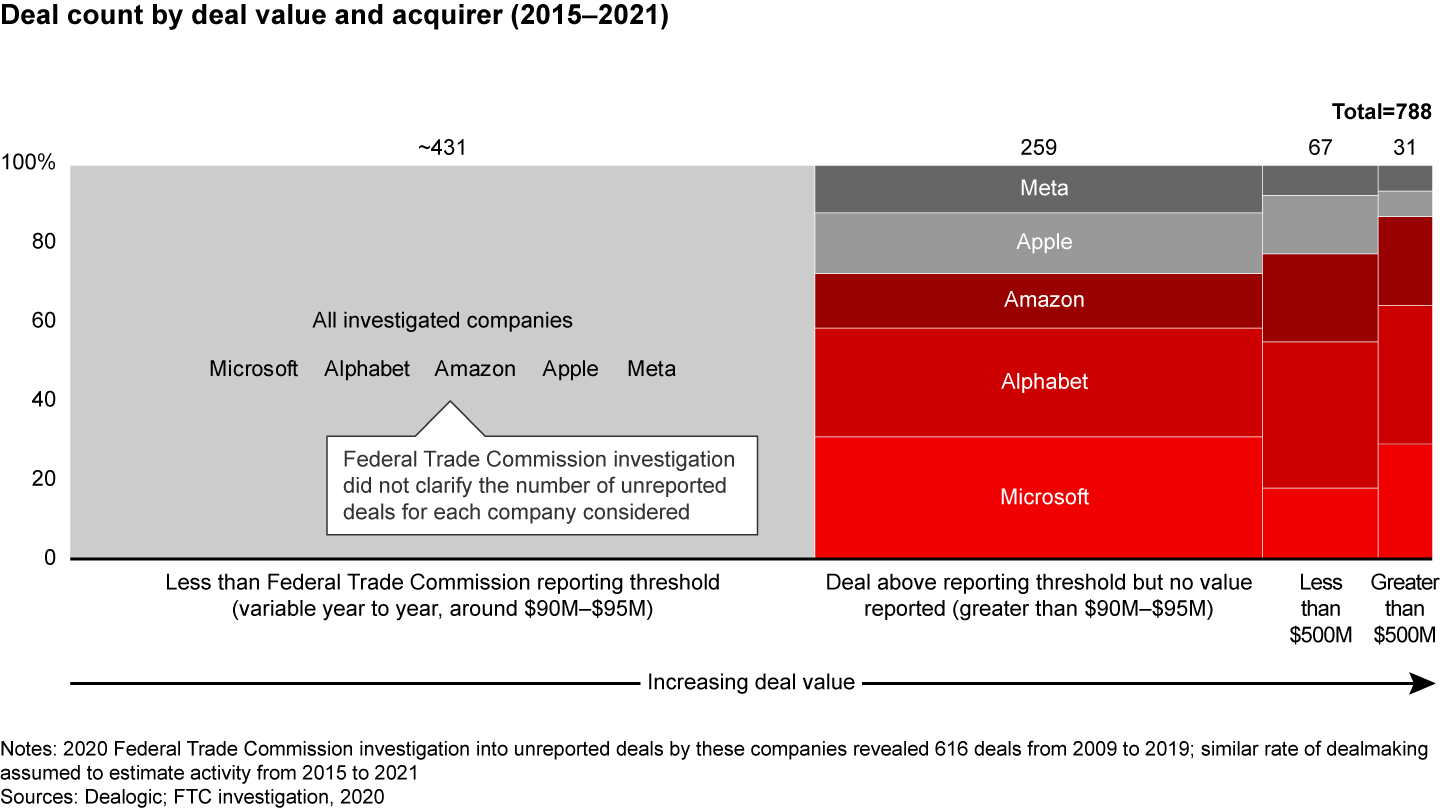
      Big tech companies have predicated their M&A strategy on large numbers of small deals
      Big tech companies have predicated their M&A strategy on large numbers of small deals
      Big tech companies have predicated their M&A strategy on large numbers of small deals

      While these deals come with the promise of access to the talent and cutting-edge innovation needed to help acquirers grow and lead the next wave of industry transitions, delivering on that promise isn’t always a sure thing, especially as some tech companies are acquiring more than 30 companies a year. Too often, the aggregate focus required to address this volume of deals causes great possibilities to give way to a distracted base business, cultural tensions, and talent attrition.

      Big tech companies now face the dual challenge of realizing the deal value in any given capability deal while also building a repeatable, high-velocity integration competency to manage the steady flow of deals coming in at a rate of one every two weeks. Some companies are surfacing as leaders in this high-stakes challenge of successfully integrating a steady flow of capability acquisitions.

      These companies are learning the factors that contribute to deal success. A clear deal thesis and integration thesis grounded in detailed customer and product diligence and aligned with the overall strategy, maniacal focus on retaining all critical talent (not just top leaders), and building a repeatable model with granular tracking of performance to both source and integrate capability deals stand out as priorities for companies ramping up this important type of organic growth.

      Deal thesis aligned to strategy and grounded in deep diligence

      At the most fundamental level, a company’s strategy for acquiring capability targets must be tightly linked to its overall strategy. Amid the industry’s relentless disruption, those strategies are constantly changing. So, M&A objectives and priorities need to shift accordingly, requiring frequent (often monthly) reviews of segment and target priorities.

      Deep customer diligence and product diligence then position acquirers to understand the value available and how it can add to the existing business. Customer diligence requires rigorous primary research, something that few companies do well. For product diligence, some companies become a customer of the target (and potentially its competitors) to work out the product glitches internally before completing a deal. Acquirers also clearly understand their parenting advantage for a particular capability deal. They entice a target by articulating the benefits of joining forces, such as access to the parent’s go-to-market capabilities or its technical talent.

      These deep insights from diligence then lend to another key requisite when integrating capability deals—namely, keeping a keen eye on revenue synergies. Tech acquirers articulate at a granular level where the synergies will come from and set aside funds to invest behind them. They focus on quick wins, often in areas in which the acquirer can help the target accelerate its growth ambitions, thus demonstrating why the combination is good for all (see “Bringing Science to the Art of Revenue Synergies”). These companies also keep a tight, highly agile connection between the acquired business and the strategy team to make sure that both are moving in tandem.

      Acquirers clearly understand their parenting advantage for a particular capability deal.

      Retaining and growing all critical talent

      The top priority in a capability deal is retaining the individuals and teams that underpin the desired competency. This is no easy feat, and more than 75% of the tech M&A practitioners we surveyed felt that retention is now more difficult than it was three years ago—and it was more commonly cited as difficult in tech than in other industries.

      The biggest retention risks mentioned by tech respondents include employees’ uncertainty about their role in the future organization and attractive alternatives in the labor market. As a result, it no longer suffices to focus on cash retention bonuses to ensure that critical talent stays. That’s why some acquirers structure capability deals differently than scale deals, with the goal of retaining the top people. For example, earn-outs, stock-for-stock acquisitions, or other methods to keep senior executives in place typically are more important for deals in tech than in other industries.

      It no longer suffices to focus on cash retention bonuses to ensure that critical talent stays.

      Another critical element for tech capability deal acquirers is that they invest heavily up front to define an operating model that strikes a balance, giving it autonomy to continue to innovate, grow the base business, and retain talent while also defining the required connection points to propagate the capability more broadly.

      Furthermore, the best tech acquirers don’t focus only on top leadership retention; they identify the frontline talent critical to creating the capability purchased, and they ensure that talent is appropriately motivated, rewarded, and ultimately retained. They go beyond simply retaining talent by also finding ways to grow the target’s own talent base. They allow the target to maintain its talent acquisition policies and processes in a way that would build out the talent pool even faster than it could on its own. Finally, they embrace the target’s start-up mentality. Its product cycles are likely to be faster and its tolerance for failure higher, so accepting the new culture is a way to avoid stifling innovation (see “Reimagining Talent in M&A”).

      Building a repeatable integration chassis

      When you manage this volume of acquisitions annually, there is no room for wasted energy, and tech hyper acquirers have learned to create a repeatable integration chassis that builds on lessons learned and drives continuous improvement. This starts with sourcing capability deals. The best companies keep a regular pulse on the market by comprehensively scanning relevant segments for emerging, venture-backed players; monitoring assets; and building a future acquisition pipeline.

      Their steady volume of deals also creates the need to act quickly and efficiently in each integration. The best integrators stay focused on the critical few decisions that truly unlock value, and they disproportionately invest in those areas. Again, talent retention is paramount. Some companies also define repeatable processes, systems connections, and talent models that allow them to efficiently adapt their integration approach for any given deal. They build integration bench strength in the form of a team of resources across functions (often residing within the functions) that are trained in integrating different types of deals.

      Finally, the tech acquirers that make the most of their small company acquisitions develop an effective feedback mechanism, with regular deal reviews aimed at understanding what’s working (and what’s not working) and transferring such learnings into subsequent acquisitions.

      The best integrators stay focused on the critical few decisions that truly unlock value, and they disproportionately invest in those areas. 

      Doing this well with an aim toward continuous improvement requires granular tracking and codification of synergies (targets and realized), implementation timelines, and investments to use as benchmarks for subsequent deals.

      Indeed, learning and continuously refining the integration approach should be the goal of any hyper acquirer hoping to fuel its growth and lead industry transitions. As in so many other areas, the tech industry is one lap ahead in this trend. That’s why many companies across industries are now tracking how the successful tech acquirers build muscles for high-velocity integration and learning from the best.

      Read the Next Chapter

      Telecommunications M&A: A Year of Resilience and Possibilities

      Read our 2022 M&A Report

      Download the PDF Explore the report
      著者
      • Headshot of Adam Haller
        Adam Haller
        パートナー, San Francisco
      • Headshot of Chris Johnson
        Chris Johnson
        Alumni, San Francisco
      関連業種
      • テクノロジー
      関連するコンサルティングサービス
      • 企業買収、合併(M&A)
      M&A Report
      Software M&A

      The good news: Most deal best practices still apply to AI acquisitions.

      詳細
      M&A Report
      Takeaways from Bain's 2026 M&A Report

      In this webinar recording, Bain's Suzanne Kumar, Dale Stafford, and Kai Grass share key trends shaping the deal landscape.

      詳細
      テクノロジー
      Why SaaS Stocks Have Dropped—and What It Signals for Software’s Next Chapter

      A sharp reset in valuations reflects AI-driven disruption, slowing retention, and a growing divide between incumbents and future winners.

      詳細
      企業買収、合併(M&A)
      What Agency Consolidation Means for CMOs

      As agency holding companies get bigger and deeper, CMOs must rethink ownership, integration, and how to stay in control.

      詳細
      M&A Report
      Defense M&A

      Bold moves will determine the winners as a continent rearms.

      詳細

      Overview

      • Letter from the M&A Team: Beneath the M&A Headlines

      • State of the M&A Market

      • Bain’s Bedrock Beliefs on How to Create Value from M&A

      Hot Topics

      • Reimagining Talent in M&A

      • Bringing Science to the Art of Revenue Synergies

      • The ESG Imperative in M&A

      • Delivering Results in Joint Ventures and Alliances Requires a New Playbook

      • Harnessing the True Value of Corporate Venture Capital

      Industry Views

      • Aerospace and Defense M&A

      • Asset Management M&A

      • Automotive and Mobility M&A

      • Banking M&A

      • Consumer Products M&A

      • Diversified Industrials M&A

      • Energy and Natural Resources M&A

      • Healthcare M&A

      • Insurance M&A

      • Media M&A

      • Payments M&A

      • Retail M&A

      • Technology M&A

      • Telecommunications M&A

      • Wealth Management M&A

      Regional Perspectives

      • Brazil M&A

      • China M&A

      • India M&A

      • Japan M&A

      First published in 2月 2022
      Tags
      • M&A Report
      • テクノロジー
      • 企業買収、合併(M&A)

      クライアント支援事例

      サステイナビリティ、社会貢献 Can Microchips Turbocharge Sustainability Improvement?

      ケーススタディを見る

      顧客戦略、マーケティング Increased sales productivity frees selling time and saves millions

      ケーススタディを見る

      業績改善 Aggressively growing an IT service provider with a high-performance culture

      ケーススタディを見る

      お気軽にご連絡下さい

      私達は、グローバルに活躍する経営者が抱える最重要経営課題に対して、厳しい競争環境の中でも成長し続け、「結果」を出すために支援しています。

      ベインの知見。競争が激化するグローバルビジネス環境で、日々直面するであろう問題について論じている知見を毎月お届けします。

      *プライバシーポリシーの内容を確認し、合意しました。

      プライバシーポリシーをご確認頂き、合意頂けますようお願い致します。
      Bain & Company
      お問い合わせ Sustainability Accessibility Terms of use Privacy Cookie Policy Sitemap Log In

      © 1996-2026 Bain & Company, Inc.

      お問い合わせ

      How can we help you?

      • ビジネスについて
      • プレス報道について
      • 採用について
      全てのオフィス