
Skip to Content
  • オフィス

    オフィス

    北米・南米
    • Atlanta
    • Austin
    • Bogota
    • Boston
    • Buenos Aires
    • Chicago
    • Dallas
    • Denver
    • Houston
    • Los Angeles
    • Mexico City
    • Minneapolis
    • Monterrey
    • Montreal
    • New York
    • Rio de Janeiro
    • San Francisco
    • Santiago
    • São Paulo
    • Seattle
    • Silicon Valley
    • Toronto
    • Washington, DC
    ヨーロッパ・中東・アフリカ
    • Amsterdam
    • Athens
    • Berlin
    • Brussels
    • Copenhagen
    • Doha
    • Dubai
    • Dusseldorf
    • Frankfurt
    • Helsinki
    • Istanbul
    • Johannesburg
    • Kyiv
    • Lisbon
    • London
    • Madrid
    • Milan
    • Munich
    • Oslo
    • Paris
    • Riyadh
    • Rome
    • Stockholm
    • Vienna
    • Warsaw
    • Zurich
    アジア・オーストラリア
    • Bangkok
    • Beijing
    • Bengaluru
    • Brisbane
    • Ho Chi Minh City
    • Hong Kong
    • Jakarta
    • Kuala Lumpur
    • Manila
    • Melbourne
    • Mumbai
    • New Delhi
    • Perth
    • Shanghai
    • Singapore
    • Sydney
    • Tokyo
    全てのオフィス
  • アルムナイ
  • メディア
  • お問い合わせ
  • 東京オフィス
  • Japan | 日本語

    地域と言語を選択

    グローバル
    • Global (English)
    北米・南米
    • Brazil (Português)
    • Argentina (Español)
    • Canada (Français)
    • Chile (Español)
    • Colombia (Español)
    ヨーロッパ・中東・アフリカ
    • France (Français)
    • DACH Region (Deutsch)
    • Italy (Italiano)
    • Spain (Español)
    • Greece (Elliniká)
    アジア・オーストラリア
    • China (中文版)
    • Korea (한국어)
    • Japan (日本語)
  • Saved items (0)
    Saved items (0)

    You have no saved items.

    後で閲読、共有できるようにするためにブックマークしてください

    Explore Bain Insights
  • 業界別プラクティス
    メインメニュー

    業界別プラクティス

    • 航空宇宙、防衛、政府関連
    • 農業
    • 化学製品
    • インフラ、建設
    • 消費財
    • 金融サービス
    • ヘルスケア
    • 産業機械、設備
    • メディア、エンターテインメント
    • 金属
    • 採掘・鉱業
    • 石油、ガス
    • 紙、パッケージ
    • プライベートエクイティ
    • 公共、社会セクター
    • 小売
    • テクノロジー
    • 通信
    • 交通
    • 観光産業
    • 公益事業、再生可能エネルギー
  • 機能別プラクティス
    メインメニュー

    機能別プラクティス

    • カスタマー・エクスペリエンス
    • サステイナビリティ、 社会貢献
    • Innovation
    • 企業買収、合併 (M&A)
    • オペレーション
    • 組織
    • プライベートエクイティ
    • マーケティング・営業
    • 戦略
    • アドバンスド・アナリティクス
    • Technology
    • フルポテンシャル・トランスフォーメーション
  • Digital
  • 知見/レポート
  • ベイン・アンド・カンパニーについて
    メインメニュー

    ベイン・アンド・カンパニーについて

    • ベインの信条
    • 活動内容
    • 社員とリーダーシップ
    • プレス・メディア情報
    • クライアントの結果
    • 受賞歴
    • パートナーシップを結んでいる団体
    Further: Our global responsibility
    • ダイバーシティ
    • 社会貢献
    • サステイナビリティへの取り組み
    • 世界経済フォーラム(WEF)
    Learn more about Further
  • キャリア
    メインメニュー

    キャリア

    • ベインで働く
      キャリア
      ベインで働く
      • Find Your Place
      • ベインで活躍する機会
      • ベインのチーム体制
      • 学生向けページ
      • インターンシップ
      • 採用イベント
    • ベインでの体験
      キャリア
      ベインでの体験
      • Blog: Inside Bain
      • キャリアストーリー
      • 社員紹介
      • Where We Work
      • 成長を後押しするサポート体制
      • アフィニティ・グループ
      • 福利厚生
    • Impact Stories
    • 採用情報
      キャリア
      採用情報
      • 採用プロセス
      • 面接内容
    FIND JOBS
  • オフィス
    メインメニュー

    オフィス

    • 北米・南米
      オフィス
      北米・南米
      • Atlanta
      • Austin
      • Bogota
      • Boston
      • Buenos Aires
      • Chicago
      • Dallas
      • Denver
      • Houston
      • Los Angeles
      • Mexico City
      • Minneapolis
      • Monterrey
      • Montreal
      • New York
      • Rio de Janeiro
      • San Francisco
      • Santiago
      • São Paulo
      • Seattle
      • Silicon Valley
      • Toronto
      • Washington, DC
    • ヨーロッパ・中東・アフリカ
      オフィス
      ヨーロッパ・中東・アフリカ
      • Amsterdam
      • Athens
      • Berlin
      • Brussels
      • Copenhagen
      • Doha
      • Dubai
      • Dusseldorf
      • Frankfurt
      • Helsinki
      • Istanbul
      • Johannesburg
      • Kyiv
      • Lisbon
      • London
      • Madrid
      • Milan
      • Munich
      • Oslo
      • Paris
      • Riyadh
      • Rome
      • Stockholm
      • Vienna
      • Warsaw
      • Zurich
    • アジア・オーストラリア
      オフィス
      アジア・オーストラリア
      • Bangkok
      • Beijing
      • Bengaluru
      • Brisbane
      • Ho Chi Minh City
      • Hong Kong
      • Jakarta
      • Kuala Lumpur
      • Manila
      • Melbourne
      • Mumbai
      • New Delhi
      • Perth
      • Shanghai
      • Singapore
      • Sydney
      • Tokyo
    全てのオフィス
  • アルムナイ
  • メディア
  • お問い合わせ
  • 東京オフィス
  • Japan | 日本語
    メインメニュー

    地域と言語を選択

    • グローバル
      地域と言語を選択
      グローバル
      • Global (English)
    • 北米・南米
      地域と言語を選択
      北米・南米
      • Brazil (Português)
      • Argentina (Español)
      • Canada (Français)
      • Chile (Español)
      • Colombia (Español)
    • ヨーロッパ・中東・アフリカ
      地域と言語を選択
      ヨーロッパ・中東・アフリカ
      • France (Français)
      • DACH Region (Deutsch)
      • Italy (Italiano)
      • Spain (Español)
      • Greece (Elliniká)
    • アジア・オーストラリア
      地域と言語を選択
      アジア・オーストラリア
      • China (中文版)
      • Korea (한국어)
      • Japan (日本語)
  • Saved items  (0)
    メインメニュー
    Saved items (0)

    You have no saved items.

    後で閲読、共有できるようにするためにブックマークしてください

    Explore Bain Insights
  • 業界別プラクティス
    • 業界別プラクティス

      • 航空宇宙、防衛、政府関連
      • 農業
      • 化学製品
      • インフラ、建設
      • 消費財
      • 金融サービス
      • ヘルスケア
      • 産業機械、設備
      • メディア、エンターテインメント
      • 金属
      • 採掘・鉱業
      • 石油、ガス
      • 紙、パッケージ
      • プライベートエクイティ
      • 公共、社会セクター
      • 小売
      • テクノロジー
      • 通信
      • 交通
      • 観光産業
      • 公益事業、再生可能エネルギー
  • 機能別プラクティス
    • 機能別プラクティス

      • カスタマー・エクスペリエンス
      • サステイナビリティ、 社会貢献
      • Innovation
      • 企業買収、合併 (M&A)
      • オペレーション
      • 組織
      • プライベートエクイティ
      • マーケティング・営業
      • 戦略
      • アドバンスド・アナリティクス
      • Technology
      • フルポテンシャル・トランスフォーメーション
  • Digital
  • 知見/レポート
  • ベイン・アンド・カンパニーについて
    • ベイン・アンド・カンパニーについて

      • ベインの信条
      • 活動内容
      • 社員とリーダーシップ
      • プレス・メディア情報
      • クライアントの結果
      • 受賞歴
      • パートナーシップを結んでいる団体
      Further: Our global responsibility
      • ダイバーシティ
      • 社会貢献
      • サステイナビリティへの取り組み
      • 世界経済フォーラム(WEF)
      Learn more about Further
  • キャリア
    人気検索キーワード
    • デジタル
    • 戦略
    前回の検索
      最近訪れたページ

      Content added to saved items

      Saved items (0)

      Removed from saved items

      Saved items (0)

      M&A Report

      M&A in Times of Turbulence: Lessons from the Last Recession

      M&A in Times of Turbulence: Lessons from the Last Recession

      The opportunity cost is huge for companies that stay on the sidelines.

      著者:Andrew Grosshans, David Harding, Suzanne Kumar, and Joerg Ohmstedt

      • min read
      }

      レポート

      M&A in Times of Turbulence: Lessons from the Last Recession
      en
      At a Glance
      • Many companies are wary about acquiring during this downturn, but 2008–2009’s active acquirers outperformed their less-active competitors over the long haul.
      • More specifically, they achieved a greater compounded average annual total shareholder return than that of their less-active competitors.
      • Being an active acquirer is not an end in itself.
      • The most important objective is to execute the strategy—be it strengthening the core and increasing scale or creating strategic options via a scope deal.

      This article is part of Bain's 2023 M&A Report.

      Explore the report

      Bain’s bedrock beliefs on how to create value from M&A rest on fundamental truths that have stood the test of time: If you want to be successful at M&A, develop a repeatable model. Do it often, learn from your mistakes, and make it a material part of your business. Done right, it will generate higher shareholder returns.

      This year, we look back at the global financial crisis of 2008–2009 and ask what lessons can be learned from different M&A behavior during times of turbulence.

      Stay in the game through tough times to come out ahead

      We assessed the returns to shareholders of different M&A strategies employed by a universe of 2,845 publicly traded companies from around the world for the period between 2007 and 2017.

      In 2007, worldwide deals surpassed 40,000 for the first time; their cumulative value hit $4.6 trillion, 40% above the dotcom peak in 2000. It seemed like the M&A party might never stop. But when the global financial crisis brought the boom to an abrupt end and most economies went into recession sometime during 2008–2009, the hangover set in. Many business leaders grew leery of any kind of dealmaking—deal volume dropped by 14% from 2007 to 2009.

      The reaction was understandable, but the opportunity cost for many was huge. Companies that were active in M&A during turbulent times, the data shows, consistently outperformed those that stayed away from deals. Companies that acquired during the last economic downturn achieved an average annual total shareholder return (TSR) of 5.9% compared with 4.7% for those that did not (see Figure 1).

      Figure 1
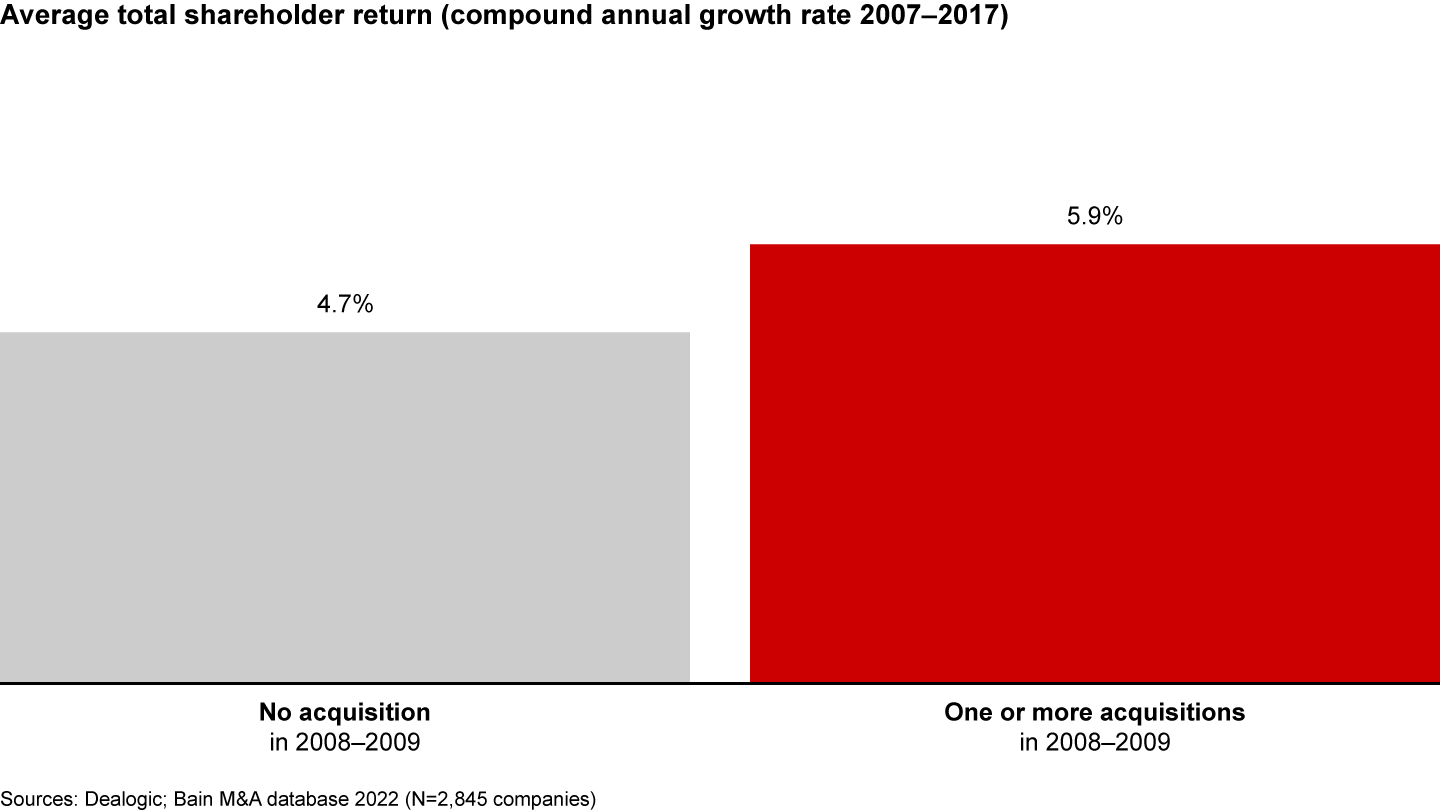
      Companies that acquired during the last economic downturn have tended to outperform significantly over the long term
      Companies that acquired during the last economic downturn have tended to outperform significantly over the long term
      Companies that acquired during the last economic downturn have tended to outperform significantly over the long term

      Of course, being an active acquirer is not an end in itself. The most important objective of M&A is to help execute a company's strategy—be it strengthening the core business and increasing scale or creating strategic options via a scope deal. During a recession, M&A also serves another purpose: creating strategic options. The post-recession landscape will be very different, and no one really knows how supply chains may change, what the financial system will look like, or to what degree consumers will have changed their spending patterns.

      Being an active acquirer is not an end in itself.

      Several industry-defining deals were made throughout the last economic recession. In 2008, BASF acquired Ciba for $5.4 billion in what accounted for the largest acquisition in BASF’s company history until that point, with the aim to fully integrate Ciba into BASF and a focus on realizing cost synergies initially targeted at 10% of sales (and subsequently raised). In 2009, Stanley Works—now Stanley Black & Decker—leveraged its strong M&A capability to significantly grow share by acquiring the larger Black & Decker. The merger was well-timed as the construction cycle exposure made Black & Decker vulnerable in 2009, leading to a 22% drop in revenue and a 41% drop in earnings before interest and taxes, which, in turn, lowered its valuation. Stanley was able to leverage a proven integration capability that it had built from an aggressive M&A program started in 2002 with the acquisition of 33 companies over the next several years.

      Some companies used their resources to expand their strategic options through acquisitions despite the downturn. For example, Pfizer's agreement to acquire Wyeth for $68.4 billion in early 2009 bought some time for Pfizer as patents were about to expire on several of its leading medicines, and it gave Pfizer an opportunity to diversify its pharmaceuticals portfolio and expand its pipeline (with a particular focus on biopharmaceuticals and vaccines). In the second half of 2009, Disney acquired superhero stable Marvel for $4.2 billion, with the aim of putting these characters to work in its television shows, video games, theme parks, and movies.

      Several industry-defining deals were made throughout the last economic recession.

      Should companies adjust their M&A behavior during times of turbulence?

      We have outlined the returns of different types of acquirers regarding their prerecession and recession-era M&A activity. Those companies that were active acquirers before the recession performed best by staying active—their average annual TSR was 6.1% compared with 3.8% for those that decided to move to the sidelines (see Figure 2, left). For those companies that were inactive before the recession, a change in their M&A behavior toward becoming an active acquirer resulted in an annual TSR of 5.5% compared with 5.0% for those that remained inactive (see Figure 2, right).

      Figure 2
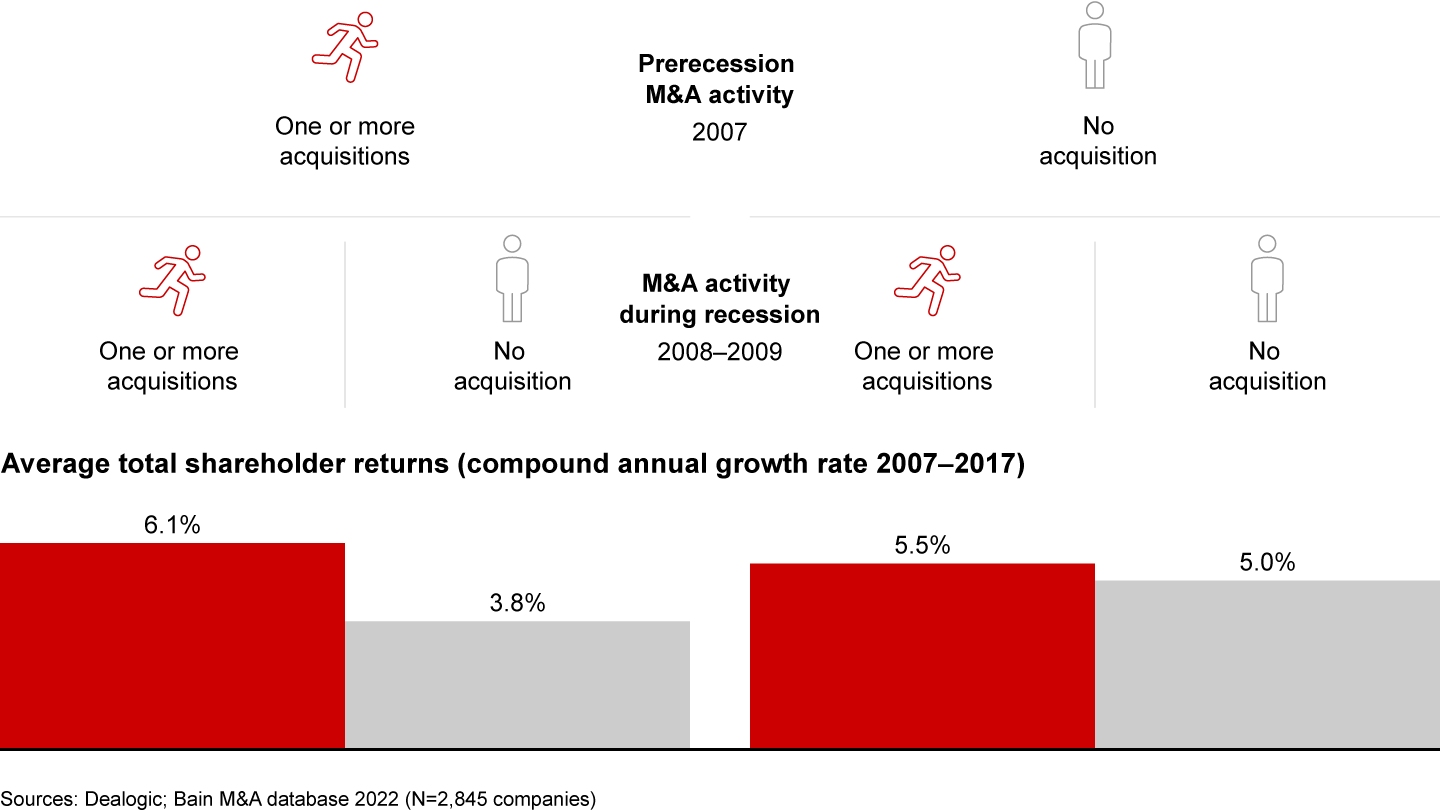
      Active acquirers outperformed bystanders during the last economic downturn
      Active acquirers outperformed bystanders during the last economic downturn
      Active acquirers outperformed bystanders during the last economic downturn

      What can be learned from the most successful acquirers?

      The core research underlying our belief in the concept of repeatable M&A (replicated multiple times over the past 20 years) shows that frequency (how many deals you do) and materiality (how much of it you do) define a lot of what differentiates M&A performance (see Figure 3). It does not take a lot of deals to become a frequent acquirer, about one per year. To be a material acquirer does require heft: 75% or more of your market cap from acquired companies over a decade. Those companies that are both frequent and material acquirers over a 10-year period—we call them “mountain climbers” (see Figure 3, top right)—create the greatest TSRs.

      Figure 3
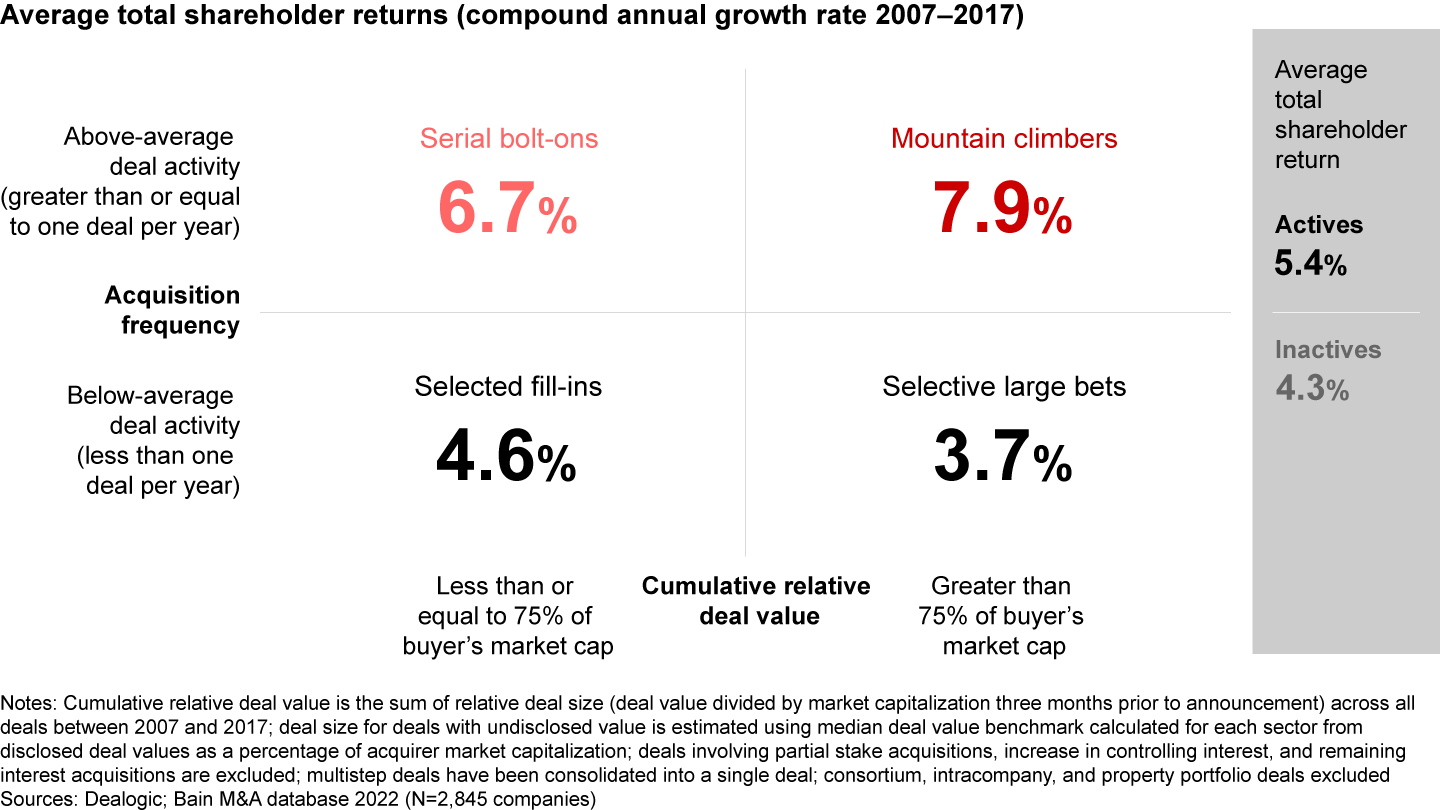
      Companies that do M&A frequently and at scale outperform
      Companies that do M&A frequently and at scale outperform
      Companies that do M&A frequently and at scale outperform

      Consistent M&A activity over economic cycles contributes to higher TSR. This finding holds up year after year, across industries. Deal success and deal failure is more a matter of cumulative experience and capability in making a deal and less a function of standalone deal circumstances.

      A big learning from our study comes from the failure of companies that are infrequent acquirers but that undertake large deals relative to their market capitalization—we refer to such companies as “selective large bets” (see Figure 3, bottom right). While we outlined above why we are encouraging M&A during turbulent times, companies that have not been doing deals to build their M&A muscle should be more cautious when the opportunity of a lifetime comes along. Among all companies studied, selective large bets are the worst performers over time as their limited acquisition experience, combined with investment in a large deal, usually results in poor deal outcomes. They generated only 3.7% in annual TSR from 2007 to 2017.

      企業デューディリジェンス

      包括的な分析により、すべてのディールから最大限の価値を創出します。

      Similar to most things in life, you get better at what you do when you do it repeatedly. Companies that acquire frequently, “serial bolt-ons” (see Figure 3, top left), tend to outperform the average company on TSR (6.7% annual).

      Mountain climbers, those companies that not only acquire frequently but that also develop the capabilities to undertake larger deals, do even better. Their 7.9% annual TSR leads the class. Investors have come to recognize this.

      With the drop of M&A activity in 2022 and all the current turbulence, some executives will no doubt sit on the sidelines thinking it is safer not to play. Experience suggests that their performance will suffer accordingly. The winners will be those that stay in the game—and learn how to play it well.

      Read the Next Chapter

      When Buying (vs. Building) Is the Right Move for Engine 2

      Read our 2023 M&A Report

      Download the PDF Explore the report
      著者
      • Headshot of Andrew Grosshans
        Andrew Grosshans
        Alumni, Los Angeles
      • Headshot of David Harding
        David Harding
        Advisory Partner, Boston
      • Headshot of Suzanne Kumar
        Suzanne Kumar
        Practice Executive Vice President, New York
      • Headshot of Joerg Ohmstedt
        Joerg Ohmstedt
        アソシエイト パートナー, Berlin
      関連するコンサルティングサービス
      • 企業買収、合併(M&A)
      M&A Report
      Defense M&A

      Bold moves will determine the winners as a continent rearms.

      詳細
      企業買収、合併(M&A)
      What Agency Consolidation Means for CMOs

      As agency holding companies get bigger and deeper, CMOs must rethink ownership, integration, and how to stay in control.

      詳細
      M&A Report
      Building Products M&A

      Why more companies are acquiring for scope.

      詳細
      M&A Report
      Mining M&A

      The next frontier isn’t about avoiding failure; it’s about mastering repeatable success.

      詳細
      M&A Report
      Oil & Gas M&A

      Why some companies are winning by a wider margin.

      詳細

      Overview

      • Looking Back at M&A in 2022

      • Looking Ahead to M&A in 2023

      Hot Topics

      • M&A in Times of Turbulence: Lessons from the Last Recession

      • When Buying (vs. Building) Is the Right Move for Engine 2

      • Tougher Times: Putting the Diligence Back in Due Diligence

      • How to Avoid the Fault Lines Sending Tremors through Cultural Integration in M&A

      Industry Views

      • Aerospace and Defense M&A

      • Automotive and Mobility M&A

      • Banking M&A

      • Consumer Goods M&A

      • Diversified Industrials M&A

      • Energy and Natural Resources M&A

      • Healthcare and Life Sciences M&A

      • Insurance M&A

      • Media and Entertainment M&A

      • Payments M&A

      • Retail M&A

      • Technology M&A

      • Telecommunications M&A

      • Wealth and Asset Management M&A

      Regional Perspectives

      • Brazil M&A

      • India M&A

      • Japan M&A

      • Middle East M&A

      First published in 1月 2023
      Tags
      • M&A Report
      • 企業買収、合併(M&A)

      クライアント支援事例

      企業買収、合併(M&A) Post-merger cultural issues jeopardize a deal

      ケーススタディを見る

      企業買収、合併(M&A) A bank and a grocer build a fruitful alliance

      ケーススタディを見る

      企業買収、合併(M&A) Forecast backs a bet on shale services

      ケーススタディを見る

      お気軽にご連絡下さい

      私達は、グローバルに活躍する経営者が抱える最重要経営課題に対して、厳しい競争環境の中でも成長し続け、「結果」を出すために支援しています。

      ベインの知見。競争が激化するグローバルビジネス環境で、日々直面するであろう問題について論じている知見を毎月お届けします。

      *プライバシーポリシーの内容を確認し、合意しました。

      プライバシーポリシーをご確認頂き、合意頂けますようお願い致します。
      Bain & Company
      お問い合わせ Sustainability Accessibility Terms of use Privacy Cookie Policy Sitemap Log In

      © 1996-2026 Bain & Company, Inc.

      お問い合わせ

      How can we help you?

      • ビジネスについて
      • プレス報道について
      • 採用について
      全てのオフィス