

論説

Misconduct by some salesforces at retail banks and the need to respond to new regulatory requirements have created a challenging landscape. Whether banks are reacting to specific changes in regulation or anticipating new rules, they have little choice now but to change the way they interact with their customers and the way they motivate and reward their own sales teams.
Amid all the noise, however, lies a major opportunity, because the most powerful force driving banks to overhaul the way they engage with customers isn’t regulation, it’s the rise of digital competition. With myriad digital options, customers no longer have to walk into their bank branch to do a transaction or purchase a product. In fact, they don’t have to use their bank—or any bank—at all.
As banks face increased competition from digital rivals, they must also contend with slowing growth in the overall consumption of retail banking services, especially in developed markets. This confluence of forces—namely, rising digital competition and sluggish overall demand—follows two decades during which banks stressed sales-driven growth as a recipe for boosting their top lines. That emphasis led to the bad practices to which regulators have responded. Banks now need a new approach—one that focuses less on pushing products and more on attracting and retaining customers.
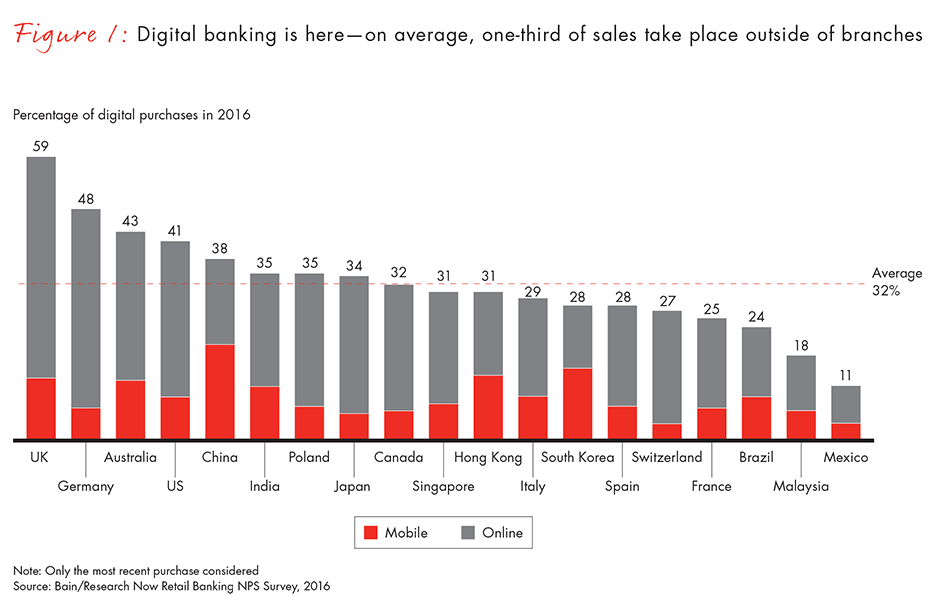
As banks shift toward more digital interactions with their customers, they have an opening—if not an imperative—to change the role of the branch. Sales of banking products and services through digital channels are a growing reality. In the UK, retail banks now sell 59% of their products digitally (see Figure 1). With customers making more of their purchases online, some leading banks are transforming their branches into something more than just venues for executing transactions. Branches are becoming centers that provide personalized financial advice, build relationships, solve problems and, perhaps paradoxically, help customers make the transition to digital.
Indeed, as banks and their customers become more digitally oriented, employees—in both branches and contact centers—are taking on a new significance. Humans, using their empathy and their analytical skills, can connect with customers in ways that robots and algorithms can’t—at least for the next five or ten years. Frontline employees, once thought of primarily as salespeople peddling products, are becoming counselors who dispense advice and explain options. This new approach requires a large-scale transformation in the way banks hire, train, supervise, reward, promote and, when necessary, discipline their employees.
Warning signs
Banks can take practical steps now to begin the transition from a selling culture to an advisory one. Bank leaders can start by assessing their current selling practices. They should be exceptionally attuned to approaches that put them at odds with the needs of their customers during a period when they should be working overtime to earn their trust.
Bank executives can start with some self-examination. They can ask themselves a simple but powerful question: Would they be comfortable seeing the emails regional managers send to their branch staff published on the front page of the Wall Street Journal or Financial Times?
When top management puts too much emphasis on achieving revenue goals, those directives can induce bad behavior. Setting sales targets for specific products can motivate employees to push services that customers don’t want, don’t need and can’t afford.
Banks should be wary of tying too much of an employee’s compensation directly to sales volume at the expense of customer satisfaction. Another risky practice: contests that reward individuals or teams of employees with prizes for hitting or exceeding sales goals. Such incentives can encourage overselling, particularly as a promotional cycle reaches its conclusion—for example, at the end of the quarter.
When sales targets are overly ambitious, when the pressure from management to achieve them is too high and when the rewards for reaching them are too attractive, employees can be tempted to resort to unsound work-arounds, even to the point of opening accounts without a customer’s consent.
Banks can also take a close look at the way they design, package and price their products. Are they misleading and confusing their customers?
Bundling, the grouping together of multiple products for one overall price, leaves customers in the dark about exactly what they’re buying and how much they’re paying for it. Consumers buying bundles can find themselves saddled with unexplained and unexpected fees and rate hikes. Banks often make it hard for customers to disaggregate a bundle. Rather than giving a customer a chance to opt in on a particular product such as overdraft insurance, the bank puts the onus on the customer to opt out.
The best source of what’s wrong with a bank’s selling practices can be the customers themselves. Banks tend to view customer complaints in isolation, however, as a single problem that needs to be resolved. Many banks lack adequate systems for dealing with an aggregation of grievances and for making sure top management knows about them and takes steps to address them.
Building a customer-centric bank
Banks shouldn’t wait for regulators to knock on their door before they review their corporate culture and improve their sales practices. Leadership teams have a strategic imperative to change their selling practices and place customers at the heart of their business. Many retail banks have long claimed to put their customers first, but the shift to digital puts those slogans to the test.
First, banks can rethink the role of the branch, transforming it from a place where customers make transactions and buy products to a hub where highly trained employees provide advice and education to clients, resolve issues, and build relationships. At the same time, upgrades to call centers can turn them into contact centers, where informed associates give customers the kind of guidance they might come to expect at a branch.
Branches and contact centers can become essential components of a system that delivers great experiences to customers. At a time when customers have access to multiple channels (including digital), branch staff should be recognized for the role they can play in contributing to a sales process that may—and likely will—start or end outside the branch.
As customers perform more of the steps involved in buying a banking product online—including research, comparison shopping and execution—they will turn to branches and contact centers for guidance in buying more complex products such as mortgages. With such complexity, the chances for overselling and mis-selling—that is, misleading customers about the costs, benefits and risks of a product—rise. These challenges can be mitigated by employee training and supervision.
At the same time, banks can make an effort to simplify their products and make sure customers understand the pricing and the risks. Transparency sends a powerful message to both the organization and its customers. But it’s only one step. Banks also need systems to measure customer satisfaction regularly and act when scores are low.
Creating a superior customer experience is an everyday task. Banks shouldn’t have to wait for customers to tell them that something is going wrong. Nonetheless, when customers complain about a product or service, those grievances should be taken seriously. Every attempt should be made to resolve the problem, including a follow-up call to see if the customer is satisfied with the solution. Top management regularly should be informed about complaints and systematic failures in customer experience, the efforts to get to the root of the problems, and the steps taken to fix them.
To make this customer-centric approach work, banks can change the way they motivate and reward employees. Eliminating product targets and volume-based incentives is only a start. Several large UK banks have overhauled their compensation plans in recent years. These moves have come in response to several major regulatory actions. In 2011, for example, UK authorities clamped down on banks for mis-selling a product known as payment protection insurance, which is essentially a policy that pays off a loan if a borrower falls ill, loses a job or dies.
Following the UK regulatory action, one large bank abolished volume sales targets and introduced a balanced scorecard, which tracks how well teams of employees satisfy customers, how many interactions they have with clients and how many customers they have helped to migrate to online banking. Another large UK bank emphasized assessing a Net Promoter Score®, which measures customer loyalty, in employee evaluations.
When developing compensation plans, banks can ask themselves if the incentives they’ve created enable the sales staff to recommend the right solution for customers based on their training and experience, with no bias for a particular product. One relatively simple step can be to reduce the portion of an employee’s variable compensation tied to sales volume. The goal should be to create a culture in which employees are motivated to promote an excellent customer experience every time.
Even with reimagined branches and contact centers, simplified products and pricing, and new approaches to compensation, banks will still face the risk that some employees will not act in the customer’s best interest. Those issues can be addressed by training, testing and managing performance so that employees always do right by the customer. Make sure all employees understand the code of conduct—and then enforce it.
Employees should be trained to focus on customers’ needs, and they should know that their managers are monitoring their interactions with clients. Conducting regular risk assessments and tracking sales activity and usage trends help management spot warning signs. A spike in the sales of a particular product could be an indication of overselling or mis-selling. Banks should also consider incentives to encourage, protect and reward whistle-blowers.
As bank customers migrate to online and mobile platforms, banks can also use increasingly sophisticated digital tools to help manage their interactions with those customers. Advisers based in branches or contact centers can tap customer relationship management systems to develop recommendations for products that meet their clients’ true needs. In an increasingly digital world, human employees—properly trained, monitored, evaluated, rewarded and supported by the right technology—will play a critical role.
Retail banks face increasing pressure from regulators, new competition from more nimble rivals, slowing growth in developed markets and the rapid evolution of all things digital. In this environment, they have an opportunity to redefine themselves as service-oriented organizations that truly know their customers and put their needs first. If banks want to stay relevant in this changing landscape, they should use this moment to adjust to the new realities of retail banking.
Richard Fleming and Joe Fielding are partners with Bain & Company in New York. The authors want to acknowledge the contribution of Andrea Isola, a principal in the New York office.
Net Promoter Score® is a registered trademark of Bain & Company, Inc., Fred Reichheld and Satmetrix Systems, Inc.
First published in 12月 2016