

論説

No matter your approach, business transformations can test the mettle of any organization. Traditional transformation programs are highly centralized, top-down processes: Headquarters orders staff and outside consultants to identify a set of deliverables, which leads to a design phase, a strategic three-year roadmap, and reliance on a program office that executes the initiatives outside the routine flow of business.
But there’s one valuable component that many of these carefully choreographed programs lack: frontline ownership.
Letting the front line take the lead
Without line ownership, a tension exists between program sponsors, who attempt to spur change but lack formal authority over resources, and line managers, who control those resources but must also focus on running the business. Confusion arises around roles and responsibilities, with change agents constantly circling back for permission to act or escalate a decision. When only a fraction of the workforce gets mobilized for the effort, the bulk of managers and employees feel disengaged, and few want to contribute ideas or participate. The transformation does not achieve the desired results, or benefits that are achieved tend to slip as soon as the program ends.
Line-led teams, effective at delivering fast-paced results, should be at the heart of running and delivering the transformation, along with managing regular day-to-day responsibilities. They should be supplemented with cross-functional teams, which are formed and empowered to solve the 5 to 10 most complex initiatives. Those initiatives may require test-and-learn processes or “one-way door” solutions with sophisticated design and interdependency management.
But the true ownership of the transformation sits with line managers, who have the authority and aligned incentives to achieve key targets. While line-led transformations may still have a results delivery office, its role is to set up initiatives and, subsequently, the front line for success. Responsibility for delivering changes to the business lies with the line-led team.
One reason that highly centralized efforts often come up short is that they fail to capture the abundance of improvement recommendations that frontline employees have or overlook vital employee knowledge. For example, when headquarters executives at an oil and gas company wanted to wring short-term savings from their pipeline operation they changed the specifications for equipment in new production processes, which later led to operational shutdowns and required costly repairs. In another case, a major retailer’s attempt to cut costs resulted in reduced staff hours at stores, causing long checkout lines and widespread annoyance among customers. In both cases the view from on high missed critical facets of ground-level operations.
In contrast, tapping into local knowledge and experience can uncover ideas that are not visible to the center. When a multinational healthcare corporation held ideation sessions with frontline maintenance teams to learn about their biggest concerns, they discovered that a troublesome power cord design was causing repeated failures and high maintenance costs. The issue was known by maintenance staff, but they lacked the ownership to correct the root cause until the transformation program gave them a platform.
Marco D'Avino, a partner with Bain’s Performance Improvement practice, shares two ingredients that are necessary for a successful line-led transformation.
Executing a line-led transformation
Two ingredients, often absent in “business as usual” operations, are essential to orchestrate a successful line-led transformation: intent and accountability (see Figure 1).
Figure 1
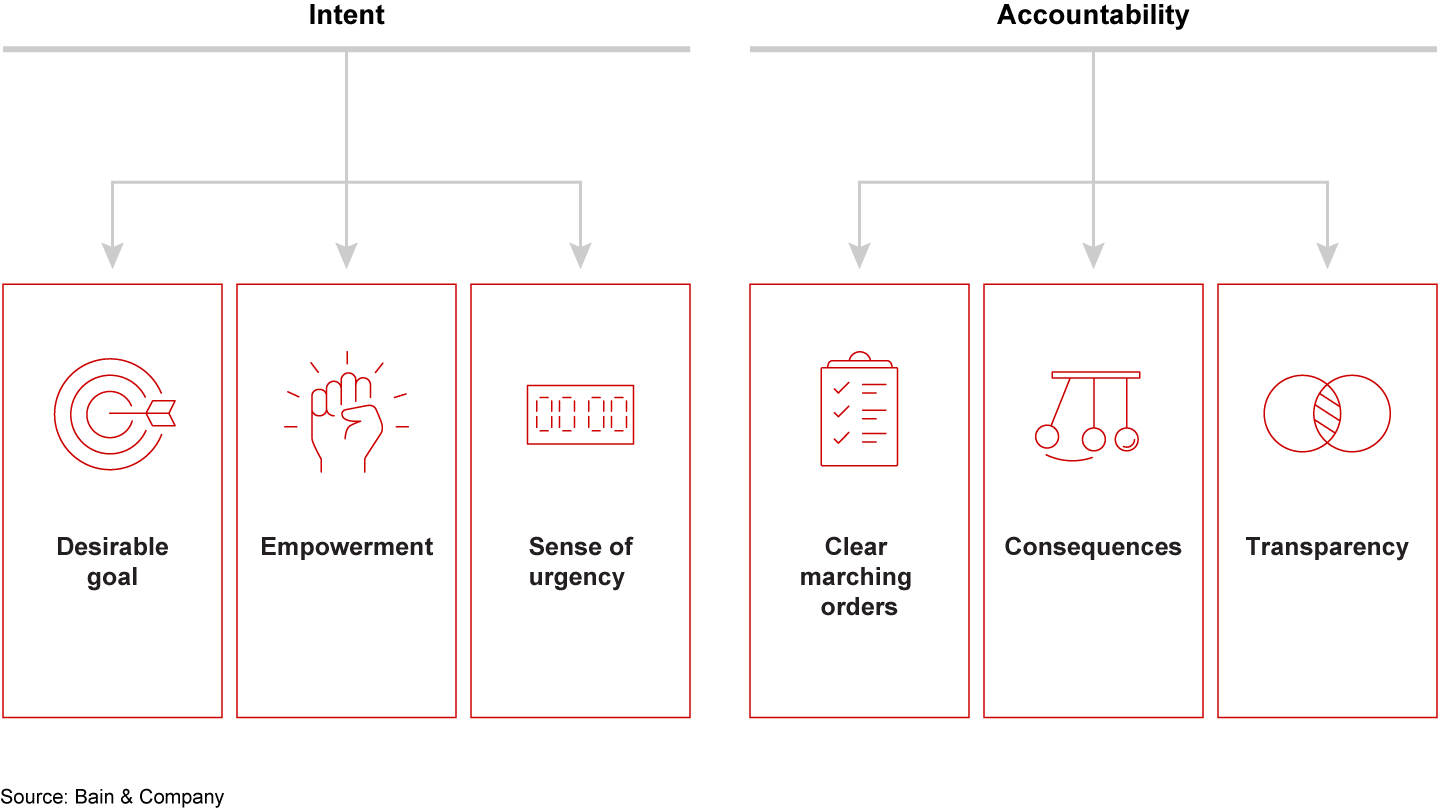

Intent consists of three components:
- a goal that’s articulated simply and understood by all employees;
- empowerment of each of the initiative owners so they feel they can make a difference; and
- a sense of urgency that reinforces the key messages of the transformation.
Accountability can be infused throughout the organization by relying on another set of components:
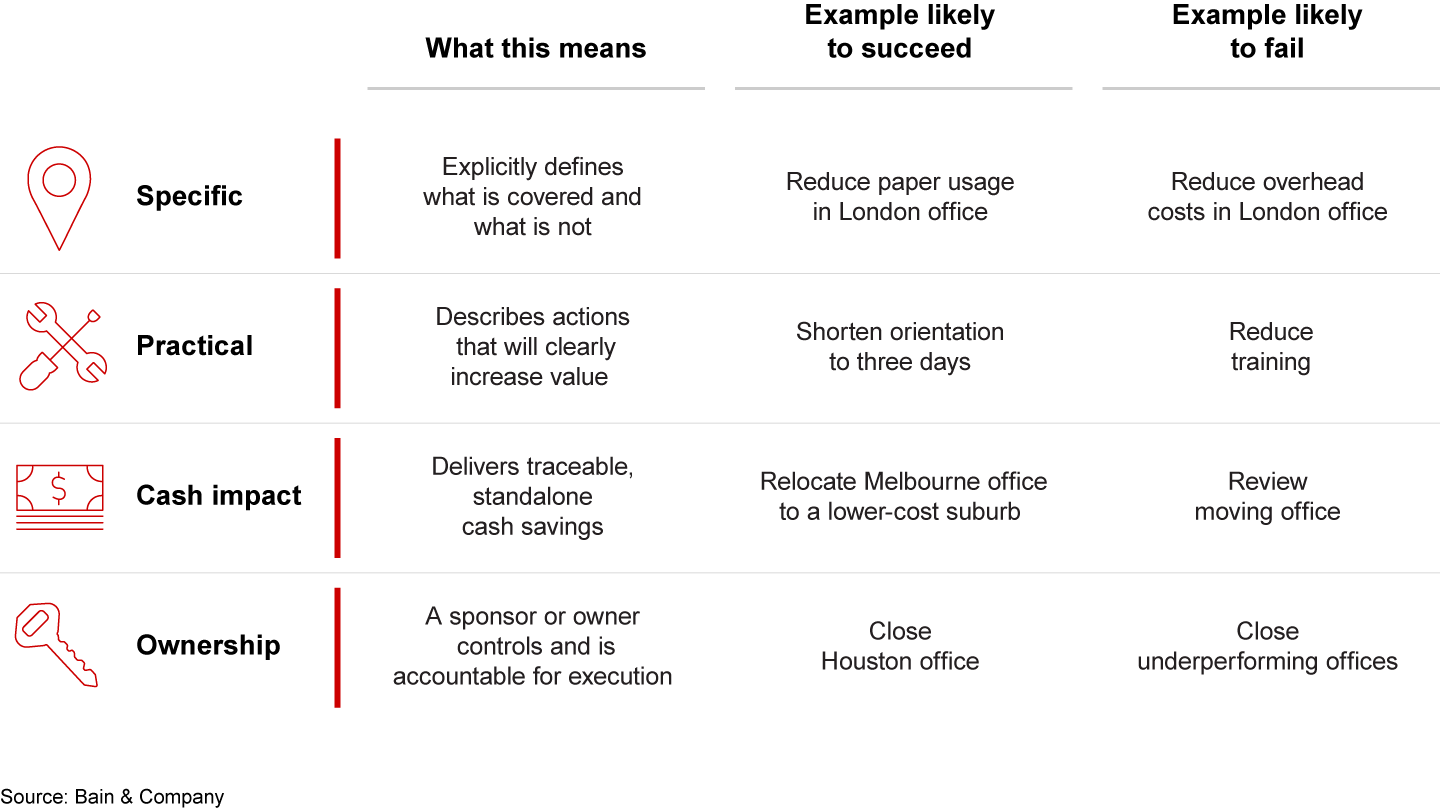
- specific targets for each business unit and a concrete plan showing how to attain those targets (see Figure 2) ;
- positive and negative consequences that kick in when individuals hit or miss their targets; and
- transparency, using metrics that indicate progress toward the goals and that everyone follows.
Figure 2

It is critical to select line managers who are motivated and capable to drive transformation initiatives. You might successfully address intent and accountability, but if line managers don’t exhibit change-oriented behavior, effectiveness will suffer. One company was able to solve this this by delegating parts of the initiative to up-and-coming “star” employees.
To increase frontline manager effectiveness, companies can more directly link transformation targets with an individual’s performance targets, increase training and coaching for line managers, and structure the transformation organization according to best practices.
Balancing line-led and cross-functional teams
Listening to the front line, getting their buy-in for initiatives, and having them drive implementation are all critical regardless of the type of change a company is seeking. But there is also a role for cross-functional teams; the balance should be dictated by the company’s needs. For example, does the company need to rapidly reduce costs to stabilize the business, or is it looking to improve the business’s core functions to enable strategic growth?
When an organization requires immediate results, line-led teams need to be the primary drivers. Frontline teams can generate hundreds of innovative ideas, then quickly transition to execution through a stage-gate process. Simple, handbrake initiatives can quickly capture value and build momentum for continued grassroots ideation and solutions. Once the line-led transformation is initiated, cross-functional teams can be leveraged to drive further value.
When change is less time sensitive, a transformation program can begin with cross- functional teams. Overcoming challenges related to strategic growth often requires solving complex, nonlinear problems. These initiatives may unlock significant value. However, they require critical insights and innovative solutions best tackled by cross- functional teams. When this is the case, line-led teams are introduced later in the transformation to implement ready-to-deploy solutions and fill the hopper with new ideas.
A healthcare provider’s success story
A European healthcare provider that operates hospitals, primary care facilities, and community services was facing severe, long-term headwinds, many of which were exacerbated by Covid-19. These included a dramatic uptick in the number of people waiting on elective procedures; increased rates of staff burnout; continued budget constraints caused by an uncertain macroeconomic outlook; and higher healthcare demands from an aging population.
In response, the executive team decided to transform their operations with the goal of continually delivering value-based results. Frontline managers and employees provided numerous valuable initiatives, with two pressing problems emerging as priorities: reducing clinic appointment cancellations and maximizing the utilization of clinic time slots.
Contact centers introduced new processes to ensure patients weren’t booked into slots that would be canceled later (for reasons such as a doctor’s absence for training or annual leave). In the first month after rollout, avoidable cancellations fell by 54% across four pilot medical specialties. Outpatient services developed new systems aimed at filling all available time slots, reducing open clinic spots, and increasing the number of patients seen each day. A pilot demonstrated a 30% reduction in the share of vacant clinic spots after implementing the new processes. As a result, in the first year of the transformation, the program delivered 30,000 hours of released frontline nursing time; created 6,000 additional clinic appointments each year; and built the organizational foundation to continue delivering results.
Patience pays off for line-led transformations
A line-led approach can produce huge dividends. One major engineering firm that adopted this approach achieved an overhead cost-reduction target of $450 million over 18 months, off a total cost base of $1.2 billion. Investors rewarded this by quadrupling the stock price. The transformation became an enabler for their entire strategic agenda, allowing the company to aggressively pursue M&A, drive innovation, and transition the company’s focus to sustainability—all with this same line-led approach.
But it’s important to remember that line-led transformations do not happen overnight. They usually require initial prodding from the center until the logic and enthusiasm take hold locally—a “tell them, then coach them, then let them run” evolution. As change-oriented behavior takes root, organizations reap the benefits of successful transformations and foster an enduring culture shift that continually generates value.
First published in 11月 2023