

論説
At a large natural-resources company, hiring a new general manager for a mine required the involvement of three human resources professionals, four regional leaders and two executives from corporate. Getting all these people to agree on a new hire typically took months. In the meantime, positions sat open and promising candidates were snapped up by faster-moving competitors.
At a global energy company, senior executives relied on their own functions to gather data to support key decisions. The requests led to countless hours of uncoordinated work throughout the organization, hundreds of different reports and many more hours reconciling the reports’ conflicting or inconsistent information. By the time executives got the data, it was often out of date. When they requested an update, the process started all over again.
Nearly every large company has troubling stories like these—bureaucracies running wild, decisions getting stuck in the swamp, G&A costs spiraling out of control. They’re all manifestations of creeping organizational complexity, one of the most toxic ailments a company can experience. Unchecked complexity in an organization demoralizes employees, slows innovation and raises costs. We have found that people in many companies spend 25% or more of their time on low-value or inefficient activities. If you could get rid of all that unproductive work, you could gain the equivalent of 10 hours more a week from every employee.
In this brief video, Bain Partner Torsten Lichtenau describes an approach that helps leaders minimize complexity in their organizations.
Where does all the complexity come from? Growth. Companies add product lines and business units. They expand into new regions. They merge and acquire. Every such move increases complexity and makes it harder for people to work together effectively. To measure how far complexity has progressed in your own organization, it’s helpful to examine four variables:
- Nodes. A “node” is every point where elements of an organization—functions, business units, regions and so on—must interact to get something done. If you track the number of nodes in your organization over several years, you’re likely to find that it expands geometrically, because every new element adds a new set of nodes. The energy company mentioned earlier saw nodes increase from 800 to 12,000 over a 10-year period.
- Hierarchy. As organizations grow, they tend to create new executive and staff positions, generating more work for everybody. An analysis of management layers and managerial spans over time usually reveals ever-increasing hierarchy. Hierarchy increases costs. An Australian bank found that the fully loaded cost of every general manager was about A$2 million. Each GM’s “caravan”— the assistants and other subordinates, along with all the work those people created—added at least another million in cost.
- Unclear decision roles. Does every individual know what role he or she plays in major decisions? Internal surveys reveal that even relatively flat organizations struggle to make critical choices when decision roles are poorly defined. Bain research shows that low decision effectiveness correlates strongly with poor financial performance.
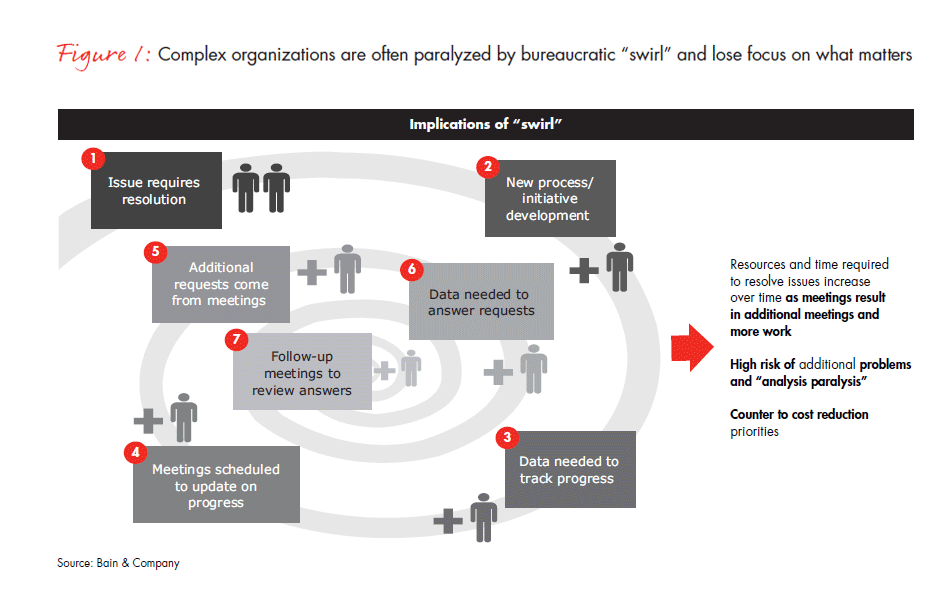
- “Swirl.” Ask people whether your organization makes decisions faster than competitors, or faster than it did in the past. Also look at your G&A costs relative to competitors. Many companies find that initiatives pile up, meetings proliferate and everyone keeps asking for more and more information. A “culture of swirl” develops, in which every new issue generates additional work and cost without producing results (see Figure 1).
Gauging where you stand on all these variables is the first step toward a solution. Once you know how bad the problem is, you can attack it on all four fronts. Here’s how:
1. Decide where the work is to be done
We recently studied a large public university where every department had its own HR, IT, finance and administrative staff. You could write this off as a typical example of academic bloat and inefficiency, except that it isn’t so far removed from the corporate world. The same energy company we have been discussing created many general managers in hopes of encouraging executives to think like owners. Each of the new GMs expected to have his own HR staff, IT department, finance department, quality department and so on. But much of the work generated by these units was unnecessary. A company needs financial accounting, for example, at the business-unit level, supported by good controls at corporate. It needs benefits management at the country level (because of country-specific regulations) and at corporate (for maximum consistency). Everything else is likely to be redundant.
Determining where the work needs to be done can eliminate massive amounts of swirl. It also enables an organization to simplify its structure, greatly reducing the number of nodes. Restructuring the energy company cut the number of nodes from 12,000 to about 5,000, which facilitated faster decision making and operations.
2. Determine the appropriate level of supervision for each kind of work
“Delayering” is a time-honored fix for sclerotic organizations: A company broadens managerial spans and eliminates layers of hierarchy. But delayering can backfire unless it is done carefully. Highly repetitive, transactional work can typically support a broad span of control. Specialized work requires closer supervision and thus a narrower span. The task is not simply to delayer but to tailor the supervisory structure to the job.
Ingersoll Rand, a $14 billion diversified manufacturer, relied on just this approach when it attacked organizational complexity a short while ago. Initial studies revealed that the company’s existing spans of control ranged from 4 to 7, far below the industry benchmark average of 9. The company then identified appropriate spans for various types of work—6 for specialized product-management tasks, 11 for many manufacturing jobs and so on. It created and then implemented targets at this level of detail for all its functions throughout the organization. The move not only helped the company save some $26 million in costs, it also led to faster decision making and a more nimble organization.
3. Assign roles for critical decisions
Every company has a set of key decisions that determine its business performance. The set includes not just obvious high-value decisions such as major investments but routine, everyday decisions that add up to a lot of value over time. These decisions have to be made and executed well and quickly, with a degree of effort appropriate to the issue at hand. A good decision-rights tool clarifies who plays the essential roles in such a decision. Our own tool, called RAPID®, assigns responsibility for Recommending, offering Input, Agreeing, Deciding and Performing.
Smart use of RAPID makes for better, faster, more effective decision making, as Intel’s Embedded and Communications Group (ECG) discovered. ECG develops and markets semiconductor devices for a wide range of industrial, automotive and communications applications. At one point the group was struggling with decisions about what should go on its “roadmap” of products slated for development. The general manager and marketing director responsible for each of ECG’s three product areas wanted a say. So did ECG’s strategic planning manager, who looked across all three areas. Because of the confusion, said then–general manager Doug Davis, “We were making decisions without including the right people, so they didn’t stick.” Quality and speed both suffered. “Someone who hadn’t been involved early on would bring a new piece of data, and we’d go back and revisit the decision.”
As part of a reorganization of his unit, Davis and his team used RAPID to define roles for this and other critical decisions. For the roadmap, they gave decision authority to the strategic-planning manager within ECG, as he was best placed to make trade-offs across the division’s product areas. Implementation wasn’t perfectly smooth. Some product general managers, for example, weren’t happy with “just” an input role and would second-guess the strategic-planning manager’s decisions. But Davis and his team reinforced the new roles, and soon the decisions were going smoothly—and a lot more quickly. “We’re not thrashing around on these things as much,” said Davis. “We’re not going back to revisit decisions that were already made.”

Decide & Deliver
Learn more about the five steps that leading organizations use to make great decisions quickly and execute them effectively.
4. Define and reinforce behaviors that eliminate the culture of swirl
Many complexity issues persist or grow worse because of the behavior of senior management. Suppose that a company has established crystal-clear decision roles. If executives routinely intervene in decisions or overrule the decision-maker’s choice, they undercut the entire approach. It’s the same with other behaviors. If executives routinely ask for more and more data, they will generate more and more swirl. If they aren’t held accountable for costs, they will tend to spend more and more money (see "Complexity and orphan costs” below).
Yet people don’t change their behavior easily, and companies may need to create new processes and incentives to encourage them to do so. The mining company we mentioned earlier found that it had 76 separate initiatives under way simultaneously. It eliminated all but 12, and it began requiring anyone proposing an initiative to write a detailed business case in support. Graham Packaging, a global manufacturer of plastic containers, illustrates the power of incentives. As part of a turnaround effort led by Mark Burgess, the company developed a system known as the Earnings Improvement Plan (EIP). The EIP focused on several specific initiatives designed to build shareholder value, each one including detailed action plans and accountabilities. It covered the vast majority of employees, thus building engagement throughout the organization, and it paid cash bonuses tied to achievement of EIP targets. The incentives helped everyone at Graham Packaging stay focused on a set of simple, measurable metrics under individuals’ control. It also reinforced the importance of teamwork in solving problems. Customer issues, for example, were no longer “sales” or “operations” problems; they were problems that had to be addressed cooperatively. When Graham was sold to a strategic buyer in 2011, its equity value was nine times what it had been when the turnaround began.
Organizational complexity is like an invasive weed, sucking up resources and strangling the growth of a healthy garden. But companies can use the variables we outlined to assess how far complexity has progressed, and they can then attack it on all fronts. The result will be a stronger, more productive organization—and better financial results.
In a simple world, every business would know its costs and manage them appropriately. When organizational complexity intervenes, however, a business may have no ability to calculate or manage its true costs. The results are predictable: costs spiral out of control.
IT costs are often a case in point. Corporate organizations create centralized ERP systems and “backbones,” and then allocate the costs to business units. BUs don’t control the allocation and are therefore not measured on controlling those allocated costs. So IT becomes essentially a free resource. That creates a “tragedy of the commons” situation: Individual businesses ask for lots of IT services because the cost is spread among many business units, and those charged with providing the services have no reference base from which to judge what is of high value and what of lower value. As a result, no one really controls the costs, and they tend to skyrocket.
Solving this problem requires basing the decisions more on market indicators. In this example, BUs should be held accountable for IT costs, and for special requests in particular. To put some discipline into its own allocation of costs, the energy company mentioned in the main article formed a board for the IT department made up of the department’s customers (business unit presidents). The board set budgets and ensured that core costs were competitive with those of outside suppliers. Soon after the company made this change, IT costs plummeted.
Mark Gottfredson is a partner with Bain & Company in Dallas and a senior member of the Global Performance Improvement practice. Michael C. Mankins leads Bain & Company’s Organization practice in the Americas and is a partner in San Francisco.
First published in 12月 2013