

論説

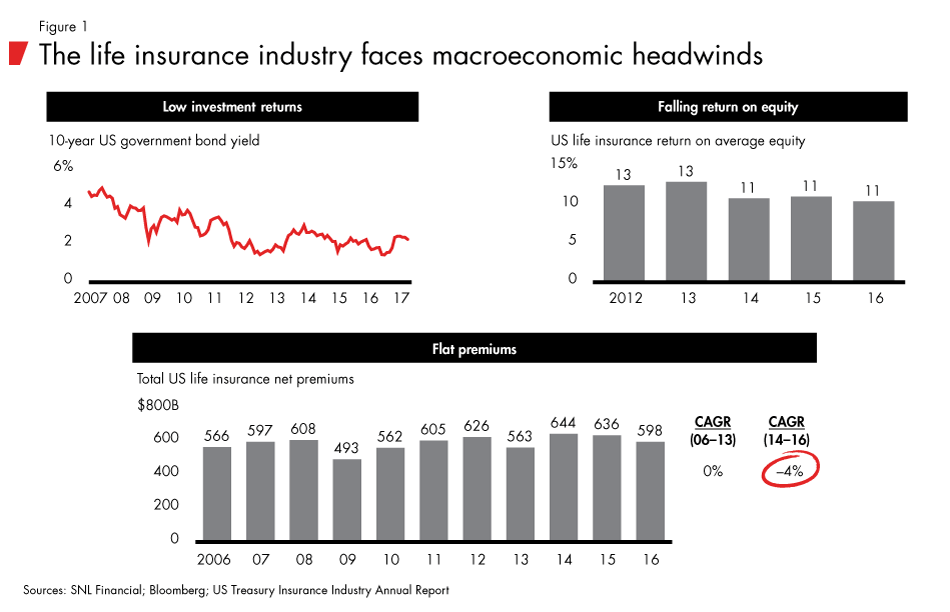
Life insurance companies are under pressure. Their traditional business model is stagnating. Since 2014, premiums for US life insurers have fallen at an average annual rate of 4%, the industry’s return on equity has been flat and persistently low interest rates continue to depress returns (see Figure 1).
Insurers have been slow to adjust to these new realities. Despite their efforts to trim expenses, many are still suffering from bloated costs. Operating expense ratios, which measure noncommission operating expenses as a percentage of direct revenue, have deteriorated at leading US life insurers for the past five years.
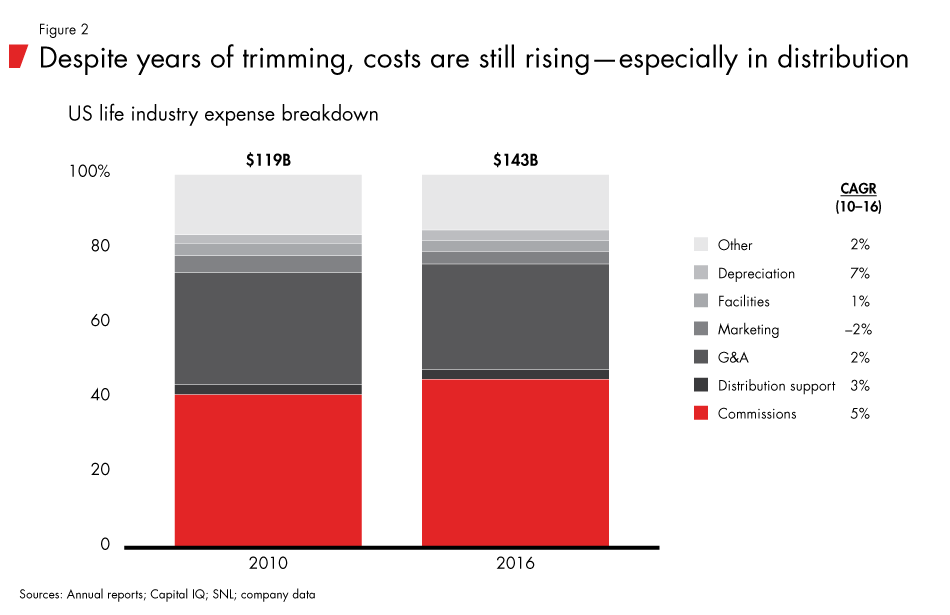
Distribution costs have grown at an average annual rate of 5% since 2010. Life insurers rely on agents for more than 90% of their policy sales. All told, agent commissions and distribution expenses account for about 60% of a typical insurer’s operating expenses, and a lack of growth in agent productivity has contributed to a rise in overall costs (see Figure 2).
Life insurers have tried for years to contain costs, but they have little to show for it. By stinting on investments in operational improvements, they may have actually hindered their ability to do things more effectively. Meanwhile, costs in areas such as oversight and compliance have continued to creep up.
To make matters worse, life insurers aren’t pleasing their customers. The average Net Promoter Score® for US life insurers is 4.5%, according to Bain & Company’s survey of insurance customers in 20 countries (see Customer Behavior and Loyalty in Insurance: Global Edition 2017). Life insurers rely on a sales-led, agent-based approach to marketing, resulting in limited knowledge of their customers. Their customers, in turn, can display minimal connections, or loyalty, to the brand.
One way insurers are trying to address these problems is by expanding their use of digital channels and data analytics. But they are late to the party. Life insurers are saddled with cumbersome and costly processes and legacy systems, and they have long underinvested in IT. In 2016, insurers spent 3.2% of their annual revenue on IT, less than half the 6.8% spent by banks. Some 70% of life insurance executives surveyed by Willis Towers Watson believe they lag behind other financial services sectors in the adoption of digital technologies.
When it comes to technology, insurers are running to catch up with their customers. They’re also trying to fend off challenges from insurtech upstarts that aren’t encumbered by outmoded systems. Insurance customers, particularly those under the age of 35, are increasingly turning to mobile apps to research policies, get advice and buy products.
Leading insurers have begun to realize that digital is only a piece of the solution. To meet the challenges of the marketplace they need nothing less than a total transformation of the way they do business. Their tardiness in digital is symptomatic of a larger problem. They are steeped in organizational cultures that have been slow to embrace change.
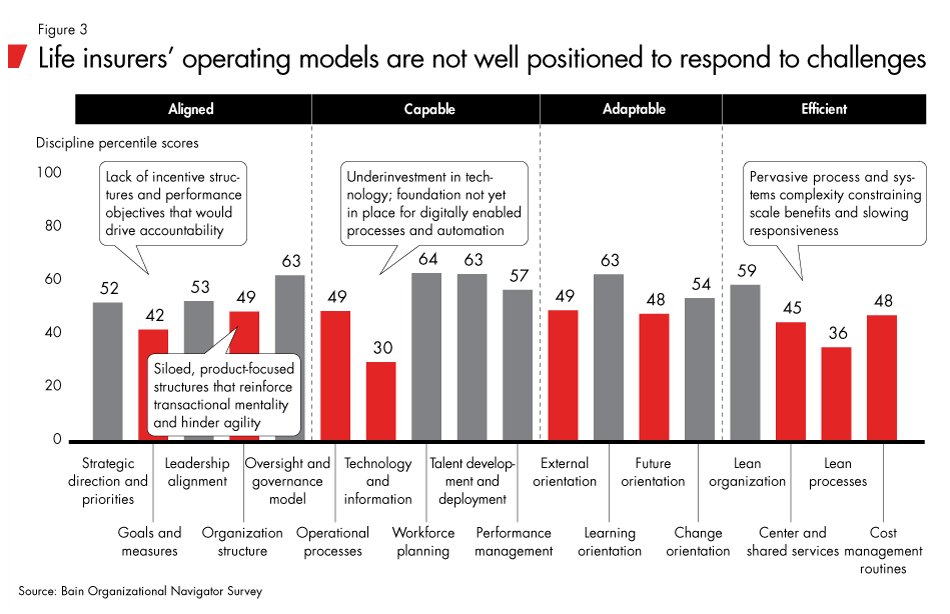
Life insurance is rooted in actuarial science. All insurers have to calculate and manage risk; that’s an essential part of what they do. But this risk-containment ethos can permeate the entire company, resulting in overly cautious and internally focused organizations. Insurance executives surveyed by Bain & Company give their companies relatively low grades for creating an environment that sets high expectations, holds people accountable and rewards innovation (see Figure 3).
Start with a bold vision
Leading life insurers recognize that organizational and cultural issues are at the heart of their lingering cost problems, distribution challenges and uneven customer experiences. They know that lasting transformation will be possible only if they overcome inertia and fundamentally change behavior. These companies approach transformation as a multipronged process:
- They begin by laying out a bold vision to shake up the organization and the way it operates. Many set an ambitious goal to cut costs by as much as 25% within two to three years. They plan to use the savings to invest in the technologies and talent that will enhance the customer experience, lift productivity and improve profit margins.
- Once they have articulated their goals, companies construct an operating model that instills accountability, weeds out underperformers and rewards initiative. They create new, customer-facing positions and fill them with high achievers. They reorganize their go-to-market capabilities around customer segments instead of functions. They also overhaul their technology operations—shifting centralized resources closer to actual business owners.
- As their new operating framework takes shape, insurers begin to attack their legacy cost base in earnest. They use technology to simplify and streamline entrenched processes, from sales to underwriting to fulfillment. They take a hard look at customer transactions that require multiple handoffs from department to department, including some that may still feature handwritten and printed forms that are transported from place to place in manila folders.
One company’s transformation experience
For one leading life insurer, the first step in the transformation process was to candidly assess its position. It faced slowing top-line growth, stagnant productivity, a major technology deficit—and a lack of progress in areas it had already established as priorities, including digitalization and the customer experience.
The company was encumbered with legacy technology, and it didn’t set clear performance expectations for employees. That resulted in limited accountability for underachievers and insufficient incentives for those who excelled.
The company began its transformation by laying down a marker. It aimed to increase earnings by about 40% in five years. The company knew that it wouldn’t be able to meet its earnings targets from the projected growth in its core market. It would have to cut operating costs by 20%. Achieving these ambitious objectives would require something more than business as usual, something more radical and long-lasting than the incremental approaches that emanated from the standard annual budgeting process.
The company defined a set of guiding principles that were critical to ensuring that the transformation aligned with its long-term goals:
- put the customer first (easier said than done);
- reduce complexity throughout the organization;
- accelerate digitalization and automation;
- stop doing activities that no longer add value, and invest in those that do; and
- make tough decisions and hold people accountable for performance.
These principles gave the leadership team license to think broadly as it transformed the business.
Mikaela Boyd, a partner with Bain's Financial Services practice, discusses how insurers can transform their business and reinvent their culture.
The company then set about building an organization that would focus on serving the customer and would encourage agility and innovation. It shifted from a model that was organized around functions, such as underwriting, marketing and sales, to a structure based on business units that focused on major customer segments, including retail and corporate. It moved the IT development staff from the corporate level into the business units—fostering much closer collaboration on technology. The central IT group, meanwhile, narrowed its focus to infrastructure management, software development standards, and tools and training.
The company conducted a broad review of its talent and developed a robust performance management system. It raised productivity expectations and enriched its talent pool with internal transfers and external hires. The company successfully managed this process, so that by the end, close to 40% of roles were filled with new talent—both internally and externally sourced.
As the company tackled its operating model, it also accelerated changes in marketing and distribution. Over the years, complexity and inefficiency had crept into the distribution system, with overlapping sales organizations supporting multiple brands and channels. The company followed a traditional sales-led model, where agents bore the primary responsibility for interacting with customers. The company, which had a large sales management organization, was expending significant resources to recruit, train and support these agents.
When the company conducted a zero-based review of the outlays to agents, it found that its support model no longer aligned with the agents’ needs. Agents wanted more sales and technical training, as well as technology, to help them become more productive in an increasingly digital world. Having a state-of-the art customer relationship management (CRM) system meant more to the agents than attending company-sponsored sales conferences in exotic locales.
By consolidating and scaling back sales management infrastructure and associated activities, the company was able to reduce gross operating costs in its distribution system by 35%. The company invested a significant portion of these savings with enhanced technical training, digital tools (including an upgraded CRM) and advanced analytics to support more effective marketing. With these steps, the company managed to simultaneously reduce expenses, help its agents become more productive and more effectively serve its customers.
The company applied zero-based thinking across the organization. By setting ambitious goals and moving quickly on multiple fronts, it saw results almost immediately. In just nine months, management reduced headcount by about 10%, with no impact on revenue or service levels.
The company devised a roadmap, which calls on it to meet its full potential cost reduction target of 20% over the next three years. With the organization and talent in place, the company is now well positioned to tackle key opportunities, which include process simplification and digitalization, automation, an overhaul of legacy technology and strategic sourcing.
The company has also accelerated progress on its growth agenda. The strategic business units, focused on customer segments, are able to more quickly develop enhancements to the customer experience. For example, the company recently introduced an innovative savings program geared to millennials who are enrolled in its group health insurance plans.
The company has also seen a change in its culture. Decisions are made faster thanks to new ways of working that reduce spin and confusion. While there are many items still on the agenda, the company has established a firm foundation for transforming itself into an efficient, performance-driven enterprise resolutely focused on providing customers with a superior experience.
Antonio Rodrigues and Jed Fallis are partners with the Financial Services practice in Bain & Company’s Toronto office. Henrik Naujoks leads Bain’s Financial Services practice in Europe, the Middle East and Asia, and is based in Zurich. Harshveer Singh is a partner with the Financial Services practice based in Singapore.
The authors would like to acknowledge the contributions of Michael Kochan, a principal with Bain’s Financial Services practice in the firm’s Toronto office.
Net Promoter®, Net Promoter System®, Net Promoter Score® and NPS® are registered trademarks of Bain & Company, Inc., Fred Reichheld and Satmetrix Systems, Inc.
First published in 1月 2018