
Skip to Content
  • オフィス

    オフィス

    北米・南米
    • Atlanta
    • Austin
    • Bogota
    • Boston
    • Buenos Aires
    • Chicago
    • Dallas
    • Denver
    • Houston
    • Los Angeles
    • Mexico City
    • Minneapolis
    • Monterrey
    • Montreal
    • New York
    • Rio de Janeiro
    • San Francisco
    • Santiago
    • São Paulo
    • Seattle
    • Silicon Valley
    • Toronto
    • Washington, DC
    ヨーロッパ・中東・アフリカ
    • Amsterdam
    • Athens
    • Berlin
    • Brussels
    • Copenhagen
    • Doha
    • Dubai
    • Dusseldorf
    • Frankfurt
    • Helsinki
    • Istanbul
    • Johannesburg
    • Kyiv
    • Lisbon
    • London
    • Madrid
    • Milan
    • Munich
    • Oslo
    • Paris
    • Riyadh
    • Rome
    • Stockholm
    • Vienna
    • Warsaw
    • Zurich
    アジア・オーストラリア
    • Bangkok
    • Beijing
    • Bengaluru
    • Brisbane
    • Ho Chi Minh City
    • Hong Kong
    • Jakarta
    • Kuala Lumpur
    • Manila
    • Melbourne
    • Mumbai
    • New Delhi
    • Perth
    • Shanghai
    • Singapore
    • Sydney
    • Tokyo
    全てのオフィス
  • アルムナイ
  • メディア
  • お問い合わせ
  • 東京オフィス
  • Japan | 日本語

    地域と言語を選択

    グローバル
    • Global (English)
    北米・南米
    • Brazil (Português)
    • Argentina (Español)
    • Canada (Français)
    • Chile (Español)
    • Colombia (Español)
    ヨーロッパ・中東・アフリカ
    • France (Français)
    • DACH Region (Deutsch)
    • Italy (Italiano)
    • Spain (Español)
    • Greece (Elliniká)
    アジア・オーストラリア
    • China (中文版)
    • Korea (한국어)
    • Japan (日本語)
  • Saved items (0)
    Saved items (0)

    You have no saved items.

    後で閲読、共有できるようにするためにブックマークしてください

    Explore Bain Insights
  • 業界別プラクティス
    メインメニュー

    業界別プラクティス

    • 航空宇宙、防衛、政府関連
    • 農業
    • 化学製品
    • インフラ、建設
    • 消費財
    • 金融サービス
    • ヘルスケア
    • 産業機械、設備
    • メディア、エンターテインメント
    • 金属
    • 採掘・鉱業
    • 石油、ガス
    • 紙、パッケージ
    • プライベートエクイティ
    • 公共、社会セクター
    • 小売
    • テクノロジー
    • 通信
    • 交通
    • 観光産業
    • 公益事業、再生可能エネルギー
  • 機能別プラクティス
    メインメニュー

    機能別プラクティス

    • カスタマー・エクスペリエンス
    • サステイナビリティ、 社会貢献
    • Innovation
    • 企業買収、合併 (M&A)
    • オペレーション
    • 組織
    • プライベートエクイティ
    • マーケティング・営業
    • 戦略
    • アドバンスド・アナリティクス
    • Technology
    • フルポテンシャル・トランスフォーメーション
  • Digital
  • 知見/レポート
  • ベイン・アンド・カンパニーについて
    メインメニュー

    ベイン・アンド・カンパニーについて

    • ベインの信条
    • 活動内容
    • 社員とリーダーシップ
    • プレス・メディア情報
    • クライアントの結果
    • 受賞歴
    • パートナーシップを結んでいる団体
    Further: Our global responsibility
    • ダイバーシティ
    • 社会貢献
    • サステイナビリティへの取り組み
    • 世界経済フォーラム(WEF)
    Learn more about Further
  • キャリア
    メインメニュー

    キャリア

    • ベインで働く
      キャリア
      ベインで働く
      • Find Your Place
      • ベインで活躍する機会
      • ベインのチーム体制
      • 学生向けページ
      • インターンシップ
      • 採用イベント
    • ベインでの体験
      キャリア
      ベインでの体験
      • キャリアストーリー
      • 社員紹介
      • Where We Work
      • 成長を後押しするサポート体制
      • アフィニティ・グループ
      • 福利厚生
    • Impact Stories
    • 採用情報
      キャリア
      採用情報
      • 採用プロセス
      • 面接内容
    FIND JOBS
  • オフィス
    メインメニュー

    オフィス

    • 北米・南米
      オフィス
      北米・南米
      • Atlanta
      • Austin
      • Bogota
      • Boston
      • Buenos Aires
      • Chicago
      • Dallas
      • Denver
      • Houston
      • Los Angeles
      • Mexico City
      • Minneapolis
      • Monterrey
      • Montreal
      • New York
      • Rio de Janeiro
      • San Francisco
      • Santiago
      • São Paulo
      • Seattle
      • Silicon Valley
      • Toronto
      • Washington, DC
    • ヨーロッパ・中東・アフリカ
      オフィス
      ヨーロッパ・中東・アフリカ
      • Amsterdam
      • Athens
      • Berlin
      • Brussels
      • Copenhagen
      • Doha
      • Dubai
      • Dusseldorf
      • Frankfurt
      • Helsinki
      • Istanbul
      • Johannesburg
      • Kyiv
      • Lisbon
      • London
      • Madrid
      • Milan
      • Munich
      • Oslo
      • Paris
      • Riyadh
      • Rome
      • Stockholm
      • Vienna
      • Warsaw
      • Zurich
    • アジア・オーストラリア
      オフィス
      アジア・オーストラリア
      • Bangkok
      • Beijing
      • Bengaluru
      • Brisbane
      • Ho Chi Minh City
      • Hong Kong
      • Jakarta
      • Kuala Lumpur
      • Manila
      • Melbourne
      • Mumbai
      • New Delhi
      • Perth
      • Shanghai
      • Singapore
      • Sydney
      • Tokyo
    全てのオフィス
  • アルムナイ
  • メディア
  • お問い合わせ
  • 東京オフィス
  • Japan | 日本語
    メインメニュー

    地域と言語を選択

    • グローバル
      地域と言語を選択
      グローバル
      • Global (English)
    • 北米・南米
      地域と言語を選択
      北米・南米
      • Brazil (Português)
      • Argentina (Español)
      • Canada (Français)
      • Chile (Español)
      • Colombia (Español)
    • ヨーロッパ・中東・アフリカ
      地域と言語を選択
      ヨーロッパ・中東・アフリカ
      • France (Français)
      • DACH Region (Deutsch)
      • Italy (Italiano)
      • Spain (Español)
      • Greece (Elliniká)
    • アジア・オーストラリア
      地域と言語を選択
      アジア・オーストラリア
      • China (中文版)
      • Korea (한국어)
      • Japan (日本語)
  • Saved items  (0)
    メインメニュー
    Saved items (0)

    You have no saved items.

    後で閲読、共有できるようにするためにブックマークしてください

    Explore Bain Insights
  • 業界別プラクティス
    • 業界別プラクティス

      • 航空宇宙、防衛、政府関連
      • 農業
      • 化学製品
      • インフラ、建設
      • 消費財
      • 金融サービス
      • ヘルスケア
      • 産業機械、設備
      • メディア、エンターテインメント
      • 金属
      • 採掘・鉱業
      • 石油、ガス
      • 紙、パッケージ
      • プライベートエクイティ
      • 公共、社会セクター
      • 小売
      • テクノロジー
      • 通信
      • 交通
      • 観光産業
      • 公益事業、再生可能エネルギー
  • 機能別プラクティス
    • 機能別プラクティス

      • カスタマー・エクスペリエンス
      • サステイナビリティ、 社会貢献
      • Innovation
      • 企業買収、合併 (M&A)
      • オペレーション
      • 組織
      • プライベートエクイティ
      • マーケティング・営業
      • 戦略
      • アドバンスド・アナリティクス
      • Technology
      • フルポテンシャル・トランスフォーメーション
  • Digital
  • 知見/レポート
  • ベイン・アンド・カンパニーについて
    • ベイン・アンド・カンパニーについて

      • ベインの信条
      • 活動内容
      • 社員とリーダーシップ
      • プレス・メディア情報
      • クライアントの結果
      • 受賞歴
      • パートナーシップを結んでいる団体
      Further: Our global responsibility
      • ダイバーシティ
      • 社会貢献
      • サステイナビリティへの取り組み
      • 世界経済フォーラム(WEF)
      Learn more about Further
  • キャリア
    人気検索キーワード
    • デジタル
    • 戦略
    前回の検索
      最近訪れたページ

      Content added to saved items

      Saved items (0)

      Removed from saved items

      Saved items (0)

      M&A Report

      Bain’s Bedrock Beliefs on How to Create Value from M&A

      Bain’s Bedrock Beliefs on How to Create Value from M&A

      A repeatable model helps to generate higher total shareholder returns.

      著者:David Harding and Joerg Ohmstedt

      • min read
      }

      レポート

      Bain’s Bedrock Beliefs on How to Create Value from M&A
      en

      This article is part of Bain's 2022 M&A Report.

      Explore the report

      This report necessarily spends most of its time on what is new and different in the world of M&A. For example, we have argued that executive teams need to modify their playbooks to retain critical talent; account for new business needs, such as environmental, social, and corporate governance; and capture revenue synergies.

      All of that said, there are some fundamental truths about M&A that have withstood the test of time. The analyses discussed below have been replicated multiple times over the past 20 years. The answer remains the same across all the different cohorts we have studied.

      Headline: If you want to be successful at M&A, develop a repeatable model. Do it often, learn from your mistakes, and make it a material part of your business. Done right, it will generate higher total shareholder returns (TSRs).

      Fast fact: About 84% of publicly listed companies have participated in M&A over the past decade.

      We have assessed the returns to shareholders of the different M&A strategies employed by a universe of 2,897 publicly traded companies from around the world.

      It turns out that two axes define a lot of what differentiates M&A performance—frequency (how many deals you do) and materiality (how much of it you do). We have outlined the 10-year compound annual growth rates for the TSRs of four groups of acquirers by deal frequency and materiality. The 16% of companies that did no deals reported an annual TSR of 5.4% (see Figure 1).

      Figure 1
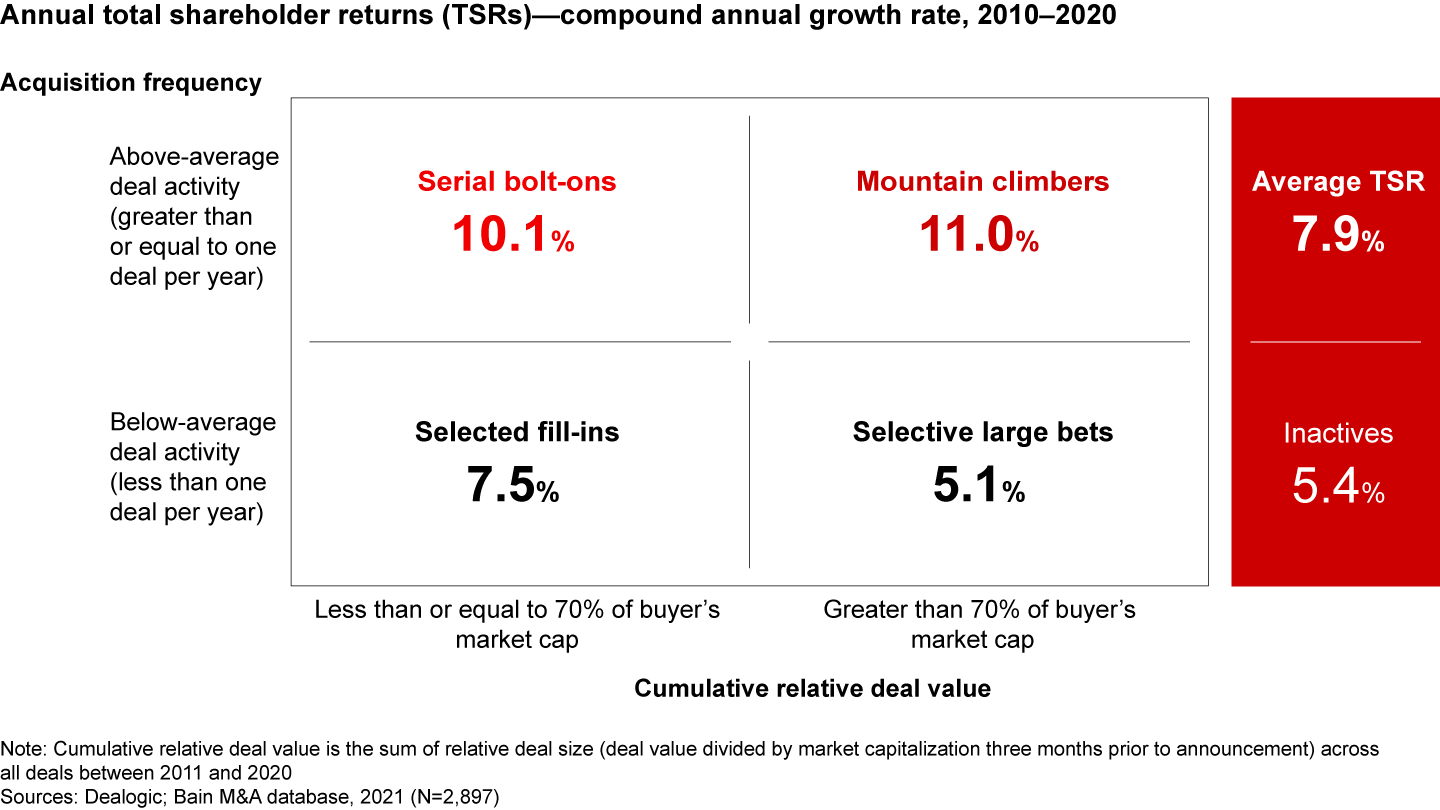
      Repeatable M&A is the winning strategy
      Repeatable M&A is the winning strategy
      Repeatable M&A is the winning strategy

      It does not take a lot of deals to become a frequent acquirer, about one per year. To be a material acquirer does require heft—namely, 70% or more of your market cap from acquired companies over a decade. Still, 18% of all the companies in our sample were considered material acquirers.

      So what do these trends tell us?

      First, consistent M&A activity over economic cycles contributes to higher TSR. This finding holds up year after year, across industries. Deal success and deal failure is more a matter of cumulative experience and capability in making a deal and less a function of standalone deal circumstances.

      Second, similar to most things in life, you get better at what you do when you do it repeatedly. Companies that acquire frequently (serial bolt-ons) tend to outperform the average company on TSR (10.1% annual).

      Third, companies that not only acquire frequently but that also develop the capabilities to undertake larger deals do even better. We call these companies mountain climbers, and their 11.0% annual TSR leads the class. Investors have come to recognize this.

      Consistent M&A activity over economic cycles contributes to higher total shareholder returns. This finding holds up year after year, across industries.

      We spend a lot of time studying mountain climbers to understand their distinguishing capabilities. Two mountain climbers, Thermo Fisher Scientific and Hitachi, are highlighted in the following section. More broadly, we have identified and track 334 mountain climbers. Many are well-known success stories, including Ahold Delhaize, Alimentation Couche-Tard, Assa Abloy, Bristol-Myers Squibb, Broadcom, Charter Communications, Cigna, Melrose Industries, Qualcomm, Salesforce, Schneider Electric, Siemens, Sony, Stanley Black & Decker, Symrise, Toyota, Tyson Foods, UnitedHealth Group, and so on.

      Mountain climbers follow an integrated approach to managing M&A from strategy to integration, which strengthens and reinforces their repeatable M&A capability with each deal (see Figure 2).

      Figure 2
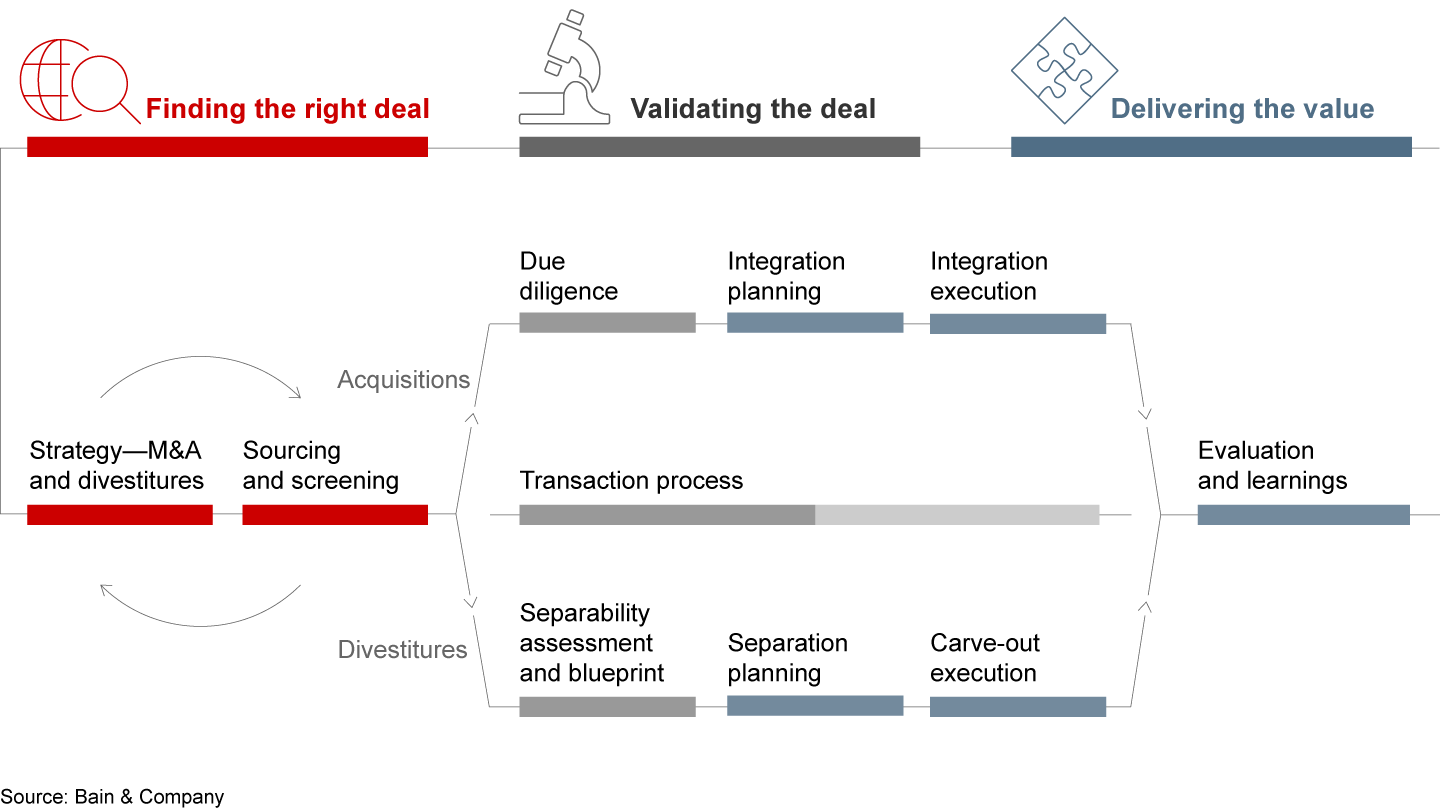
      If done right, M&A creates value—especially with a repeatable model built upon a disciplined M&A capability
      If done right, M&A creates value—especially with a repeatable model built upon a disciplined M&A capability
      If done right, M&A creates value—especially with a repeatable model built upon a disciplined M&A capability

      In addition to being frequent and substantial acquirers, mountain climbers also proactively manage their portfolios by pruning noncore businesses. It’s another big factor that contributes to their success. According to our analysis, more than 90% of mountain climbers divest, and the average mountain climber will divest about 27% of its market capitalization over a 10-year period. These companies deploy a repeatable process for systematically identifying assets for divestiture and preparing them for sale.

      Another big learning from our study comes from the failure of companies that make infrequent, big bets. We refer to such companies as “selective large bets”: They are infrequent acquirers, but they undertake large deals relative to their market capitalization. Among all companies studied, these are the worst performers over time as their limited acquisition experience, combined with investment in a large deal, usually results in poor deal outcomes. They generated only 5.1% in annual TSR from 2010 to 2020.

      Infrequent acquirers that undertake large deals relative to their market capitalization are the worst performers over time.

      Going forward, an even higher premium will be placed on building a repeatable M&A capability that delivers successful outcomes across multiple deal types—small and large, scale and scope. The leap from small deals to large deals is a big one as is the one from scale deals to scope deals. We believe that the new wave of M&A—in particular, those involving capability-driven scope deals—will require a fundamentally different approach to realize the value. Companies will need to adapt and modify their diligence and integration playbooks as they pursue scope deals for growth and potentially more transformative, capability-driven scope deals.

      The new wave of M&A—in particular, those involving capability-driven scope deals—will require a fundamentally different approach to realize the value.

      What mountain climbers do differently

      While every company will have a distinct strategy and M&A roadmap that accounts for its industry and competitive dynamics, we’ve distilled some of the practical actions mountain climbers take to underpin their repeatable M&A capability. What we have learned is that there is no silver bullet that guarantees success. Instead, we see the best rigorously applying learnings from past deals across the entire M&A process to increase their chance of success. Here we show two fairly distinct approaches that have powered two companies toward winning in their respective industries.

      Thermo Fisher Scientific, a leading US biotechnology product development company, has brought together several acquisitions over the past 10 years to deliver a more than tenfold increase in its share price. Its M&A capability is widely recognized as a strong differentiator and a sustainable growth lever.

      After experiencing an $8 billion loss in 2009, Japan’s Hitachi announced that it would shift away from its comprehensive electronics conglomerate portfolio. In 2015, Hitachi began restructuring its portfolio. To that end, the company acquired to fortify its new core, systematically divesting unrelated businesses to fund the acquisitions.

      What drives Thermo Fisher Scientific’s repeatable M&A capability?

      Finding the right deal

      • Using organic and inorganic levers for growth: Thermo Fisher Scientific redeploys 60% to 75% of its capital to M&A, 10 points to 25 points more than competitors, while driving above-market organic growth of 4% to 6%. Capital deployment incorporates the impact from active portfolio pruning through divestitures.
      • Building new growth vectors through M&A: The company consistently uses M&A to enter growing technological segments through large platform deals and then builds scale through smaller tuck-ins to round out capabilities. With each successive acquisition of leading assets in targeted growth markets (for instance, microscopy, contract development and manufacturing, and bioproduction), Thermo Fisher Scientific has built a more comprehensive and integrated offering for customers.
      • Ongoing target screening and relationship building: The company proactively develops deal perspectives on a broad range of companies within its core markets as well as attractive adjacencies. This comprehensive, thesis-driven approach to deal screening allows Thermo Fisher Scientific to move quickly and sometimes exclusively to strike attractive deals.

      Validating the deal

      • Confidence in synergy assessment: With its accumulated experience, Thermo Fisher Scientific can identify and quantify potential revenue synergies in addition to cost synergies with strong conviction.
      • Being open to new sources of value: After the deal close, Thermo Fisher Scientific stays open to discovering new sources of value beyond revenue synergies and joint R&D through capability sharing that has often unlocked higher growth in acquired companies.

      Delivering the value

      • Strong connections between deal team and integration team: The integration team is supported by leaders that were part of the deal/due diligence team, ensuring that the deal thesis and sources of value translate into an integration thesis that guides planning.
      • Integrating at speed: Thermo Fisher Scientific has built a repeatable and rapid approach to integrations, often reporting cost and revenue synergies ahead of schedule. Successful integrations near the core (Life Technologies, Affymetrix, IntegenX) enabled successful replication of the approach to adjacencies (FEI, Patheon, Brammer Bio).
      • Reusing a common but customized approach: Thermo Fisher Scientific has codified common processes into repeatable integration playbooks that are tailored and applied differently to each acquired company, depending on the integration thesis and situation.

      What drives Hitachi’s repeatable M&A capability?

      Finding the right deal

      • Multiyear M&A roadmap: Hitachi’s transformation of the business portfolio is guided by a multiyear strategic roadmap involving both acquisitions and divestitures. Revisited and realigned every three years, Hitachi’s most recent midterm management plan saw respective four times and five times increases in investment from the previous two midterm plans.
      • Focus on growth deals: Strategic investment areas include the IT, energy, and industry sectors as well as North America and Asia-Pacific as focus regions.

      Validating the deal

      • Validating the growth potential: A key purpose of the company’s acquisition activity is access to global/international customer bases and high-growth business areas, such as the robotic systems integration business that the JR Automation together with the acquisition of KEC Corporation provided.
      • Limiting capital outlays while strengthening the business: A creative leadership team used a cash-free merger between Hitachi’s automotive supplier business and three Honda affiliate suppliers, creating a leading global components supplier and doubling Hitachi’s scale in the parts business.

      Delivering the value

      • Realizing synergies while leveraging the global talent gained through acquisition: With the strategic objective to win in the global market, Hitachi moved its railroad headquarters to Europe and put executives from its subsequent acquisition on Hitachi Rail’s management team. Even as Hitachi improved the acquired business’s technology and operations, it stressed the need to learn from the acquired business as well.
      • Transforming into a truly global company: Hitachi is strengthening the group-wide standardization of global operations—for instance, by adopting enterprise resource planning templates that are based on Hitachi ABB Power Grids’ global operations, expanding shared services using its core business systems and infrastructure service platforms, and building a group-wide customer relationship management system.

      Read the Next Chapter

      Consumer Products M&A: Creating Value by Acquiring Insurgent Brands

      Read our 2022 M&A Report

      Download the PDF Explore the report
      著者
      • Headshot of David Harding
        David Harding
        Advisory Partner, Boston
      • Headshot of Joerg Ohmstedt
        Joerg Ohmstedt
        アソシエイト パートナー, Berlin
      関連するコンサルティングサービス
      • 企業買収、合併(M&A)
      M&A Report
      Media M&A

      AI and other tech tools can boost bidding confidence in this highly competitive environment.

      詳細
      M&A Report
      Banking M&A

      As conditions shift, leading banks are fusing scale with scope to create future-ready organizations.

      詳細
      M&A Report
      Consumer Products M&A

      In their quest for profitable growth, more companies are divesting brands or buying insurgents.

      詳細
      M&A Report
      Defense M&A

      Bold moves will determine the winners as a continent rearms.

      詳細
      M&A Report
      Building Products M&A

      Why more companies are acquiring for scope.

      詳細

      Overview

      • Letter from the M&A Team: Beneath the M&A Headlines

      • State of the M&A Market

      • Bain’s Bedrock Beliefs on How to Create Value from M&A

      Hot Topics

      • Reimagining Talent in M&A

      • Bringing Science to the Art of Revenue Synergies

      • The ESG Imperative in M&A

      • Delivering Results in Joint Ventures and Alliances Requires a New Playbook

      • Harnessing the True Value of Corporate Venture Capital

      Industry Views

      • Aerospace and Defense M&A

      • Asset Management M&A

      • Automotive and Mobility M&A

      • Banking M&A

      • Consumer Products M&A

      • Diversified Industrials M&A

      • Energy and Natural Resources M&A

      • Healthcare M&A

      • Insurance M&A

      • Media M&A

      • Payments M&A

      • Retail M&A

      • Technology M&A

      • Telecommunications M&A

      • Wealth Management M&A

      Regional Perspectives

      • Brazil M&A

      • China M&A

      • India M&A

      • Japan M&A

      First published in 2月 2022
      Tags
      • M&A Report
      • 企業買収、合併(M&A)

      クライアント支援事例

      企業買収、合併(M&A) Post-merger cultural issues jeopardize a deal

      ケーススタディを見る

      業績改善 Aggressively growing an IT service provider with a high-performance culture

      ケーススタディを見る

      企業買収、合併(M&A) An OFS captures post-merger growth synergies

      ケーススタディを見る

      お気軽にご連絡下さい

      私達は、グローバルに活躍する経営者が抱える最重要経営課題に対して、厳しい競争環境の中でも成長し続け、「結果」を出すために支援しています。

      ベインの知見。競争が激化するグローバルビジネス環境で、日々直面するであろう問題について論じている知見を毎月お届けします。

      *プライバシーポリシーの内容を確認し、合意しました。

      プライバシーポリシーをご確認頂き、合意頂けますようお願い致します。
      Bain & Company
      お問い合わせ Sustainability Accessibility Terms of use Privacy Cookie Policy Sitemap Log In

      © 1996-2026 Bain & Company, Inc.

      お問い合わせ

      How can we help you?

      • ビジネスについて
      • プレス報道について
      • 採用について
      全てのオフィス