

M&A Report

At a Glance
- In this time of accelerating disruption, many companies look beyond traditional M&A and participate in a broad range of joint ventures and alliances to access assets and capabilities.
- Frequent acquirers achieve higher total shareholder returns than their counterparts, and they are more likely to use partnerships, according to Bain research.
- Doing partnerships well requires some notable differences from M&A in approach and capability.
- Companies need to tailor the exploration and diligence to emphasize partner fit and trust between parties, and overinvest in creating the right governance structure and operating model.
This article is part of Bain's 2022 M&A Report.
As they grapple with the double whammy of industry turbulence and skyrocketing valuations, more companies are looking beyond traditional M&A to alternative deals, making joint ventures (JVs), alliances, and minority investments an integral part of their growth strategy.
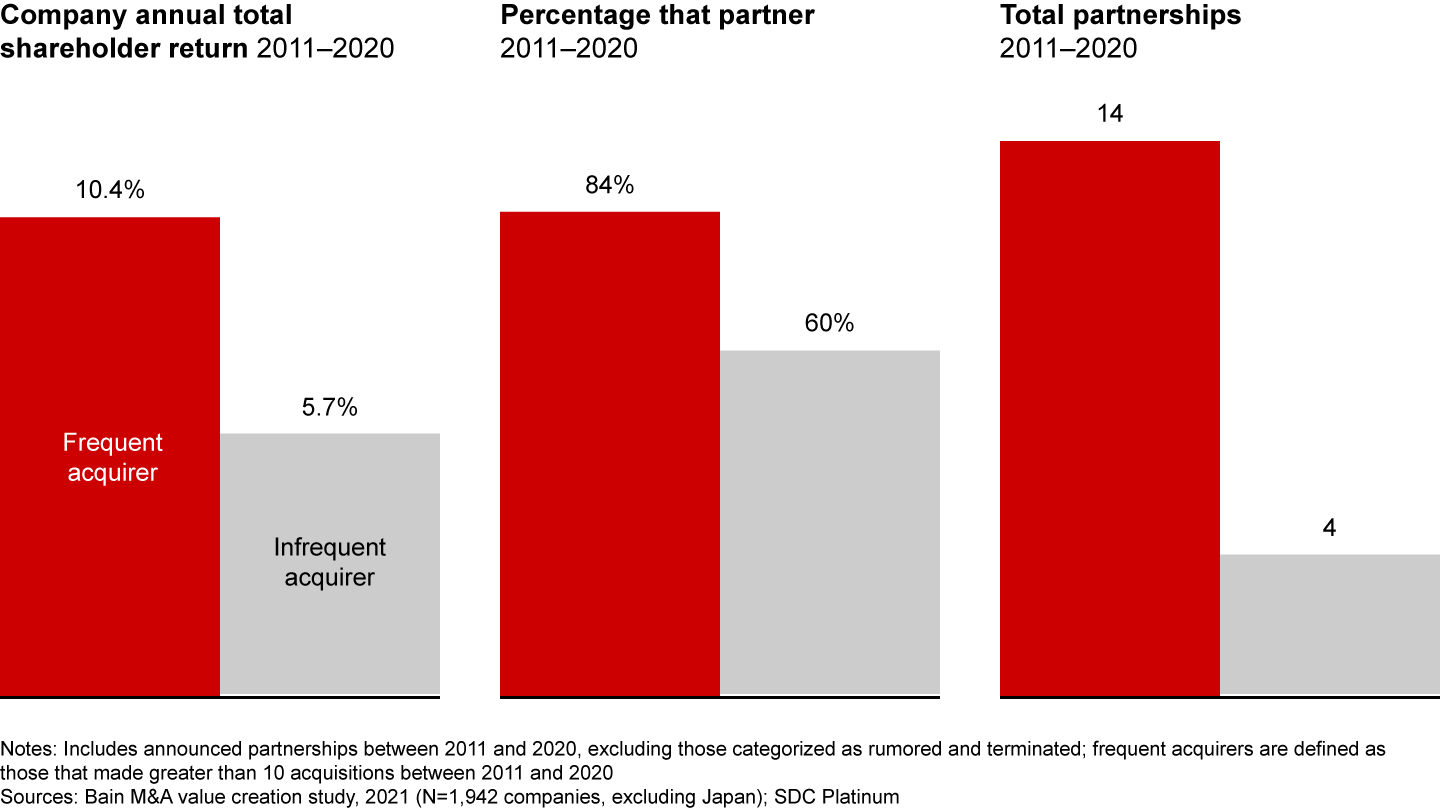
Partnerships are a critical extension of the M&A and growth strategy. Over the past 10 years, the total shareholder return of frequent acquirers was nearly double that of infrequent acquirers, according to Bain research (see Figure 1). A vast majority of frequent acquirers rely on partnerships, and they use them more frequently than infrequent acquirers.
Figure 1

But partnerships are hard to do well. They take a lot of focus and cooperation, and they require a playbook that differs in some fundamental ways from traditional M&A. Companies need to thoughtfully address those differences.
Sharing the risk
JVs and strategic alliances have always been a way to gain access to capabilities. Now, the need has become greater as companies look for ways to get out ahead of accelerating disruption. Companies use partnerships to share risk and investment in the development of new technologies, for example. This is especially prevalent in areas such as automotive and telecom, both of which are in the midst of seismic shifts in industry standard technology.
In early 2021, telecom operator KPN partnered with pension fund APG to form Glaspoort, a joint venture to roll out fiber networks in the Netherlands. This JV allowed KPN to share the cost of building out its fiber network, and it fit with APG’s infrastructure investment focus.
More companies are using partnerships to address social and environmental challenges.
For their part, automakers are partnering to address the challenges of electric and autonomous vehicles. General Motors (GM) and Ford both formed JVs with technology companies to manufacture battery cells and arrays for electric vehicles. GM’s JV with LG Energy plans to produce Ultium battery cells for electric vehicles, and Ford’s partnership with SK Innovation has a goal to produce approximately 60 gigawatt hours (GWh) annually starting in the mid-2020s.
Increasingly, partnerships are a route to addressing social and environmental challenges. In consumer products, ending plastic waste has become a core issue of sustainability. Organizations such as the Alliance to End Plastic Waste have drawn support from companies across industries hoping to combine the resources and capabilities required for delivering a solution.

Harnessing the True Value of Corporate Venture Capital
Companies miss out by treating corporate venture capital like traditional M&A.
The scorecard on partnerships
Most partnerships deliver value. Practitioners tell us that two out of three partnerships contributed their expected value over the past three years. Of course, that also means one out of three partnerships failed to deliver on expectations.
An effective partnership playbook can go a long way toward avoiding the fate of sinking into the bottom third of value-destructive partnerships.
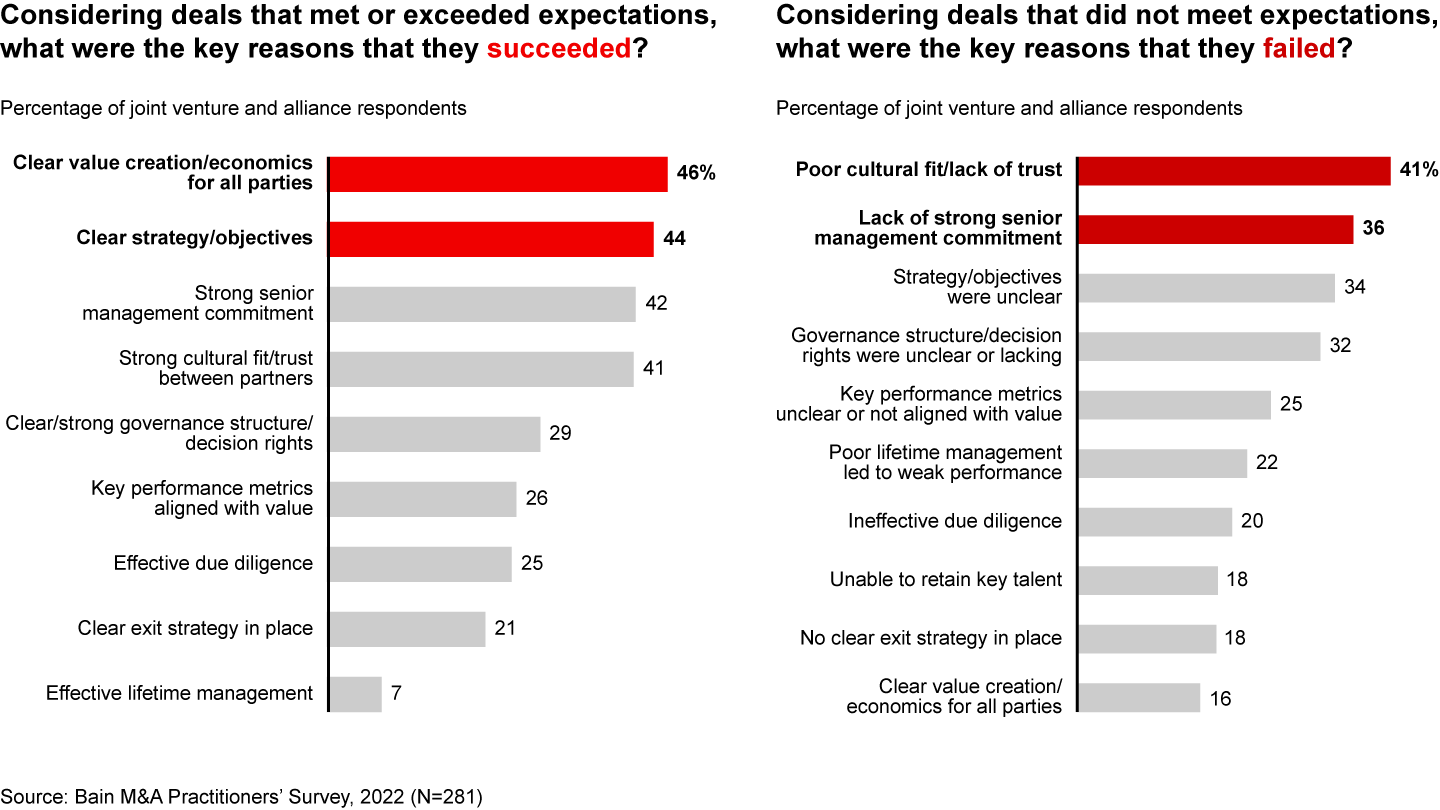
Digging deeper, we see that the difference between the winners and losers rests on execution. Clear value creation/economics and strategy are the top (and nearly equal) contributors to success, according to our survey of 281 practitioners, and a lack of these dimensions contributes to failure. Yet the top reasons for failure are execution related: poor cultural fit and a lack of strong senior management commitment (see Figure 2). Execution is an ongoing process that requires up-front diligence and strong commitment over the life of the partnership. Having an effective partnership playbook can go a long way toward delivering effective execution and avoiding the fate of sinking into the bottom third of value-destructive partnerships.
Figure 2

Building the partnership playbook
When companies fail to achieve the full potential of a partnership or strategic alliance, it’s often because they underestimate how the playbook for these alternative deals differs from the playbook required for traditional M&A.
In these M&A alternatives, there are three critical things to get right.
Tailor the exploration and diligence process to emphasize partner fit and trust between parties. Picking the right partner involves not only estimating economic value for both sides but also finding a cultural and strategic fit (in which companies can be synergistic) and working to build trust early. Specific areas of fit that can be examined during diligence include risk appetite, market perspective, and accountability preferences.
Companies with mismatched risk appetites and misaligned market perspectives on issues such as the most important segments to focus on and how to win are likely to run into conflict when new opportunities arise for the partnership.
Accountability preferences, such as the level of oversight and sign-off needed for partnership activities, are another area in which it’s important to reach alignment early in diligence. Finally, trust is an elusive but key component of the partnership exploration and building process.
Companies with mismatched risk appetites and misaligned market perspectives on issues such as the most important segments to focus on and how to win are likely to run into conflict when new opportunities arise for the partnership.
Overinvest in creating the right governance structure and operating model. Getting a partnership’s operating model and governance right up front (before signing) matters. In an acquisition, the initial operating model can be adjusted as needed post-integration. The parent company does not need to ask permission to make governance changes. In partnerships (and JVs in particular), however, making changes to the operating model after signing often turns into a complex negotiation between partners.
The operating model considerations in a partnership are different than in M&A. There are two considerations in a partnership: the operating model of the partnership entity, such as a JV, and the operating model between the parents and partnership entity. For the parent-partnership model, companies should consider control across three dimensions: equity (share in profits/losses), investment, and management control.
There are critical questions to answer based on these dimensions. Will each parent be a portfolio manager, strategic architect, or a combination of both? Will one parent play a more dominant role in operations, or should there be an even balance between partners? What capabilities and assets will each parent contribute? What decisions need to be approved by one or both parents?
There are myriad other considerations that add complexity to the operating model. Many companies get weighed down trying to anticipate all decisions that the partnership will make so that they can build them into the operating model. Often the best path is to aim for simplicity and enable agility in the partnership.
Giving a partnership independence to make decisions while defining a few targeted areas of capability access (from one or both parents) allows the entity to grow and change with the market. Trusting a JV or alliance to learn from mistakes and grow can be the ticket to a healthy and independent value creating partnership.

Five Big Things to Know about M&A in 2022
Retaining talent, capturing revenue synergies, boosting ESG, and making the most of alternative deal models are top of mind for buyers.
Show commitment to lifetime management. Similar to any business, it’s important to recognize that the future will usually be different than planned. A partnership is likely to perform well on some dimensions and underperform on others as the market evolves. To keep the partnership relevant, a periodic strategic refresh can help. This allows companies to revisit the strategic intent and align on what to stop, start, and continue based on the evolution of the partnership and market dynamics.
This is often most effective when done outside of the quarterly review process. One example of this is a partnership-focused offsite every two years, which includes both partnership leaders and some outside leaders to keep the thinking fresh. Another critical component of most partnerships is planning for the end. Initial negotiations should recognize the potential for a partnership’s evolution as market dynamics shift. Should the partnership have an off-ramp after a certain period of time or when market dynamics shift? Should one or both partners have the option to acquire? What are the most likely exit rationales and trigger points? Having a clear exit plan can save both parties lots of frustration down the road.
Needed: A partnership capability
Doing this right requires being thoughtful about how to set up the internal partnership capability. Companies that maintain an active portfolio of partnerships often have a level of centralized partnership capability. This can vary from partnership knowledge management—in which guidelines, processes, and lessons learned are captured in a center of excellence—to an exclusive JV/alliance team that oversees partnership screening, setup, and management.
Companies should also be thoughtful about the overlap among the partnership team, M&A team, and business unit leadership. Several areas of the partnership process, such as screening and parts of due diligence, can build off the M&A team and playbook. But as we’ve mentioned, there are areas in which the JV process should be distinct.
It’s also critical to be thoughtful about where business unit leadership plugs into the partnership process. If business unit leaders own the partnership once it’s set up, it is important to loop them in early in the process to get input during diligence, partnership setup, and other stages.
As more companies opt for partnerships to help them deal with industry disruption and the high multiples for traditional M&A, they will discover just how different alternative deals are from typical acquisitions—and how critical it is to approach them with a fresh set of eyes.
Read our 2022 M&A Report
Overview
Hot Topics
Industry Views
Regional Perspectives
First published in 2月 2022