

The Visionary CEO’s Guide to Sustainability

概要
- Adaptation isn’t optional; climate risk is already disrupting operations and financials.
- Operations executives now rank increased resilience—including to physical climate risk—as a top strategic priority.
- Advanced analytics—including AI, digital twins, and geospatial tools—helps leaders identify and address climate vulnerabilities in real time.
- Robustness strategies like redundancy, modularity, and decentralization remain underused even as supply chain shocks rise.
This article is part of Bain's 2025 CEO Sustainability Guide
It’s time to face reality.
Even with aggressive decarbonization, companies still face the harsh consequences of a much warmer world. Only 25% of corporate Scope 1 and 2 emissions can be mitigated through levers that are ROI positive today, according to Bain’s analysis of 14 industries in its proprietary Decarbonization Lever Library. The remaining 75% represents a vast emissions gap, including 43% with no current pathway to ROI positivity (see Figure 1).
Figure 1
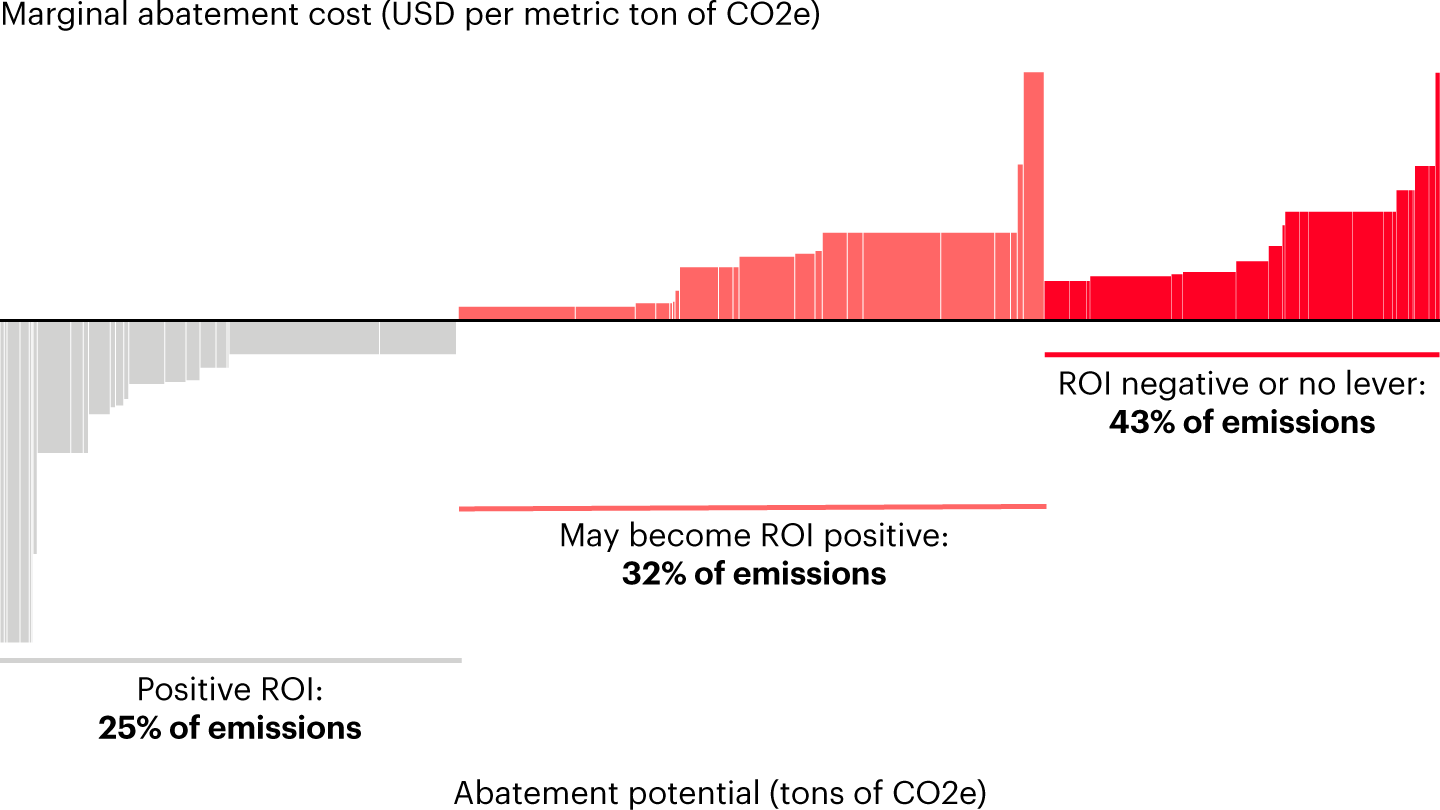

Adaptation is both necessary and inevitable. Unless public policy shifts dramatically or innovation delivers miracles, Climate Action Tracker estimates that we’re headed for a world that will be 2.5 to 2.9 degrees Celsius warmer by 2100. The costs of that pathway, and the need to adapt, are no longer theoretical. Central banks already bake climate risk into their stress tests and economic policy. Business leaders must do the same. The impact is showing up now in real losses, rising volatility, and systemic strain.
Broken supply chains. Climate change is straining global trade routes, degrading infrastructure, and forcing companies to rethink sourcing strategies. Key minerals remain concentrated in climate-vulnerable regions, and even the land upon which businesses are built is degrading through desertification and salinization. In Europe, droughts have forced barges on the logistically critical Rhine and Danube rivers to reduce loads, spiking shipping costs and prompting some companies to curb output.
Increasing scarcity. It’s becoming harder to source and price raw materials vital to food systems and industrial growth. Changing growing zones and water stress are undermining the reliability of key crops. In a recent study, experts estimate that for every 1 degree Celsius of warming, global food production could drop by 120 kilocalories per person per day. Commodity markets are more volatile and unpredictable, and they’re often decoupled from inflation. One example: Prices of cocoa, a climate-sensitive crop, have tripled since 2022 due in part to prolonged drought, extreme heat, and declining yields.
Lost productivity. Extreme heat makes work impossible. Some heat-stressed regions are reporting 20% to 30% drops in labor productivity, with higher spikes in labor-intensive agriculture and construction. The International Labor Organization (ILO) estimates that by 2030, the equivalent of 80 million full‑time jobs will be lost due to heat stress.
Exiting insurers. Insurers are the canary in the coal mine of climate risk. Rising temperatures have made large areas effectively uninsurable. In the US, for example, insurers have had to dramatically adjust premiums and coverage and have even pulled back from states like Florida and California due to mounting wildfire and hurricane losses. Globally, according to Gallagher Re, $263 billion of disaster-related losses went uninsured in 2024, representing 63% of total economic losses.
The preparedness paradox
Operations executives aren’t blind to these risks. In a 2024 Bain survey, they ranked increased resilience—including to climate physical risk—as a top strategic priority alongside managing cost (see Figure 2). There’s a growing recognition that performance and preparedness must go hand in hand.
Figure 2
Even in the face of these looming threats, only 3% of all climate capital expenditure is directed toward adaptation and resilience with the private sector contributing a mere $7 billion, according to data from the Climate Policy Initiative (see Figure 3). This imbalance between recognition of risk and investment continues, even as the cost of risk and global climate finance flows has increased.
Figure 3


Note: Data for 2019 and 2021 is the average of two consecutive years (i.e., 2019 and 2020, and 2021 and 2022, respectively)
出所 Climate Policy InitiativeThis presents a fundamental contradiction. The risks are obvious, the costs are rising, and executives recognize resilience is a priority—yet funding and action remain stalled. In boardrooms and budget cycles, climate risk is treated as a secondary issue: too complex to quantify, too long-term to prioritize.
This deadlock persists because leaders face three real and solvable challenges that must be addressed before investment and action can be unlocked.
Focus where it counts. Many companies aren’t short on intent—they are short on visibility. Climate risk is spread across functions, geographies, and suppliers, and responsibility for those risks is often siloed in sustainability, enterprise risk management, operations, or procurement. The most critical exposures often lie beyond the company’s walls, where data is scarce and accountability is blurred. Without an integrated view, it’s hard to see where the real vulnerabilities—and the smartest interventions—lie.
To better understand their risks, leading companies are adopting structured, tech-enabled scans of climate risk. This requires a dual lens: first, looking at operations and supply chain, and then more broadly at the macro forces shaping exposure (climate, geopolitics, social). Tools like AI, geospatial analytics, digital twins, and resilience scoring are helping companies focus on what matters most. One US energy company, for example, uses AI to detect transformer stress under extreme weather—avoiding outages before they happen.
Greater insight can also reveal opportunity. As companies better understand physical risk, they’re launching new services, supply chain offerings, and climate-adapted products. A global insurer, for example, is turning its risk data into wildfire and flood resilience consulting—transforming protection into a new source of revenue.
Design for robustness. For decades, operational strategy has prioritized efficiency—lean inventories, tightly coupled supply chains, and just-in-time models. These systems perform well in stable conditions, but in the face of today’s climate volatility and geopolitical shocks, efficiency often turns into fragility. Yet companies continue to invest based on the old playbook. Bain’s 2024 Operations Executive Survey shows that many of the resilience levers getting the most attention, including automating operations, are efficiency driven. Useful, yes, but not sufficient for operating in a world defined by disruption rather than predictability.
Today’s environment demands robustness, a concept borrowed from biology. As French scientist Olivier Hamant notes, natural systems are designed not just for performance, but to absorb shocks and operate under stress. This means embracing redundancy, modularity, and decentralization. Our survey shows that these strategies, which include supplier diversification, footprint shifts, and flexible manufacturing, remain underused (see Figure 4).
Figure 4
Robustness isn’t about adding buffers everywhere. It’s about balance: maintaining efficiency while building flexibility and investing in adaptation where it matters most. Consider how a leading manufacturer has strategically built redundancy into its supply chain, holding safety stock of key components like semiconductors and employing dual- and multi-sourcing to ensure production can continue in the face of shocks.
Build resilience governance that works. One of the most persistent barriers to climate adaptation is that, in a typical company, no one truly owns it. Resilience cuts across the organization but falls between the cracks. Sustainability teams model the risks but lack the power to act. COOs focus on efficiency. CFOs see upfront cost with uncertain return. With no one accountable, critical decisions like where to invest in robustness are delayed or ignored. The result is stalled action just when coordinated effort matters most.
Breaking this gridlock requires structural accountability. Some firms are beginning to appoint chief resilience officers (CROs) or resilience councils with the cross-functional authority to translate climate risk into decisions and action. Titles and councils alone aren’t enough. Leaders embed resilience into performance dashboards and ensure the same rigor that’s applied to financial decisions is applied to climate risk. This allows them to make tough calls about how much redundancy to build in, when optionality is worth the cost, and how to sequence investments. A leading consumer goods manufacturer has integrated adaptation metrics, such as supplier risk exposure and climate vulnerability, into its executive dashboards. These indicators now inform capital planning and contingency sourcing decisions.
How to turn climate adaptation into a business advantage
With the right visibility, structures, and mindset, CEOs can turn climate adaptation from a cost into a business advantage. The companies that win won’t just predict climate risk. They’ll organize for it, invest with discipline, and adapt faster when disruption hits. It’s not about preparing for everything. It’s about building robustness where it matters most.
Read our 2025 CEO Sustainability Guide
More from the report
First published in 9月 2025